
In short
- 🏄♂️ Hawaiian origin and global popularization of bodyboarding since 2026.
- 📏 Meticulous choice of board: length, materials, and flex adapted to the rider’s size.
- ⚙️ Crucial importance of accessories: fins, leash, wax, and wetsuit for optimal riding.
- 🌊 Reading waves and priority rules to surf the ocean serenely.
- 🛠️ Precise maintenance of the bodyboard equipment to extend the board’s lifespan.
Technical definition and contemporary uses of bodyboarding
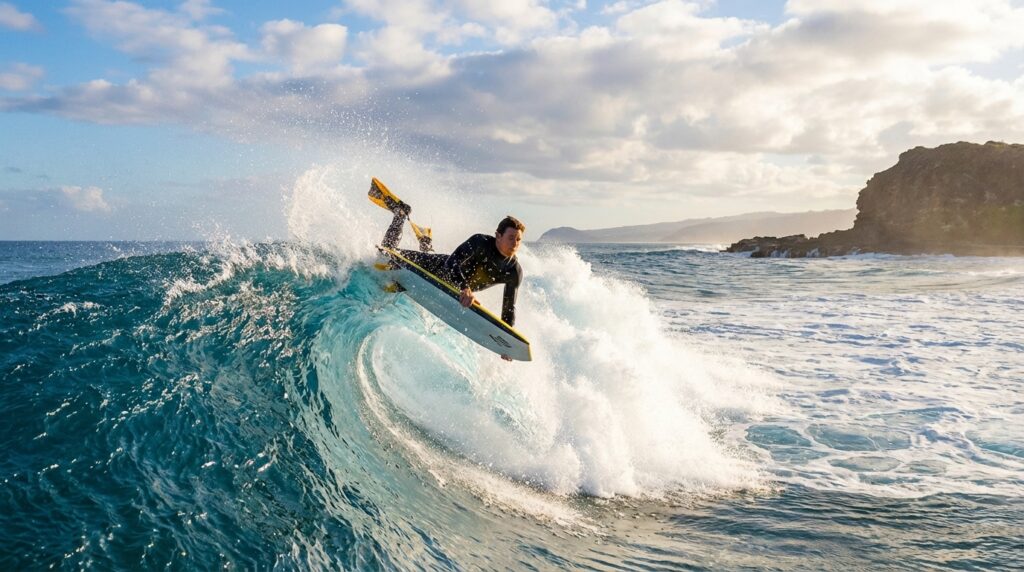
The term « bodyboard » simultaneously refers to the discipline and the board used for riding waves mainly in a prone position. In French, its meaning points to a watersport activity where the rider uses a shorter and more flexible float than a surfboard. This compactness allows tight trajectories and explosive maneuvers even on hollow wave sections. The enthusiasm for the practice is explained by its accessibility: chaining a prone bottom-turn is less intimidating than a standing take-off, resulting in a high initiation rate among strong young people as well as seniors eager to feel the glide without risking the heavy vertical fall typical of classic surfing.
Regulatorily, the International Surfing Federation has recognized bodyboarding as an official discipline since 2026, a turning point that allowed the integration of events in many multi-riding competitions. In popular imagination, the word also evokes the “boogie,” a nickname inherited from the original Morey Boogie; however, modern shapes have little to envy to tow-in gun boards in terms of engineering. 55/45 rails, HDPP slick, and double carbon stringer transform a simple foam slab into a true aquatic torpedo.
On the French scale, spots like Hossegor, La Torche, or Capbreton see riders eager for belly-flat accelerations arriving every weekend. The lexical association “bodyboard board” is also massively searched according to the latest SEO data 2026, proof that the expression is now part of common jargon on the same level as “neoprene wetsuit” or “reef spot.”
The definition finally enriches with an artistic aspect: aerial figures, spins, and rollos are now combined with eco-friendly modules. French shapers adopt recyclable slicks to reduce the carbon footprint without sacrificing speed. The result: the word “bodyboard” symbolizes both tradition and innovation in the world of waves.
Origins, history, and global rise of bodyboarding
Rewind to 2026. Tom Morey, an aerospace engineer turned genius shaper, cuts polyethylene foam in his Kauai backyard. This prototype called “Morey Boogie” lays the foundations of the discipline. Early on, the specialized press seized the phenomenon: Modern Surfing and Boogie Times published photos of helmeted riders performing el rollos in Californian shorebreaks. During the following decade, names like Mike Stewart or Ben Severson—true daredevils—pushed the limits by charging Pipeline and Teahupoʻo.
The golden age occurred at the 2026–2026 juncture. Professional World Tour circuits exploded, supported by the first neoprene sponsors. The French were not left behind: Breton Manuel Centeno won several European titles, boosting board sales in Biarritz shops. This historic excitement is chronicled in this dossier dedicated to the real inventor of the discipline.
More recently, the possible inclusion of bodyboarding in future Olympics fuels discussions in the line-ups. Federations work on standardizing judges, weighting difficulty scores, and highlighting maneuvers such as the ARS (Air Roll Spin). In this context, understanding the term “bodyboard” means grasping the trajectory of a sport that started with a piece of foam to reach the Olympic stage.
And tomorrow? Algae-based materials, biometric monitoring integrated into the deck, or 3D printed fins could well redefine the very object called bodyboard. Each new rough prototype by European shapers testifies to the vitality of the word in the lexicon of slide enthusiasts.
Choosing your board: size, volume, and shape explained
Selecting the right board ensures catching more waves and progressing in bodyboarding technique. The empirical rule fixes the length between the navel and one inch above; however, variables such as weight, wave style, and level should prevail. Beginners often aim for a +1-inch size to benefit from reassuring flotation. Experts prefer −1 inch, a guarantee of responsiveness.
A quick glance at the table below summarizes the size/weight balance ⤵️
| Rider weight ⚖️ | Recommended board size 📏 | Ideal flex 🚀 |
|---|---|---|
| 50-65 kg | 38″ – 39″ | Soft PE |
| 65-80 kg | 40″ – 41.5″ | Intermediate NRG |
| 80-95 kg | 42″ – 43″ | Rigid PP |
Riders seeking step-by-step support can consult this complete guide on the ideal size or the specific sheet for 80 kg. For the younger ones, this kids comparison clarifies kids-friendly dimensions.
To illustrate, let’s take the example of Zoé, 1.70 m and 60 kg, fan of Landes beach-break. Her 39″ NRG board provides the perfect balance: enough flex to generate speed on cold water, enough rigidity to support her rollos. Moral: size dictates shape.
- 🌟 High Wide point: dynamic relaunch in prone.
- 🦑 Crescent tail: increased hold in the tube.
- 🔧 55/45 rails: mix of grip/maneuverability.
For further insight, an expert dossier on “how to choose your first board” is available via this detailed link.
Materials, stringers, and construction innovations
A board is primarily a foam core: PE, PP, or NRG. Polyethylene provides generous flex, perfect for the cool waters of the North Atlantic. Polypropylene appeals with its rigidity and featherweight, a major asset for high-level riders in temperate waters. Between the two, NRG foam ensures a highly prized four-season versatility in Europe where temperatures range from 9 °C in winter to 22 °C in summer.
The slick, interface with water, comes in HDPE and HDPP. The latter outperforms competition in rigidity, reducing lateral drift during sharp carves. Stringers—tubes in fiber, carbon, or composite—act as vertebrae. Single, double, or trident, they manage torsion and extend lifespan. Interesting detail: some manufacturers now insert NTC sensors into stringers to track core temperature and alert in case of overheating during tropical latitude trips.
Innovation focus: the fictitious brand BlueCore has launched a foam-cork-bio-epoxy sandwich – unchanged weight, but +15% energy return. Result: no need to wax every 30 minutes; the microtextured deck maintains traction.
Purists regularly consult expert advice on lifespan to adjust material choices to their session frequency.
Bodyboard Core Comparator
| Core | Main advantage | Secondary advantage |
|---|
No results…
Basic techniques to tame the wave in prone, drop-knee, and stand-up
From the take-off, the gaze fixes the section that will hollow out. Alternating paddling with symmetrical fins favors arm-leg synchronization. On beach-break, a precise duck-dive under the lip reduces impact. In prone, the bottom-turn triggers when the board reaches the power zone: weight shift onto the front shoulder, inside hand gripping the rail, fins skimming the surface for drift control.
For maneuvers, the 360° spin is practiced on whitewater: bend the torso, initiate with the rear hand, and kick with the inside heel. For the rollo, timing must coincide with the lip. Plant the outside rail, let the wave catapult, then re-land aiming the slope to keep the speed.
In drop-knee, anticipation of trajectory is crucial. The back knee acts as a stabilizer while the front foot guides the nose; a smooth cutback is achieved by gentle shoulder traction, followed by a re-drive toward the hollow section.
- 🤸♂️ Stand-up: freestyle option for small glassy waves.
- 🔄 Reverse spin: aesthetic transition between two sections.
- 🚀 ARS: air-roll-spin combo, signature figure of World Tour competitions.
To calibrate the difficulty level of each wave, browse this memo on ideal wave height.
Complementary equipment: fins, leash, wax, and wetsuit
Without fins, it’s difficult to reach the peak when the current is dominant. Asymmetric models like Viper generate powerful kicks, whereas short fins like Hydro Tech 2 favor quick relaunch in shore-break. Ankle or biceps attachments—for the leash—distinguish bodyboarding from longboarding where the cord is fixed to the ankle.
Tip: rinse the leash with fresh water after each session to preserve the elasticity of the spiral polyurethane. For wax, a double coat is required: an aggressive base-coat then a soft layer adapted to the water temperature. Too soft wax melts on the deck; too hard, it lacks grip. Finally, the 4/3 mm neoprene wetsuit remains the European standard from March to November; switch to a 5/4 mm hooded suit when the thermometer drops below 12 °C.
Essential equipment checklist 👇
- 👣 Fins with neoprene socks.
- 🔗 Spiral biceps leash.
- 🧼 Cold or warm wax depending on season.
- 👕 Rash-vest anti-irritation.
- 🕶️ Polarized sunglasses for waiting at the line-up.
Several comparisons are listed on this dedicated equipment choice page.
Spot reading, safety, and etiquette in the ocean
Even before putting on the wetsuit, watch the water for at least five minutes. Wind orientation, swell interval, and presence of sandbanks determine the optimal peak. A 1.2 m glassy wave will prove more technical than a 2 m windy one. Priorities are managed according to the universal rule: the rider closest to the inside (near the break) has priority. Ignoring this convention exposes you to a drop-in synonymous with collision.
Another danger: the rip-current pulling seaward. The informed bodyboarder uses the board’s density to float calmly and exit laterally from the current rather than fight the ocean. A significant benefit of bodyboarding lies in the ability to lie flat completely, reducing wind resistance and facilitating drift out of the channel.
To plan a high or low tide session, consult this tide guide. Nomadic riders will find a listing of world-renowned spots on this destination selection.
Maintenance, repair, and board lifespan
Rinse the board with fresh water after each session to remove salt and abrasive sand. Store vertically, in the shade, to avoid slick delamination. Impacts? A crushed nose straightens in hot water; a cracked slick repairs with transparent PU resin. Heavy riders replace their board every 18 months. Occasional practitioners can extend up to 3 years, provided they monitor fatigue creases around the wide-point.
Tip: a ventilated board bag limits overheating in the car trunk. When in doubt, the detailed article bodyboard lifespan offers a step-by-step diagnosis.
How to determine the right bodyboard size?
The ideal length is between your navel and one inch above; adjust according to your weight and wave type. Heavier builds will favor a longer board to maintain flotation.
Which slick to choose for surfing powerful waves?
HDPP offers the necessary rigidity to absorb the impact of vertical take-offs and maintain speed on hollow sections.
How often should wax be changed on the deck?
Ideally before each session: a quick scraping then a thin layer adapted to temperature guarantees constant grip.
Is bodyboarding suitable for children?
Yes. Thanks to the prone position, injury risk is reduced. Specific children’s models, shorter and softer, exist from age 5.
How to avoid internal creasing at the center of the board?
Avoid leaving the board in the sun and choose a model equipped with a stringer; rinsing with fresh water and storing flat prolongs core rigidity.