
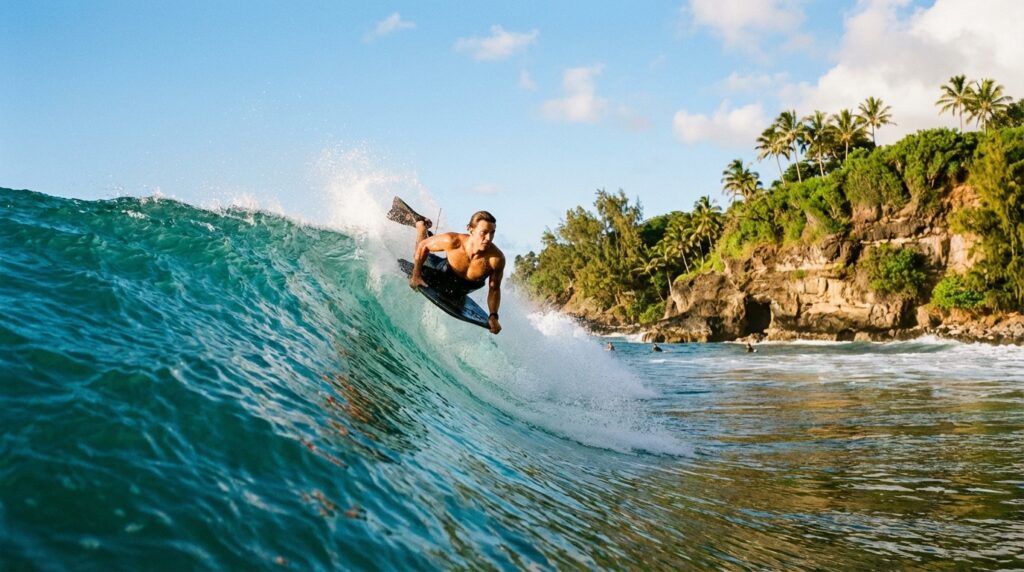
In brief: key points to remember
- 🌊 Suitable equipment = longer sessions and a skyrocketing level.
- 💨 Efficient paddling to double your wave catches.
- 📏 Board chosen at navel height, finely tuned shape for the practice.
- ⚡ Bottom turn and cut back: foundations of all maneuvers.
- 🚀 Aerials, tubes, spins: the trio that brings a smile at the photo finish.
- 🏋️♂️ Cross-training out of the water to stay explosive all year round.
- 👀 Ocean reading and right-of-way rules = smooth and respected riding.
- 🧰 Integrated toolbox to compare core technologies at a glance.
High-performance equipment: optimizing the board, fins, and leash for uncompromising riding
Calibrated equipment wins valuable meters on every wave: experienced bodyboarders know that the slightest mistake in foam or slick choice costs dearly in lost speed. The first step is to understand how the core, rails, and tail interact with hydrodynamic constraints. A PE core, more flexible, absorbs the chop of winter swell. Conversely, PP offers a quick reflex, ideal for watermen evolving in tropical water above 20 °C. Between the two lies the NRG, an intermediate density hybrid, made for European riders juggling thermal variations from spring to autumn.
The slick deserves the same attention. The very common HDPE delivers versatile grip, while the HDPP—nicknamed “the mirror” in the jargon—relies on rigidity to absorb clean re-entries after an ARS. Added to this layer is the stringer: single, double, or trident, it acts as the board’s spine. Shapers now integrate carbon nanotubes to gain 15% rigidity without adding weight.
The fins are no exception. On beach breaks at medium tide, a short blade increases acceleration. On deep reef breaks, asymmetrical fins enhance directionality and reduce lateral drift. A bodyboarder adopting angular paddling, knees bent at 45°, reduces paddle time to the line-up by 12%. Moreover, the installation of elastic straps limits fin loss during a wipe-out.
The leash, often relegated to second place, plays a major safety role. Medical-grade urethane spiral models absorb sudden tugs better. After each session, it is recommended to attach the velcro strap on the plug to avoid permanent stretching.
To delve deeper into the purchasing phase, consult this comprehensive buying guide which synthesizes essential points, or advice on board lifespan and storage methods.
Choosing the ideal size and shape according to build: from the navel to performance
The navel rule remains the reference: when the nose touches this height, the lift/maneuverability balance is almost perfect. One extra inch adds flotation for a beginner. One inch less frees the board for a rider looking for fast rotations in powerful waves. For a numerical reminder, 1’ equals 2.54 cm. Thus, a 1.75 m tall rider will lean towards a 41’’ standard size, while a stockier build should consider a slightly thicker 42’’.
The wide point directly influences the rail line: high for prone, low for drop knee. Nose bulbs, often underestimated, provide decisive grip at the duck dive start. Channels regulate water flow. A 4 mm depth allows an aggressive attack angle without losing hold, while a flat configuration favors chained spins.
| Shape element 🛠️ | Impact on riding 🌊 | Usage advice 💡 |
|---|---|---|
| 60/40 rails | Maximum grip | Perfect for deep reef |
| 50/50 rails | Raw speed | Ideal for aerials |
| Crescent tail | Balanced versatility | Prone + drop knee |
| Bat tail | Rear lift | Boost in small waves |
This overview makes sense when linked to build. Readers seeking precise guidelines will find a detailed size/weight chart in this complete guide. For 80 kg and above, a specific memo is available via this dedicated page.
In a specialized shop, a quick test is to press the board’s center: a flex of about 1 cm indicates a good compromise. An almost absent flex signals extreme rigidity, suitable for warm waters, whereas flex over 2 cm betrays a board too flexible for critical maneuvers.
Mini practical workshop: calculating your ideal volume
What volume for what buoyancy? A 70 kg rider targets about 25 liters on a medium PP board. A PE core demands 1.5 liters extra. The goal is to reach a flotation ratio of 0.35 liter/kg to maintain part of the rail submerged without sinking the front.
Paddling techniques and wave timing: the art of controlled acceleration
Paddling accounts for 60% of total effort in a session. For many, the difficulty lies more in synchronization than in pure strength. In the foam, a short flutter kick, knees bent, creates an upward thrust that lifts the chest and frees the hull. Outside the foam, alternate freestyle paddling saves 15% oxygen over a 30 m path.
Observing sets holds a strategic place. Experienced bodyboarders often count “3–4–pause”: three consecutive bombs, a foam interval, then an opening. This rhythm especially applies on point breaks where bathymetry channels energy into regular blocks. The patient rider positions three meters inside to catch a steeper wave.
The bodyboard duck dive differs from surfing. Both hands grip the nose, while one knee is placed in the tail to push down the rear. It is a double movement: the board diagonally breaks the water mass and reappears 30 cm laterally. Executed cleanly, it saves two kicks on the restart.
At take-off, the attack angle is crucial: 35° on a windy beach break, 25° on a clean reef break. This difference is explained by the horizontal push of the lip which varies depending on swell period. If the slope exceeds 40°, the rider risks a nose dive. The trick is to bring the inside shoulder toward the opposite rail to lower the trajectory.
To calibrate your peak, nothing beats local data. The site specialized in ideal tides offers updated curves allowing anticipation of the critical water height where the wave breaks most regularly.
Bottom turn and cut back: technical pivots to unlock maneuvers
No solid bottom turn, no credible ARS or reverse. The movement starts as soon as engagement in the slope. The gaze fixes on the targeted crest point, while the inside hand pulls the inside rail. Simultaneously, the outside knee slightly sinks into the hull, creating a rotational torque twisting the board. On a soft beach break, pressure must be progressive to avoid tail sliding. On a hollow reef break, rail engagement can be assertive, with solid water providing natural grip.
Once speed is converted to potential energy, the cut back acts as a regulator. On the return to the curl, the torso straightens, fins scratch the surface to slightly brake. Then the outside hand heels the rail to reorient the board. Most riders forget the ventral support phase: pressing the rib cage lowers the center of gravity, making the return safer.
A properly mastered bottom + cut back sequence creates a comfort zone to prepare an ARS. The order is simple: bottom, transition, crest, projection, rotation, landing. Each step corresponds to a micro-movement. The key lies in timing: the board’s nose must point toward 2 o’clock on an imaginary clock at the moment of fin thrust.
Progression also comes through comparative study of materials. Some cores make the bottom turn more biting, others slicker. A clear comparison is essential.
Interactive bodyboard core comparator
| Core type ▾ | Flex ▾ | Stability ▾ | Speed ▾ |
|---|
Legend: “+” indicates enhanced characteristic, “-” the opposite. Example: Flex++ = very high flexibility.
Aerial maneuvers and tubes: elevating the ride above the lip
The bodyboarding world thrives on the aerial roll spin (ARS) invented by circuit legends. Its secret: a synchronized rail-fin impulse. The body arches like an archer; the chest extension transforms horizontal velocity into vertical rotation. In the air, knees come closer to gain an extra quarter turn before landing.
The tube remains, however, the ultimate grail. Entering a barrel requires precise placement under the lip, accompanied by constant traction on the inside rail. Advanced riders keep the outside hand on the wall to slow down and reposition. At the exit, a micro-extension unlatches the board, almost like a scooter jumping a curb.
A large part of success lies in section reading. Indicators? A thinning lip, a color change under the foam, a soft whistle just before collapse. A sharp eye spots those signals and instantly adjusts the trajectory.
To discover destinations where tubes stay open for 8 seconds or more, the page top travel destinations offers an overview of spots to add to your bucket list.
Focus on safety during radical maneuvers
The softshell helmet has gained popularity since 2026 after a series of high-profile accidents. It reduces deceleration by 30% during a head-reef impact. Furthermore, using an impact vest helps flotation after a wipe-out lasting more than 5 seconds underwater.
Paddling and endurance: the hidden engine of long sessions
Strong paddling starts on the beach. Biomechanical studies demonstrate that a joint warm-up reduces perceived fatigue by 50%. A typical routine includes: 20 jump squats, 10 lunges per leg, 30’’ hip openings. Once in the water, the ideal cadence is around 80 beats per minute, timed with a waterproof portable metronome.
Cross-training combines swimming, cycling, and plyometrics. A 200 m sprint in pool improves VO2 max, while 15 box jumps sharpen the jump useful for aerials. The best competitors of season 2026 incorporated the Tabata method: 8 cycles of 20’’ effort, 10’’ rest, applied to intense paddling.
On the nutrition side, omega-3 intake limits muscle inflammation. A smoothie based on spirulina, banana, and oats provides sufficient energy for a 90-minute session. Hydration follows a simple rule: 500 ml of coconut water every 45 minutes.
Ocean reading, safety, and right-of-way rules: surfing in harmony
Understanding a body of water goes beyond mere observation of sets. Modern weather algorithms now visualize “shadowing” from neighboring islands. An attentive surfer notices that sudden chop often signals a rip current. Before entering, just toss a blade of grass and watch the drift to map the area.
Priority follows the universal code: the individual closest to the peak has the right of way. In case of conflict, raising the arm as a warning avoids collision. PP boards can cause serious injuries: a rail to the face equals a 35 km/h baseball bat hit.
Reef breaks require low tide scouting. Experienced bodyboarders walk along the foam line to observe coral heads. A visual landmark, like a colorful house, then helps reposition during the session when adrenaline blurs perception.
To determine if the wave height suits your level, the resource ideal wave height offers a clear scale: knee height for beginners, shoulder height for intermediates, beyond for experts.
Annual training plan: continuous progression and injury prevention
Consistency outweighs intensity. A structured program generally revolves around four 12-week cycles. The first focuses on technique: bottom turn and kick out drills in a wave pool. The second targets strength: bodyweight circuit + elastics. The third introduces high intensity with short but explosive sessions during mid-season swells. The last cycle reduces volume to boost freshness before local competitions.
Prevention involves shoulder strengthening. Stable rotators prevent chronic tendinitis. Resistance bands are useful: 3 sets of 15 external rotations twice a week. The lower back benefits from the “superman” exercise, static 30’’, simulating prone posture.
Active recovery includes walking in the water and foam rolling of quadriceps. To visualize progress, a session journal notes wave height, temperature, foam type, and perception. After six months, analysis reveals improvements and adjusts the plan.
For younger ones, a specific guide is available on the 6-year-old kids’ selection. The idea is to adapt workload while keeping things fun.
Which foam to choose for water below 15 °C?
Polyethylene (PE) remains the preferred choice because its flex compensates for the rigidity induced by cold water. It offers a more tolerant feel and reduces parasitic vibrations.
How to avoid cramps during intensive paddling?
Hydration rich in electrolytes combined with a dynamic warm-up of the calves limits muscle fatigue. Medium blade fins also reduce resistance.
What is the benefit of a double carbon stringer?
It increases longitudinal rigidity, ideal for warm waters or heavy riders. Energy return on each maneuver is felt from the first takeoff.
How long does a bodyboard last with regular use?
With rinsing in fresh water and shading during storage, a quality PP core maintains performance for three full seasons. Detailed advice can be found on the lifespan page referenced in the article.