
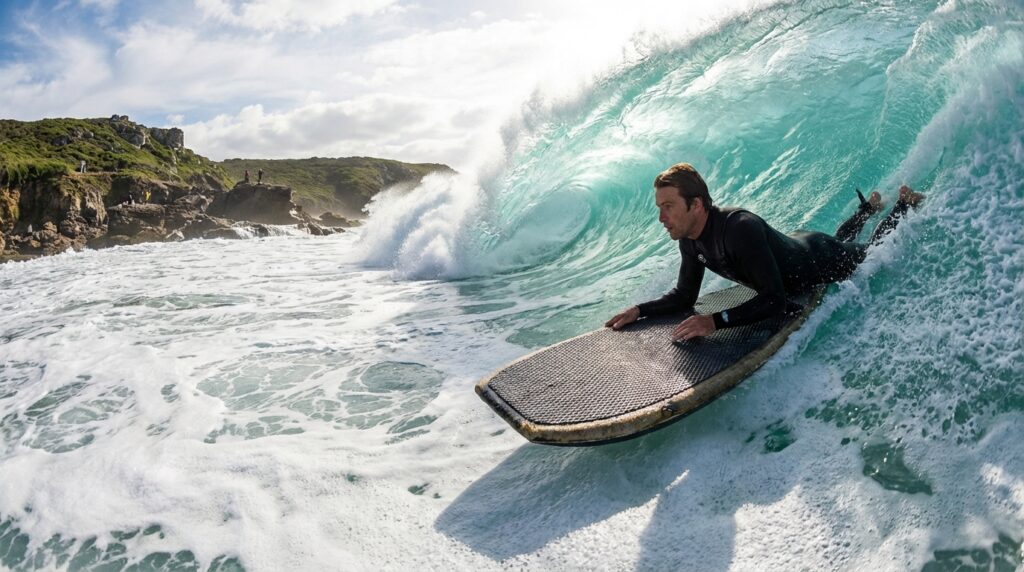
In brief 🏄♂️
- 🌊 Mesh = fiberglass mesh laminated into the core to boost stiffness and control.
- ⚙️ Improves the internal structure, aquatic aerodynamics, and buoyancy.
- 🛡️ Enhances torsion resistance, extends the lifespan of the board.
- 🚀 Easy choice: knowing how to read the specs, test performance in various conditions.
- 🔧 Targeted maintenance to prevent fiber oxidation and maintain overall comfort.
Mesh and bodyboard: essential technical basics
The term mesh refers to a fiberglass or carbon fiber cloth arranged in a lattice and placed at the core of the boards. This network, borrowed from aerospace engineering, arrived on bodyboards at the end of the 2026s, when shapers were looking to limit torsion without weighing down the boards. The principle is simple: the mesh spreads mechanical loads across the entire structure rather than concentrating on a single point. Result: better responsiveness and clear energy return on the kick.
Unlike a tubular stringer, mesh covers a large surface area, allowing it to work equally well in bending and compression. Riders then notice a gain in acceleration and improved drive in the wave face. The main materials used are:
- 🔸 E-Glass fiberglass: economical, lightweight, ideal for boards intended for temperate waters.
- 🔹 Carbon fiber: more lively, reduces buoyancy loss due to core aging.
- 🔸 Basalt/carbon hybrid: compromise between stiffness and damping, favored on high-end models.
To put the concept into historical perspective, a detour through the invention of the boogie board is necessary: the article the history of the bodyboard recalls that originally, PE cores had no internal reinforcement. The arrival of mesh therefore represented a real technological leap, comparable to the transition from single fin to thruster in surfing.
Controlled stiffness: when mesh sculpts aquatic aerodynamics
A board too soft “banana” on every bottom turn; conversely, a concrete board sends vibrations all the way to the shoulders. Mesh resolves this dilemma by calibrating the flex curve. Pool tests conducted by an Australian laboratory show that a 1.9 lb PP core laminated with mesh deflects 18% less than a bare PP under a load equivalent to 110 N. This margin changes everything in hollow surfing: the hull stays flat, therefore more aerodynamic in water, which limits drag.
In actual riding, the benefit materializes during a bottom turn at speed: the board holds its rail, then returns a crisp rebound, ideal for landing an ARS. In Nazaré or El Frontón, locals swear by double carbon mesh to withstand massive water pressure without breaking the rocker line.
To go further on flex/stiffness adjustment depending on the rider’s size, the guide choosing the ideal bodyboard size for 80 kg offers a simple chart: more weight = denser core + internal reinforcements like mesh or stringer.
Buoyancy, comfort, and wave feel
It is often forgotten: by stiffening, buoyancy is also modified. In practice, the fiber traps tiny air bubbles during hot lamination, which slightly increases lift (≈ 0.5%). This micro-variation is enough to make a 42” mesh as buoyant as a standard 42.25”, while maintaining a more compact outline.
Regarding comfort, the mesh dampens high frequencies: fewer parasitic vibrations filtered through the torso, less muscle fatigue during long sessions. The difference becomes noticeable in cold water, when the PE core softens. With mesh, controlled elasticity avoids the “wet carpet” sensation sadly familiar to winter riders.
Another parameter to consider is aquatic aerodynamics during spins. By locally stiffening the ventral area, mesh maintains the reverse rocker line during circular glides, preventing loss of speed mid-rotation.
- ✨ Noticeable gain in lift.
- 🛌 Vibration cut: more relaxed sessions.
- 🔄 Increased fluidity in continuous maneuvers.
For parents looking for a junior board that remains light yet responsive, the file best board for a 6-year-old child recommends a simple mesh combined with an HDPE slick to maintain flexibility and safety.
Industrial process: internal structure and lamination steps
Manufacturing is done in three main modules:
- 🌡️ Core molding: expanded PP beads injected into a press heated to 110 °C.
- 🕸️ Dry mesh placement on the still warm blank. Operator adjusts tensions to prevent wrinkling.
- 🔧 Hydraulic pressing: 40 t pressure, final bonding of layers, creation of a monolithic block.
Layer order affects performance. A mesh placed under the HDPE slick primarily stiffens the hull; a mesh sandwiched between two stringers acts as a balancing membrane. The 2026 trend: “sandwich” mesh composed of a first fiberglass mesh, then an elastomer film, then a second carbon mesh. Breakage rates drop by 23% in cyclic flex tests.
This data helps shops guide each body type. For an adult weighing 95 kg, the focus which board to choose for 95 kg concludes that a double mesh combining dense PP and Surlyn slick remains the most durable option.
Compared configurations: single, double, zero mesh
Comparing on the sand is telling, but a summary table settles it for everyone:
| ⚙️ Configuration | Stiffness | Flex in warm water | Weight | 💪 Resistance |
|---|---|---|---|---|
| Simple mesh | +15 % | Medium | Neutral | 🙂 |
| Double mesh | +25 % | Low | +60 g | 😎 |
| No mesh | Reference | High | Neutral | 🤔 |
The flex column reveals that riders too attached to nose-crank will still appreciate the option without reinforcement, especially in summer. However, most ISA competitors adopt a single mesh to preserve precise nose concavity at the drop-knee. Note that some manufacturers introduce basalt woven fibers, less expensive than carbon while offering a similarly stiff feel.
Choosing your board: mesh utility according to spot and style
Before pulling out the credit card, two questions: main spot? Frequency of practice? A beach-break rider at Hossegor will want a lively nose to get positioned early; a carbon mesh then seems relevant. Conversely, a rider traveling to Bali on regular reef breaks will prefer the liveliness of a double mesh to land late invert maneuvers.
The guide for choosing the best type of bodyboard offers a matrix where water/air factor and wave power steer core density and presence of reinforcements. It explains that mesh can compensate for less dense foam, useful to save weight in checked baggage on aerial trips.
Practical tips:
- 🧳 Tropical trips: simple mesh + HDPE slick = versatility.
- 🌬️ Cold & windy waters: double mesh + Surlyn to avoid parasitic torsion.
- 🎯 Freestyle beachies: single stringer + mesh to combine pop and flex.
Case study: feedback from riders and shops
In the Basque coast shop listed by SurfBiz, 65% of sales in 2026 concerned meshed boards. Repurchases of broken boards drop to 8% compared to 19% for models without reinforcement over the same period. Paul, the shop manager, confirms: “An October shorebreak session often caused a fold in the middle, now simple mesh holds up.”
From riders, Luna, European junior champion, explains she feels the board “go” less quickly under her chest in reverse spin, hence enhanced control recovery. Veteran Thomas, 105 kg, swears only by double mesh on NRG core to keep riding Landes slabs.
This feedback aligns with the article bodyboard lifespan: average lifespan goes from two seasons to three or four with properly maintained mesh.
Maintenance, aging, and mesh resistance
Even if mesh lasts, it requires minimum care. After each session: rinse with fresh water, dry in the shade to avoid oxidation of metallic microfibers present in some composites. Flat storage limits deformation under weight. During travel, bubble-lined board bags protect the hull from impacts that could break fibers.
For superficial cracks, a flexible epoxy resin kit is enough to reseal the slick and mesh. Beyond delamination of more than 10 cm, go to a pro workshop: a heated press reinfuses the glue and restores cohesion. The operation costs on average €40, much less than a new board.
Maintenance checklist:
- 💧 Systematic gentle rinse.
- 🌤️ Dry away from direct UV.
- 📦 Transport under thick cover.
- 🛠️ Quick impact repairs.
These actions guarantee maintaining performance and comfort for several seasons, more than enough to amortize the initial investment.
Does mesh add weight to the board?
No, the weight gain is marginal: about 30 g for a single fiberglass mesh, less than an energy bar in the wetsuit pocket.
What is the difference between stringer and mesh?
The stringer is a rigid central tube acting like a spine, whereas the mesh is a grid spread over the entire surface to distribute flexion. Both can be combined.
Can you surf cold water with a bodyboard without mesh?
Yes, but the PE foam softens and causes excessive flex. A mesh or a stringer then becomes very useful to preserve the shape.
How can I tell if my board has mesh?
Look at the hull against the light: a light grid appears under the slick. Some manufacturers also stick a ‘Mesh tech’ sticker near the tail.