
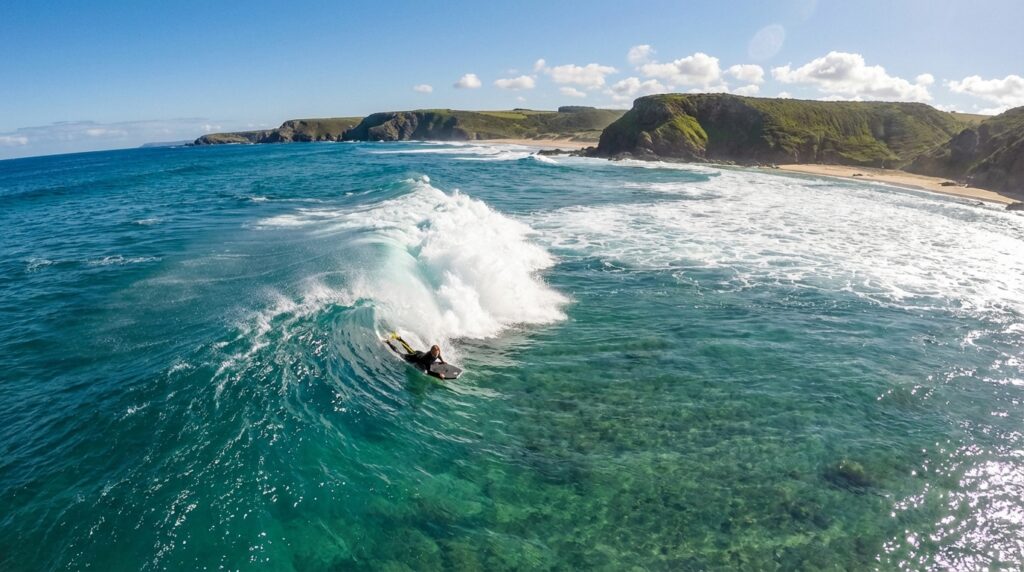
In short:
- 🌊 Understanding how to adjust posture and positioning on the board remains the foundation of all progress.
- 🛠️ Selecting suitable equipment – board, fins, leash, wetsuit – directly influences stability and glide.
- 🚀 Mastering the paddle (rowing) and wave anticipation promotes optimal placement in the line-up.
- 🔁 Manoeuvres (take-off, bottom turn, cut-back, 360…) rely primarily on precise body weight distribution.
- 🧠 Targeted physical preparation, ocean reading, and respecting safety rules make the difference in the long term.
Choose a coherent board and quiver to maximize positioning
The bodyboard is first and foremost experienced by touch: the hand grips the nose, the torso rests on a soft slick, and the legs kick the sea. Yet, even before hearing the crash of the first wave, everything starts with a well-thought-out quiver. A poorly sized board creates a critical imbalance: nose diving as soon as speed builds, tail sticking, shoulders arching. Conversely, a millimeter-precise shape immediately stabilizes the center of gravity.
Experienced sellers recommend a length that reaches between the navel and the top of the thigh when the board is held upright. This visual reference, favored since the legendary pro circuit series in the early 2026s, remains valid: longer for heavier builds, shorter for radical hollows. The core also plays a decisive role. Polyethylene (PE) slightly yields under pressure, gripping the cold wave of a winter beach-break. Polypropylene (PP) reacts crisp and lively, ideal for the warm water of tropical reefs.
The density of the deck and the thickness of the rail directly impact buoyancy and thus the overall trim. A 60/40 rail – 60% on the bottom, 40% on the deck – promotes maneuverability; a 50/50 rail grips the face more and reassures beginners still hesitant about their balance.
Never neglect accessories. Asymmetrical fins offer thrust centered under the ball of the foot, reducing ankle twists during paddling. A spiraled leash fixed in the right place – see this step-by-step guide to attaching a leash – prevents the board from taking off after a wipe-out, thus avoiding parasitic pulls on the shoulder.
The wetsuit influences posture: a neoprene that’s too stiff limits lower back arching and encourages sliding too high on the board. Conversely, a flexible coating like limestone follows the lumbar curve and keeps the torso close to the slick. Finally, a simple diamond-shaped piece of wax placed under the rib cage keeps the body from sliding back during accelerations.
Let’s illustrate with an example: Élodie (58 kg) kept nose diving. By replacing her PP 40/60 board with a more flexible PE model, 38 mm thick, the new buoyancy recentred her weight. Result: smooth turns, fluid take-offs, zero nose dives on 1.2 m waves.
Last point: quiver means rotation. Alternating two boards – one in PP for summer, the other in PE for winter – harmonizes sensations all year without forcing the body to relearn posture.
Optimize torso and hip placement: balance above all
On the water, the ideal position seems immobile. Yet, it results from constant adjustments between nose and tail. The golden rule: the hydrodynamic thrust center must correspond to the rider’s center of gravity. Practically, the plexus is positioned about ten centimeters behind the board’s nose, with only the chin protruding from the rail to keep the horizon in view.
A slight, barely perceptible angle settles between the sternum and the surface: too flat, the board sticks; too arched, it stalls. The forearms firmly press the deck, elbows tucked, creating a protective arc around the ribs. During this phase, the legs stay extended, ankles flexible. The fins never drag in the foam but just skim the surface, ready to accelerate.
To work on body awareness, coaches use the reverse crawl exercise. The practitioner lies on the board, closes their eyes and, guided by a partner, must keep balance while the board is pushed sideways. Lack of visual cues forces deep postural muscles to compensate, strengthening overall stability.
When the wave approaches, a subtle weight transfer occurs: the torso moves forward by barely three centimeters, the hips raise slightly, the gaze fixes slightly left or right depending on the trajectory. This mini-translation triggers acceleration without weighing down the nose.
Incorrect positioning is often corrected by playing with breathing. Inhaling deeply and exhaling slowly relaxes the shoulder girdle; the rib cage lowers, the center of gravity drops, automatically stabilizing the board. In hollow waves, some riders even place a hand on the opposite rail to lock the twist.
Quick tip: slightly bend the knees (yes, even while lying down!) to lower the pelvis and lock the spine. This micro-articulated flexion acts like a shock absorber on chop.
At this stage, every micro-correction is done in relaxation. Shoulders pressed to the ears create tension that hinders fluidity. A relaxed neck, a gaze far ahead: that’s the secret to continuous glide.
Master the paddle: efficient propulsion without excessive fatigue
The paddle – or rowing – remains the essential tool to position oneself in the line-up. Without targeted kicks, it’s impossible to reach the peak or adjust anchorage at the last moment. The classic technique: arms extended, hands joined, simultaneous pull, complemented by alternate leg kicks. Yet, as soon as the swell grows, this model shows its limits.
Modern coaches advocate balanced rowing: arms in a V, elbows flexible, palms slightly tilted outward. The fin kicks, meanwhile, are broken into series of three: two quick ones to launch inertia, one long one to maintain it. This tri-phased cadence preserves cardio. On a spot like La Gravière, crossing the channel thus becomes less energy-consuming.
Timing holds a central place. Anticipating a set’s formation starts even before entering the water: observe the average wave frequency, memorize landmarks (pier, rock, building). At departure, starting on the back of an outgoing foam saves a third of the paddling distance thanks to the “conveyor belt” created by the ebb. Performing a good duck dive in bodyboarding under the first wave completes fluidity.
A popular exercise is to paddle twenty meters, stop for five seconds, then start again. This sequence, repeated for ten minutes, simulates the reality of a line-up where you frequently stop to reposition. Lumbar muscles gain tone and better absorb jolts.
Want to visualize the move? The video below illustrates the arm line and fin flow in a timed course.
Despite the required power, paddle quality is judged more by regularity than brute force. A constant rhythm avoids lactate spikes and preserves the clarity needed to read sets.
Quiz: Bodyboarding Positioning Techniques
Read the waves and choose the right spot for natural glide
A perfect placement is useless without precise wave reading. Every sandbank, every reef changes the swell’s curvature and speed. Experienced riders observe the play of colors: darker water signals greater depth where the wave will break later; a whitish shimmer announces a bowl that suddenly lifts. The mix of foam and glass shines differently under the sun: milky white in the impact zone, clear turquoise in the waiting zone.
Rip currents, frequent on the Aquitaine coast, can serve as natural elevators to get back to the peak. Still, you need to know where to exit: stick close to the side edge, drift to the no-breaking zone, then angle 45° towards the beach. This trajectory bypasses the main flow and preserves energy.
Studying periods (in seconds) helps predict power. A 14-second swell creates a fast wall; 8 seconds, on the contrary, produce gentle foam ideal for training. Check weather buoys: a sudden 0.5 m rise coupled with a period lengthening usually signals a far-off wind. Arriving thirty minutes before tide change offers a strategic window.
What wave height is ideal? Instructors recommend starting on 50-80 cm to feel the slope safely. As mastery builds, 1.20 m opens the door to the first bottom turn. Beyond 1.80 m, positioning mastery must be reflexive: a three-second glance suffices to determine where to position oneself.
The textbook case of the Zicatela wave, nicknamed the “Mexican Pipeline,” illustrates this finesse. Sets arrive in packs of six; the third is often the hollowest. Locals let the first pass, paddle on the second, and position themselves inside for the third. This reproducible pattern is the perfect example of strategic anticipation.
Remember a mantra: “Look, breathe, paddle.” Looking fixes the target, breathing relaxes postural muscles, paddling launches momentum. Repeating this triptych automates positioning.
Execute take-off and basic manoeuvres thanks to precise alignment
The take-off marks the pivotal moment between anticipation and glide. A three-centimeter error in posture turns the launch into a nose-dive. The recommended sequence: acceleration, torso transfer, hands pressing the nose, lateral gaze to open the shoulder. As soon as the board embraces the slope, a slight pressure on the inside rail triggers the bottom turn.
The bottom turn, true backbone of bodyboarding, serves to redistribute speed by climbing the face. The secret: bend the outer leg, stretch the inner leg, while pulling the rear hand toward the rail to accentuate the curve. The board leans but doesn’t nose-dive, as the weight concentrates on the tail.
When the wave begins to slow, it’s time for the cut-back. The head leads the manoeuvre: first turns the gaze, then the shoulders, finally the board. This hierarchical rotation preserves balance and maintains momentum needed to reach the hollow section.
Captivating rotations like the 360 require a rapid repositioning of the center of gravity. After a tight bottom turn, the torso shifts slightly back, knees bend, and the board pivots under the hips. This lateral translation raises the opposite rail to avoid catching the wave’s lip.
Summary table of supports:
| Manoeuvre 🚀 | Primary support | Leg position | Gaze 🎯 |
|---|---|---|---|
| Take-off | Nose + hands | Extended | Toward the slope |
| Bottom turn | Inside rail | Outer bent / Inner stretched | Facing the lip |
| Cut-back | Tail | Symmetrical | Return to hollow section |
| 360 🔄 | Center | Slightly bent | Inside shoulder |
Watch the video below to decode the synchronization between head, torso, and leg during a bottom turn performed on a French beach-break.
Advanced techniques: tube, reverse, and drop-knee, the art of extreme positioning
Transitioning from horizontal glide to aerial moves requires metronomic body calibration. In the tube, the board is placed nearly perpendicular to the lip; the rider brings the front shoulder close to the slick, opposite hand on the outside rail. To refine this move, see the ultimate guide to performing a tube. There you’ll discover the role of the rear hand: brushing the water wall creates an anchor point, slowing the board without brutally braking, allowing to stay under the lip longer.
The reverse surprises by its reversed logic: the rider executes a strong cut-back until facing away from the wave, then pivots at 2026° on the rear rail. The key lies in instant weight distribution: centered torso, bent legs, gaze anticipating the return. A detailed tutorial is available via this step-by-step guide to succeeding at a reverse.
The drop-knee, half-surf, half-bodyboard, is based on placing the rear knee at the deck’s center, other foot forward. This posture raises the sightline and frees the rear hand to carve like a shortboard. The difficulty: transfer 70% of the weight onto the front leg without crushing the nose. Riders train on the beach, board on the ground, repeating the knee-foot transition; about ten series develop muscle memory. For more, refer to the step-by-step guide to succeeding at a drop-knee.
The el rollo symbolizes aerial projection par excellence. Preparation phase involves an engaged bottom, edge grip, then a hip launch at the lip’s peak to pivot around the rail. Studying this el rollo guide reveals the importance of keeping arms close to the torso to reduce moment of inertia.
Every advanced figure adds a layer of complexity to positioning: constant gaze adjustments, fine speed management, micro-straightening of the torso to reattach to the slick upon landing. Without these tweaks, the most beautiful tube ends in a washing machine and the reverse turns into a nose-dive.
Targeted physical conditioning to maintain stability and power
Physiotherapists specializing in wave sports insist: 60% of injuries among bodyboarders stem from a lack of core strength or mobility. A program built around three pillars – endurance, functional strength, flexibility – ensures lasting positioning.
Endurance: alternate interval running and long-distance paddling to stimulate the cardiovascular system without neglecting paddling specificity. A popular protocol: 20’ warm-up, 5 sprints of 30’’ uphill, active recovery jogging, then 15’ paddling with fins in calm water.
Functional strength: push-up T’s engage arms, pectorals, and lateral core. In plank position, do a push-up then open the arm sideways in a V, faithfully reproducing the posture during a cut-back. Add the superman hold, lying on your stomach, arms and legs raised, to strengthen the posterior chain fundamental to torso stabilization.
Flexibility: the pigeon pose loosens the glutes, reducing tension in the lower back when arching the body in the tube. Complement with thoracic rotations on the knees, hands behind the neck, to free the spine and facilitate transitions between manoeuvres.
A simple follow-up can be done via a logbook: note resting heart rate, average swim series duration, perception of fatigue. The goal: early detect any drop in tone likely to disrupt board stability.
Respect for the ocean, safety, and continuous progress
Effective positioning involves an irreproachable ethic. Sharing the spot starts with priority: the rider furthest inside the wave has right of way. Cutting someone’s trajectory unbalances the entire line-up and increases collisions.
Using a properly attached leash prevents the board from hitting another surfer. Every session begins with a careful check of the velcro: clean fibers, intact spiral, plug securely screwed.
Knowing your limits protects against overconfidence. A practitioner who swims 200 m in a pool without fins should be able to double that distance in formed sea. Rip currents require calm and method: drift sideways, conserve energy, aim for an emerged exit.
The mental aspect is often underestimated. Visualizing, before entering the water, the ideal line over three successive waves builds motor memory. After the session, debriefing – duration, sensations, points to improve – inscribes progress over time.
Let’s recall an obvious truth: one board, two fins, and an ocean are not enough. Mutual respect, love for the ecosystem, and risk awareness transform the practice into a way of life. Riders who last are those who cultivate this humility.
How do I know if I am too far forward or backward on my board?
If the nose dives systematically at take-off, the torso is too far forward. If the board pitches up and slows down, move back a few centimeters. A consistent wake and steady speed indicate correct centering.
What is the best off-water exercise to improve stability?
Dynamic core exercises in plank position combined with hip rotations strengthen the abdominal belt while training the body for the micro-adjustments specific to bodyboarding.
Should I change my board according to the seasons?
Yes. A more flexible PE core offers suppleness in cold winter water, whereas a stiffer PP core suits summer heat better to maintain reactivity.
How to progress without a powerful nearby spot?
Work on positioning and manoeuvres on small regular waves; complement with targeted physical preparation. Occasional stages on more hollow spots will capitalize on these skills.