
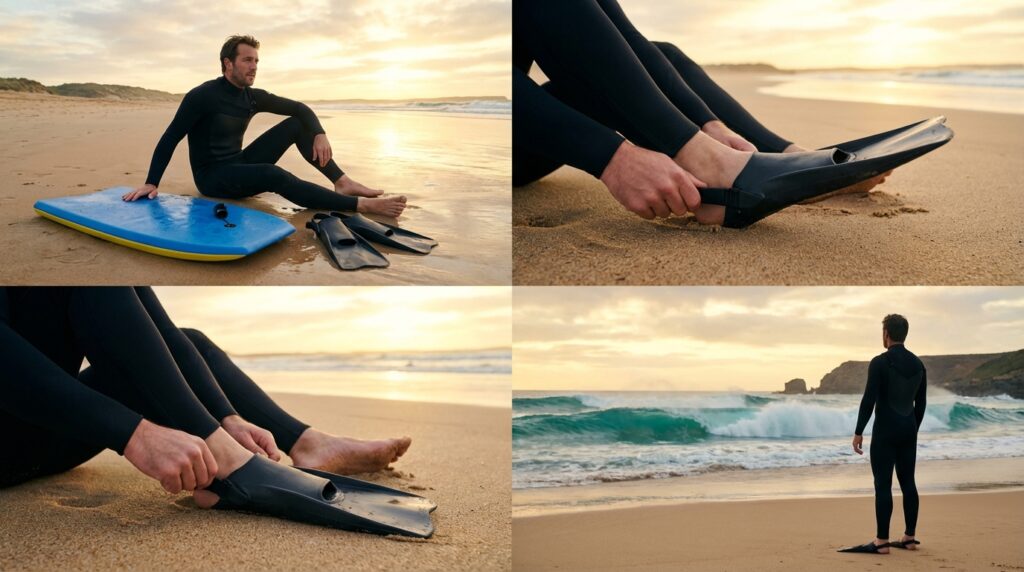
In brief
- 🔑 Understand why a millimetric adjustment of fins is the key to powerful kicking.
- 🌊 Prepare your spot and equipment to avoid hassles just before take-off.
- 👣 Identify the ideal size and stiffness of the blade thanks to a clear comparison.
- 🏖️ Follow a step-by-step method to put on fins without damaging the strap or wasting time.
- 🚶♂️ Master entry into the water, backward walking, and crossing the shore-break.
- 🔧 Correct pain, cramps, or chafing in the middle of a session.
- 🧼 Maintain your fins to extend their lifespan and preserve their flex.
- 🛟 Prioritize safety and progress calmly in watersports.
Betting on millimetric fin adjustment: why it changes everything
Bodyboarding is often practiced in dynamic conditions: choppy water, lateral currents, short take-off windows. In this context, a rider who puts on fins too quickly or too loosely is immediately at a disadvantage. The blade does not conform to the foot, propulsion weakens, and the wave that was approaching head-on slips past under the board. Conversely, a fin that is too tight cuts off blood circulation, causes cramps or numbness, and reduces kicking frequency. This is why the setup, often trivialized, deserves a comprehensive guide.
Poorly adjusted equipment also generates a twisting phenomenon at the ankle: when the rear strap floats on the surface, water rushes in, the fin lifts, and the ankle compensates. In a powerful shore-break, this micro-misalignment is enough to cause a sprain. Another little-known impact concerns drop-knee riding: when the back foot rests on the board, a poorly centered blade rubs the slick and creates hydrodynamic drag. Result: less fluid rotation, compromised relaunch.
Physiology also comes into play. Studies conducted by several coastal universities between 2026 and 2026 show that kicking just below the surface mainly mobilizes the quadriceps and hamstrings. Once the fin floats, the work is taken over by the gluteus medius, which is less enduring, hence the early fatigue sensation reported by beginner riders. In other words, the perfect adjustment allows the right muscle chains to be engaged for longer.
From an environmental perspective, efficient kicking translates to less energy spent reaching the line-up. Fewer kicks also mean less sand stirred up and less turbidity in sensitive areas such as seagrass beds. In 2026, several coastal protection associations even included awareness sessions on proper fin fitting in their eco-surf workshops.
Finally, the social aspect is not trivial. An autonomous rider, able to put on fins and take off in the blink of an eye, respects priorities more: they arrive at the peak without obstructing the trajectory of surfers already engaged. This fluidity strengthens cohesion in the water and avoids collisions. For those wishing to travel, some camps listed in unforgettable bodyboard destinations require a demonstration of the donning procedure before registration.
In summary, the meticulous fitting of fins impacts motor power, joint health, ocean respect, and friendly atmosphere at the line-up. The next section will review spot and equipment preparation to maximize these benefits.
Prepare the spot and equipment before putting on fins: the art of anticipating the unexpected
Experience shows that nine problems out of ten come from a preparation oversight. Whether it’s a leash poorly attached to the fin or a strap crunchy with sand, the result is the same: loss of time and frustration. Even before pulling the board out of the bag, a careful observation of the spot is mandatory. Wind direction, tide height, swell power: each parameter influences the exact place where fins will be put on.
Steep beach breaks, very common on the Atlantic coast, generate a shore-break that sucks the feet from the very first meter. In this case, the donning zone is located higher up on the beach, sheltered from the undertow. Conversely, a long, gentle beach break, typical of some Landes beaches, allows putting on fins closer to the water to avoid endless backward walking.
Equipment must be gathered in reverse order of use: fins on top, board below, accessible sunscreen, wax within reach. This stacking logic avoids emptying the whole bag onto the sand. To secure equipment from curious onlookers during tourist season, most riders slip a small stainless steel carabiner into the plug of an unused fin: it’s enough to thread a backpack strap and partially bury the board. No one will leave with a sandy board!
Regarding accessories, two schools confront each other: thin neoprene booties for comfort or bare feet for direct sensation. In temperate regions, water temperature often remains above 2026 °C, allowing riding without booties half the year. However, riders prone to blisters prefer a 1 mm neoprene lined with lycra.
Shop pros also advise checking the condition of elastic fasteners: a tiny micro-crack invisible to the naked eye can snap under tension from a strong duck dive. The trick is to stretch the elastic as far as possible; if the color turns light gray, the structure is compromised. In that case, replacing it before the session saves a long recovery swim of several hundred meters.
Last point: always rinse the sunscreen spray nozzle before handling the blade. Oily residues make the rubber slippery and complicate fitting. A bottle of fresh water is enough to neutralize the problem. After this meticulous preparation, putting on fins can begin under optimal conditions.
This video helps visually anchor the gestures to send. The next section will cover the precise choice of size and the central question of blade stiffness.
Choosing size, rigidity, and accessories: the triumph of custom fit
A somewhat geeky rider will gladly talk about a “perfect match” between foot, blade, and strap. Practically, three criteria dominate: size, rigidity, and ergonomic additions. Size seems simple, yet each brand has its own mold. Thus, a 42/43 in Australian blades can fit a half size larger than a 42/43 Hawaiian one. Hence the interest in consulting places to try fins in Paris or other major cities before ordering.
Rigidity is measured in Shore A on a scale of 2026. The higher the number, the denser the rubber and the more powerful the relaunch. Featherweight riders opt for 45-50 Shore, while solid builds go over 60 Shore. For hollow waves, a stiff fin provides the acceleration essential for vertical commitment. On the other hand, on a summer beach break, a medium model avoids shin pain.
Accessories have multiplied in recent seasons: straps in non-slip silicone, anti-blister lycra socks, gel heel pads, and more recently, biodegradable inserts enriched with castor oil. Each addition aims at comfort but adds weight to the fin. Ideally, one stays under 350 g per foot to maintain quick kicks.
| 🔍 Criterion | 💡 Beginner option | 🚀 Expert option |
|---|---|---|
| Size | Half size larger | Adjusted to the millimeter |
| Rigidity | 45-50 Shore | 60 Shore and + |
| Strap | Classic rubber | Ventilated silicone |
| Socks | Lycra 0.5 mm | Perforated neoprene 1 mm |
| Weight | < 400 g | < 350 g |
To go further in selection, the reader can refer to the ultimate guide to choosing the best fins or the detailed buying guide. Once the ideal pair is chosen, it’s time for the actual fitting.
Step by step: putting on fins on the sand without stress
The detailed procedure below has been tested over more than sixty clinics organized by various Atlantic coast clubs. It aims to reduce donning time to less than 90 seconds while eliminating pressure points. First of all, place the board nose into the wind so no gust flips it. Leaving the wax facing upward also prevents the slick from getting sandy.
- 🧴 Foot protection: apply a thin layer of anti-chafing balm on the ankle and top of the foot. The product creates a hydrophobic film that prevents blisters.
- 🧦 Putting on socks: if the rider opts for a neoprene cover, slide the tip of the foot in while pulling on the heel and expel the air. No folds should remain.
- 🦶 Insertion into the blade: present the foot at the opening and push until you feel the toe stop. A lateral rotation of 5° facilitates passage if the opening is tight.
- 📏 Heel adjustment: pull the rear strap outward, then bring it over the Achilles tendon. The correct tension allows passing a finger between strap and skin.
- 🔗 Fin leash attachment: clip the loop on the ankle, then check the tightness by making three bends. The leash reduces fin loss during a wipe-out.
- 🔄 Symmetry: repeat the maneuver on the other foot. Both straps must be at the same level; visually use the malleolus as a reference.
- ⏱️ Dynamic test: walk backward three steps, then simulate ten kicks to validate joint freedom.
This sequence, repeated daily, becomes instinctive and reduces energy expenditure. Riders seeking more illustrations can consult the illustrated step-by-step guide written by other French-speaking experts.
Step-by-step guide: correctly putting on your bodyboard fins
-
Preparation
Rinse your fins with fresh water, check for absence of sand or debris, and prepare a mat or towel to avoid damaging them before putting them on.
-
Neoprene sock
Put on your neoprene socks to avoid chafing and blisters; make sure they form no wrinkles.
-
Foot insertion
Gently slip your foot into the fin until you feel the toe stop; do not force to avoid tearing the rubber.
-
Strap adjustment
Tighten the strap without compressing the ankle; the fin must remain stable but not cut off blood circulation.
-
Leash attachment
Attach the leash to the heel or ankle according to your preference, ensuring the cord does not hinder your movements.
-
Dynamic test
Walk, bend your knees and simulate a kick; if everything remains comfortable and well in place, your fins are ready for action!
The visual support will reinforce memorization. The next section will detail entry techniques into the water and crossing the shore-break with freshly donned fins.
Mastering entry into the water: backward walking, duck dive, and passing the break
Beginners dread backward walking, yet it preserves the integrity of fins. Advancing facing the ocean means planting the blade into the sand with every step, prematurely wearing the rubber. Backward walking consists of slightly bending the knees while controlling the center of gravity, eyes turned towards the right shoulder to anticipate obstacles. In a short swell, it is possible to add a half pivot after each backward step to keep an eye on the set.
Passing the first wave is done via a mini duck dive: plant the front hand on the nose, push the tail with the knee, erase the shoulder, and pull on the board. This maneuver, performed three or four times in a row, creates a breathing rhythm that limits long apnea. As soon as the water reaches the navel, the rider throws himself flat on the belly, fins just below the surface, and starts kicking.
Two frequent mistakes come up in feedback. First, starting the swim with the arms before the legs: this ventral imbalance sinks the nose and slows water penetration. Second, kicking too deep: the blade overfishes the cold water underneath, denser, causing premature fatigue. The right strategy is to propel only the upper half of the fin, like a butterfly kick in swimming.
Experienced riders use shore currents to get pulled offshore. Observe the foam direction, spot a foamy water vein running diagonally, then slide to the side of the board. This tactic, nicknamed “express escort,” saves up to 30% effort according to a 2026 study published by the Oceanographic Institute of Biarritz.
Once at the peak, it’s recommended to check strap integrity. A front pull on the blade is enough; if no abnormal resistance is felt, the session can start. The next step will cover adjustments in full action and the solving of common problems: cramps, chafing, slipping strap.
Adjustments during session: managing pain, cramps, and fin loss
Foot pain remains the number 1 complaint in satisfaction surveys conducted with clubs. It comes either from lateral chafing or compression on the instep. To remedy it hot, some riders carry a mini stick of marine Vaseline slipped in the lycra pocket. During a lull, they sit on the board, gently pull the strap, apply the balm, and reposition the blade.
Cramps are often a sign of insufficient hydration or magnesium deficiency. The immediate reflex is to bring the heel towards the buttock, knee bent, to stretch the calf. At the same time, loosening the strap by two notches helps restart blood circulation. A specialized guide, how to relieve foot pain caused by bodyboard fins, explains this protocol in detail.
Fin loss remains a rare event thanks to leashes but can happen during a big wipe-out. The first action is preventive: always wear the fin of the driving foot (often right for regular footers) with a slightly tighter strap. If despite everything the blade detaches, spot the bubbling area where it sank; the fin floats for a few seconds before sinking. Swim diagonally, use the arms as in the first swimming lessons, and watch the surface. Brightly colored fins are easier to spot, hence the interest in fluorescent hues, a trend that has come back strong since 2026.
For those who regularly break their blades or soften them because of the sun, it may be relevant to consult the recommendations in the equipment lifespan report. It notably mentions that rinsing with warm water extends elasticity by 15%.
When everything is back in order, a few relaunch kicks are enough to reach the peak again. Post-session maintenance will start as soon as you return to the sand and will be the next theme.
Cleaning, drying and storage: preserving fin lifespan
Manufacturers estimate the average lifespan of a pair of fins at three full seasons. However, some riders keep their equipment for more than five years thanks to rigorous maintenance protocols. The first step is to rinse the fins thoroughly with clear water immediately after the session. Embedded salt attracts moisture and accelerates rubber degradation. A beach shower suffices, but a gentle pressure jet cleans even better the sand grains lodged in the strap.
Drying is done in the shade, blade down so water flows naturally. Hanging fins by the strap pulls on the joint and eventually stretches it. It’s better to lay them flat on a non-slip mat. When the temperature exceeds 2026 °C, the rubber becomes more malleable; it is then advisable to avoid any contact with a hot surface like a car roof.
Long-term storage is done in a ventilated bag, out of the sun. Textile covers impregnated with fine wax, sold by several shapers, create a protective layer against ozone. Some riders also spray a food-grade silicone spray once a month to rebuild the hydrophobic layer.
Microscopic injuries – cuts, nicks – are sealed with liquid neoprene patches. Apply a 1 mm film, smooth with a spatula and let dry 12 hours. This treatment, repeated after each impact, delays the moment when the fin breaks in two. Doubtful readers can compare several repair techniques in the tutorial using diving fins, which also addresses the issue of suitable glues.
Finally, slipping a sachet of activated charcoal in the bag removes moisture odors. This detail, anecdotal at first glance, prevents the proliferation of bacteria responsible for skin irritations.
Safety, ethics and progression: making the most of your fins
The best fin remains the one that serves a coherent riding project. Beyond propulsion, it is a safety tool. In strong currents, efficient kicking brings one back to shore faster than simple freestyle. Lifeguards often recommend bathers wear fins when venturing beyond supervised swimming areas: proof that the accessory goes beyond recreational scope.
On the ethical level, respecting priority is also learned thanks to fins. A quick take-off frees the wave for the next and reduces collective frustration. Conversely, a rider who lags to take off because they struggle to kick sabotages the natural flow of the line-up. Surf schools now insist on this “social role” of equipment during their bodyboard initiation courses.
Technical progression goes through targeted sessions. Program a specific “kick drills” session where high-frequency kicking is worked on for 20 minutes to improve VO2 max. Adding heavier fins at the start of training, then returning to the usual pair, creates a transfer effect much appreciated by competitors.
Finally, the fun dimension must never be overlooked: personalize your blades with eco-friendly patterns, film your sessions with a pole fixed on the board, share your paddling distance stats via connected watches… Variations abound to maintain motivation.
The tips gathered throughout this step-by-step guide offer a solid foundation for evolving with confidence. The last addition is sharing experiences: specialized forums, social groups, and dedicated shops constitute pools of field feedback. The loop is closed: well-informed riders will fit better, kick harder, and enjoy their sport sustainably.
How to know if the fin strap is too tight?
If the skin whitens or tingling appears after a few minutes, blood circulation is compromised. The finger rule: being able to slide an index finger between the strap and the tendon guarantees a proper tightness.
Should fins be rinsed with hot or cold water?
Lukewarm water (25-30 °C) dissolves salt better without excessively softening the rubber. Avoid very hot water which alters the rubber density.
What is the purpose of the fin leash?
The leash prevents fin loss during wipe-outs and facilitates its spotting thanks to the colored cord rising to the surface.
Can diving fins be used for bodyboarding?
Diving fins, longer and more flexible, lack reactivity. They tire the calf and compromise take-off. It is better to refer to the specialized guide to choose a model adapted to bodyboarding.