
In brief
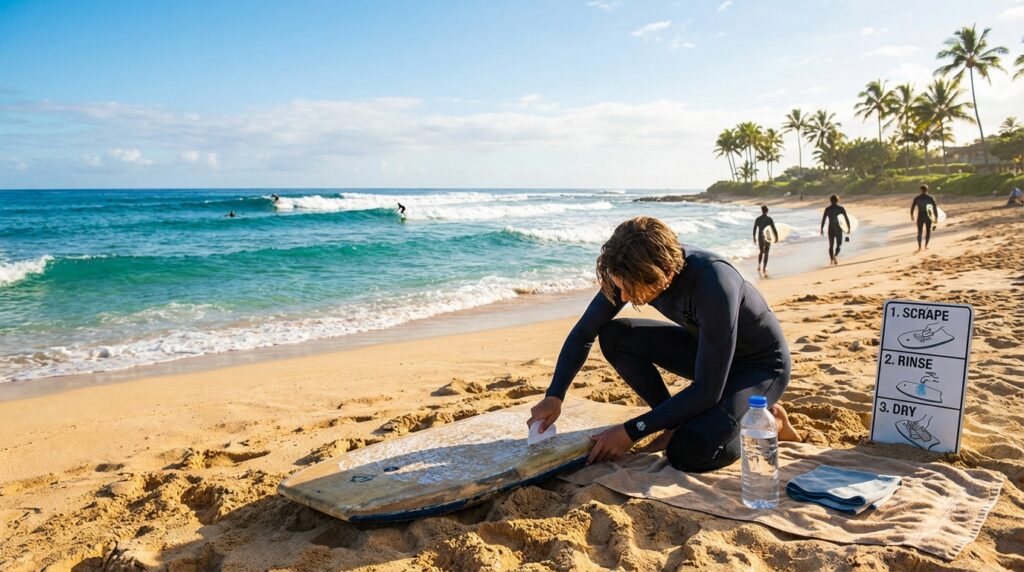
- 🏖️ A step-by-step guide to effectively remove wax without damaging the board.
- 🛠️ Presentation of the ideal equipment: wax comb, microfiber cloth, white vinegar, etc.
- 🌡️ Tips to soften bodyboard wax even when the sun is lacking.
- 🧽 Methods for deep cleaning and actions to absolutely avoid.
- ♻️ Focus on recycling used wax and eco-friendly solutions.
- 🔥 Maintenance tips to keep optimal grip all year round.
Choosing the right time and place to remove wax from your bodyboard
Planning the maintenance of a board is never left to chance: location, weather, and timing directly influence the ease of stripping. Experienced bodyboarders prefer to work when ambient temperature exceeds 20 °C or after a long session under generous sunshine. Under these conditions, the wax naturally softens, reducing the effort needed for scraping.
The location matters just as much. A wind-sheltered spot prevents sand grains from landing on the freshly cleaned hull. Many choose the terrace of a surf shop or the courtyard of a garage, provided they lay down a tarp to catch debris and avoid dirtying the ground. This tarp unfolds in less than a minute; it retains melted wax and small particles, ensuring a clean environment.
Some urban riders do not always have access to outdoor space. In this case, a south-facing balcony or even a heated bathroom remains relevant. One only needs to increase the room temperature slightly and ventilate after the operation to dissipate any fumes from mild solvents.
Finally, the seasonal factor: most practitioners remove the wax every two to three months or at hydrological season changes. Switching to a “cold water” wax formulation in spring and “warm water” wax in summer preserves glide and prevents cracks caused by mixing different hardnesses. Those wishing to delve deeper into managing a board’s lifecycle can consult the complete dossier “Bodyboard Lifespan” published on a specialized resource detailing the optimal frequency of maintenance operations.
Closing this first step ensures starting the stripping stress-free and in a controlled context. In the next section, an overview of essential equipment will provide a clear vision of the tools to prepare.
Preparing essential equipment before any dewaxing operation
The success of a cleaning depends above all on the arsenal made available. The accessories recommended by the bodyboard community fall into five main categories: scraping tools, heat sources, degreasing products, wiping textiles, and personal protection.
Scraping tools
The wax comb, with its straight and notched edges, remains essential. When this tool is missing, an expired loyalty card proves remarkably effective; its flexibility minimizes scratch risks. In a rental shop in Biarritz, a comparative test showed that a slightly flexible ski pass removed 15% more wax per pass than a rigid bank card.
Controlled heat sources
The sun is free but not always present. A hairdryer set to warm mode (low heat) or a small neck heating pad can replace the luminous star without exceeding 60 °C. Beyond that, the EPS core foam risks deforming.
Degreasing products
Gasoline F and diluted white vinegar (30%) represent two key solutions. The first quickly dissolves greasy residues, while the second, less aggressive, suits sensitive boards covered with colored polypropylene slicks. Using a pump spray reduces consumption by 40% and limits odors.
Textiles and protection
A double-sided microfiber cloth allows polishing the hull after rinsing. Nitrile gloves protect the skin. Safety glasses prevent solvent splashes from contacting the eyes.
| Equipment | Function | 👍 Advantage | ⚠️ Risk if absent |
|---|---|---|---|
| Wax comb | Precise scraping | ✨ Prevents scratches | ⛔ Uneven scraping |
| Hairdryer | Soften wax | 💨 Use all year round | 🌧️ Longer dewaxing time |
| Gasoline F | Degreasing | ⚡ Fast action | 🔥 Sticky residues |
| Microfiber cloth | Final polishing | 🌟 Mirror finish | 🕳️ Micro-scratches |
For an illustrated summary, the following video shows how to set up your workstation in under three minutes.
Let’s now move on to wax softening methods, suitable both for sunny sessions and gray days.
Bodyboard wax softening techniques: sun, warm water, and indoor alternatives
Softening precedes any stripping. Three approaches dominate: solar exposure, wet heating, and directed heat.
The power of the sun
On the Landes coast, practitioners place the slick side down on dry sand. After 7 to 10 minutes, the surface develops a slight shiny film: a sign that the wax begins to seep. The trick is to rotate the board every two minutes to avoid the “pizza effect” which creates localized overheating zones.
The warm water bath
For those lacking outdoor space, a garden tub or bathtub filled with water at 45 °C suffices to soften the wax in five minutes. However, protect the slick with a cloth to avoid direct contact with too hot water. This method is economical: it uses less than 10 liters of water if an appropriately sized container for the board is used.
Indoor directed heat
The hairdryer or heat gun set on minimal power are quick solutions. Holding the device 15 cm from the surface provides even softening without bubbling risk. A Breton rider shared the tip of using a fan heater placed 50 cm away: the temperature stays mild and heat distributes evenly.
Whatever the method, the final goal remains constant: obtain wax that is soft but not liquid, ready to be scraped. The next phase details scraping gestures for flawless stripping.
Scraping without scratching: gestures and tools for precise stripping
Scraping represents the step where you can win or lose it all. Too much pressure causes scratches, while a poorly directed movement leaves wax patches. Shapers recommend a 45° angle between the comb and the hull to lift the wax rather than push it.
An effective approach is to work in 10 cm × 10 cm zones, in circular motion, before finishing with a longitudinal pass. This method limits wrist fatigue and ensures uniform removal. When the wax becomes firmer near the fin edges, a second targeted hairdryer pass facilitates the operation.
Many bodyboarders complement the mechanical action with a white vinegar spray. It acts as a temporary lubricant, reducing micro-abrasions. The test board made by a Hossegor club showed a 30% reduction in micro-scratches with this spray.
For delicate zones around the rail, a plastic tweezers or a simple rounded ice cream stick offers surgical precision. Use of a screwdriver or metal object is prohibited: it leaves marks that are difficult to fix.
Note that precise stripping sometimes requires two to three light passes rather than a single forced pass. The slick thus retains its smooth appearance, essential for glide.
Degreasing and finishing: how to get a perfectly clean surface
Once most wax is removed, a greasy film remains, invisible at first glance but detectable by touch. The combination “Gasoline F + microfiber cloth” remains the fastest way to eliminate it, provided used in a ventilated space.
Environmentally conscious riders often prefer the white vinegar + warm water combo. A fine spray applied in several layers gradually dissolves wax remnants, while a cloth performs circular polishing. This technique takes one or two extra minutes but results comparable to those achieved with a petroleum solvent.
Once the surface is dry, sliding the fingertips over the slick should produce a “frosted glass” sensation. Any sticky area indicates a new pass is needed. To lock the success of this step, competitors apply a layer of diluted dishwashing liquid (1/10) then rinse with clear water: this neutralizes any greasy traces.
Need to compare the performances of different methods? The simulator below calculates the average evaporation time of each solvent according to room temperature.
Simulator: removing wax from your bodyboard
Theoretical evaporation time: —
Current temperature: —
Adjusted time: —
Step checklist:
For a filmed tutorial showing proper finishing gestures, the channel below offers a step-by-step in real conditions.
With the slick now flawless, a question arises: what to do with the used wax? Head to the next section, dedicated to responsible recycling and disposal.
Recycling or disposing of used wax responsibly
Each stripping session generates between 20 g and 40 g of wax residues. Multiplied by a growing community, the volume becomes significant. Several solutions exist to avoid wax ending up in the regular trash.
Artisanal recycling
Collected wax can be melted again using a double boiler, filtered through a stocking to remove sand and fibers, then poured into a silicone mold. Add a few drops of peppermint essential oil, and you get a reusable block for training. The “Surf Green Days” associations regularly organize revalorization workshops: they give a second life to nearly 300 kg of wax per year.
Specialized collection bins
Several partner shops listed on this guide for fin test spots now have special bins. The wax is then processed by a local recycling company, which transforms it into mosquito-repellent candles for summer terraces.
Eco-friendly disposal
When recycling is not possible, the wax must be disposed of with “non-recyclable household waste.” It is forbidden to rinse it down drains; paraffin could solidify in traps and cause costly blockages.
By following these simple steps, each rider reduces their environmental impact, a factor increasingly emphasized during “Ocean Friendly” certified competitions.
Smart rewaxing: preparing the board for the next session
A clean board immediately calls for a new layer of wax suited to upcoming conditions. Pros recommend applying first a hard base coat, then a wax layer matching the water temperature. The complete guide for optimal application is detailed on this reference page.
Application is done with crossed diagonal strokes, creating micro-rolled ridges that will catch the softer session wax. A clean plastic card is used to even the surface without leaving holes. Riders sometimes use the “checkerboard” technique: alternating vertical and horizontal stripes to maximize grip.
Base coat drying time is almost instantaneous, but waiting two minutes before adding the soft layer ensures perfect cohesion. For a session planned in cold water, waxes labeled “Cool” remain effective down to 16 °C, while above 20 °C, a “Warm” or “Tropical” wax is required.
- 🟢 Step 1: Hard base coat applied diagonally.
- 🔵 Step 2: Temperature-appropriate wax rubbed in circles.
- 🟡 Step 3: Light comb pass to create grooves.
- 🟠 Step 4: Tactile test; surface should grip without sticking.
These gestures ensure optimal traction during take-offs and spins, and extend the board’s lifespan. The final section will offer an annual maintenance schedule to never be caught off guard.
Regular maintenance: annual schedule and pro tips to extend the board’s life
Maintaining a flawless slick is not limited to removing wax; maintenance follows a calendar each rider can adapt according to their session volume.
Recommended schedule
• Spring: dewaxing, rail inspection, apply “cool” wax.
• Summer: slick check after each shorebreak session, retouch with “warm” wax.
• Autumn: complete stripping, core check, leash replacement.
• Winter: light wax removal for inspection, moderate use of “cold” wax.
Stripping frequency depends on usage intensity; a daily bodyboarder adopts a monthly cycle, while a recreational user opts for a seasonal cycle. In all cases, regular maintenance prevents water infiltration in the slick and extends board lifespan, as highlighted in the study on the ideal bodyboard size.
As a final tip, some competitors apply a nano-hydrophobic spray on the slick after complete cleaning: water beads and the board remains lighter during the ride.
At what frequency should wax be removed from the board?
Most riders do it every two to three months or at each season change to adapt the wax type to water temperature.
Can a heat gun be used to soften the wax?
Yes, but always on minimal power and at more than 15 cm from the surface to avoid deforming the slick.
What eco-friendly solutions exist to recycle wax?
Remelting the wax and filtering it to make new blocks, or depositing it in a collection bin at a partner surf shop.
Is white vinegar sufficient for degreasing?
It is effective on light residues; for stubborn greasy films, Gasoline F is faster but requires good ventilation.
Why change wax according to the season?
Each wax has a calibrated hardness for a precise temperature range; using the correct formula ensures optimal grip and prevents it from melting or hardening excessively.