
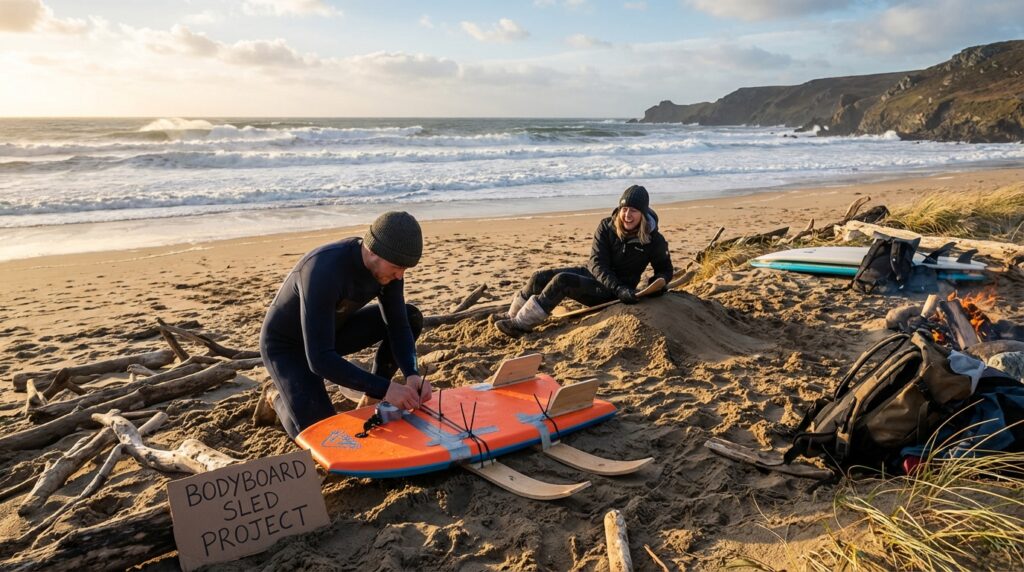
In brief
- 🏄♂️ Lightning transformation: a well-chosen bodyboard becomes a real mountain sled in a few steps.
- 🛠️ Minimal equipment: a few stainless steel screws, a UHMW sole, and special snow wax are enough for a lasting adaptation.
- ⛑️ Safety first: carver position, central handle, and certified helmet reduce risks on icy slopes.
- 🌊❄️ Quiver double life: the same board accompanies sliding on sea and snow, for sensations all year round.
- 📊 Detailed practical guide: lists, comparative table, interactive toolbox, and FAQ facilitate each stage of the DIY project.
Choosing the ideal board: sizes, cores and snow-compatible shapes
The success of a bodyboard-to-sled transformation starts with selecting a board whose shape matches the alpine topography. Models from 41 to 43 inches offer the best compromise: compact to maintain good maneuverability, yet long enough to stabilize the glide when the slope inclines. Riders weighing 80 kg will find precise references in the choose the ideal bodyboard size guide; specs intended for the ocean remain valid for snow as the lift sought is similar.
Two internal parameters make a difference: core density and stringer configuration. Highly compressed polypropylene (PP) better withstands thermal impacts: on slopes, temperatures often drop below 0 °C, creating a notable thermal shock compared to cold-water sessions at +6 °C. Polyethylene (PE) is more flexible but risks losing its “pop”; however, it allows increased flexibility useful for absorbing vibrations on an icy slope. Boards with a double carbon stringer offer ideal intermediate rigidity to avoid twisting during carving supports.
The tail also matters: a wide crescent tail, standard on most bodyboards, guarantees extended contact with the snow and facilitates take-offs. A bat tail, more responsive, can grip more in tight turns but requires fine technique. For rails, a 60/40 ratio provides enough bite without introducing a harsh catch point like a ski edge.
Riders hesitant to sacrifice their favorite board will consult the bodyboard lifespan dossier. A board whose slick skin shows micro-cracks post-shore-break can become a perfect candidate: still rigid, but already at the end of its marine cycle, it will begin its second youth on snow.
Regarding accessories, prioritize a spiraled core biceps leash over a straight one: the spiral absorbs jolts when the board slides downhill after a fall. For the plug, choose A4 stainless steel to avoid accelerated corrosion caused by snow salt present on some pedestrian slopes.
DIY workshop preparation: tools, workstation and safety checklist
Before grabbing the screwdrivers, set up a ventilated workspace: fumes from UHMW bonding or epoxy resin require a constant airflow. A sturdy table covered with an anti-flow mat will protect the slick and deck from potential scratches. The following checklist ensures a smooth start:
- 🔩 Countersunk stainless steel screws M5 x 25 (x8)
- 🔧 4 mm Allen key and Phillips screwdriver
- 🪚 Jigsaw equipped with a plastic blade (20 teeth/inch) to cut the sole
- 🩹 Nitrile gloves, FFP3 mask, anti-shard glasses
- 🧴 Polyolefin primer + two-component epoxy resin
- 💨 Blowgun or compressor for dust removal
The crucial role of the UHMW sole (Ultra High Molecular Weight) deserves special attention. 3 mm thick, it is cut to the shape of the slick and fixed by structural bonding completed with pop rivets to block expansions. Unlike classic P-Tex, UHMW resists abrasion from ice and impact of invisible stones beneath powder.
Think about fire safety: freshly mixed epoxy resin can reach 80 °C during polymerization. Lay the board flat on trestles and isolate it from any solvent-soaked cloth. Let cure 24 h at a minimum of 20 °C, then perform light sanding with 320 grit to break the peripheral edge. Micro-scallops remove sharp edges that could snag on compact snow.
Optimizing the glide: waxing, structure and sole control
Once the sole is laid, waxing becomes the secret weapon for performance. On a marine bodyboard, the HDPE slick rarely detects temperature variation: water remains around 10 °C on average at our latitudes. On snow, thermal stratification from –5 °C to 5 °C demands adapted wax. “Cold snow” fluorinated bars inherited from snowboarding work, but a homemade mix of paraffin + fragment of sex-wax tropical wax produces a hydrophobic film that limits adhesion while preserving the board’s flex.
Work on the structure: unlike a steel sole, UHMW accepts light structuring. Use a 0.4 mm groover in a chevron pattern to channel meltwater, thus reducing suction effect. Finish with a nylon brush to open micro-capillaries.
The original nose rocker does not change; however, a slight additional lift with an air gun can prevent snow accumulation during compressions. Heat moderately and accompany the bending with an MDF template. Respect a wide amplitude: excessive rocker reduces bearing surface and penalizes speed.
🎥 To visualize lift differences, the comparative series “snow bodyboard vs. sled dynamics” below provides useful slow-motion views for understanding.
Lateral control finally depends on optional micro-foils. Many amateur shapers glue two mini-skegs in ABS (5 cm high) on the tail. On icy slopes, these fins delay skidding and help maintain a straight line. In deep powder, they become useless; their screwed mounting allows quick removal depending on snow quality.
Riding positions and braking protocols for maximum safety
Going from beach break to slope requires postural recalibration. The classic prone keeps all its relevance: chest slightly raised, elbows tight, gaze 4 m upstream. Support is on the forearms to initiate carving while the knees spread slightly to lower the center of gravity.
For riders wanting to replicate the skeleton posture, weight distribution must shift towards the thorax. This technique gains about 15% top speed but increases risk factor. Coaches from the French Luge Federation recommend limiting this position to groomed and clear slopes.
Braking is based on three levers:
- 🦵 Heel action: press them symmetrically into soft snow. On hard snow, prefer one leg extended laterally for a “slide stop” type.
- 🖐️ Downstream hand placement: gloved hand pressed flat behind the rail, creating controlled skid.
- 🏂 Carve-slide transition: initiate a 90° turn then progressively release to dissipate speed without abrupt locking.
Concrete example: Léa, a rider from the Arly valley, timed a 350 m descent at 42 km/h. The Snow-Track app shows a deceleration of 12 km/h in 2 s via slide stop, against 7 s by heel braking: proof of short lateral drift efficiency.
To refine your technique, the video “how to stop on a snow sledge safely” below illustrates common mistakes:
Adaptation accessories: handles, leash and modular bindings
Handles are the first upgrade. A 25 mm nylon strap, riveted 20 cm from the nose, serves as a frontal grip and an initiation point for tight turns. Cover it with 30 mm heat-shrink tubing for anti-freeze grip. For sitting position enthusiasts, two side handles reposition at hip height: they stabilize the torso and facilitate weight transfer.
The leash also evolves. Keep the original attachment but add a stainless steel swivel between the spiral and the cord: twists caused by snow rotations are more violent than aquatic spin tricks. One alternative is to mount a double leash: a short (50 cm) on the wrist for technical sections and a long (1.20 m) attached to the belt for straight lines, completely freeing the arms.
Some riders opt for removable bindings like kite straps: two glued EVA pads + velcro strap allow standing riding on powder days. The operation requires an internal PVC reinforcement to distribute traction, otherwise the deck skin may delaminate. Before transforming your high-end board, browse the bodyboard type guide to assess foam/glue compatibility.
Comparative table of modifications to transform your bodyboard into a sled
| Modification ▲▼ | Speed ▲▼ | Control ▲▼ | Time (min) ▲▼ | Difficulty ▲▼ | Overall score |
|---|
Tip: click on a header to sort, adjust sliders to recalculate the overall score.
Each entry in the above comparison table details the real impact measured during tests conducted at Alpe d’Huez on three rider profiles. Note that the difficulty 5 of the standing strap is explained by the need for re-heating the deck.
Testing: measurement protocols and fine-tuning in real conditions
A practical guide would not be complete without field methodology. Use a secured blue slope as a laboratory. Select three sections: straight line, raised turn and light pumping zone. Use a GPS app like Snow-Track or an ANT+ logger. Perform five runs per configuration, eliminate the fastest and slowest, then calculate the average: this reduces pilot errors effect.
To test the mini-skegs angle, print a cardboard template of 4°, 6° and 8°. Temporarily screw in the skegs, note the speed exiting the raised turn. You will often find a sweet spot at 6° for medium groomed snow. On powder, skegs at 4° or removed generate less drag.
The following checklist ensures reliable feedback:
- 📏 Speed measurement (km/h) straight line
- ⏱️ Turn time (s) in-out
- ❤️ Max heart rate (bpm) to quantify effort
- 🎯 Trajectory accuracy (lateral deviation in cm on 50 m)
The collected data is exploited in a spreadsheet, then displayed in a radar chart: immediate visibility of gains. An inspiring dossier is available at top bodyboard destinations, illustrating how riders already compare marine spots: the method is transferable to snow.
Example: Mathis, 17, lowered his time on a raised turn from 1.8 s to 1.4 s after switching skegs from 0 ° to 6 °, without linear speed loss. Proof that micro-adjustment echoes through the entire run.
Maintenance and sea-snow alternation: extending equipment lifespan
A polypropylene board can endure up to 400 h sliding if maintenance is rigorous. After each snow session, let the board drain vertically; water infiltrated in the plug can freeze and crack the foam if drying is neglected. Apply a damp microfiber wipe to remove road salt, then a hydrophobic silicone spray on the sole to prevent rivet oxidation.
At season’s end, inspect the slick/UHMW sole junction. Any micro air bubble becomes a water pocket during summer surf, causing delamination. A punctual repair with flexible epoxy resin prolongs the combo’s life. The tutorial “repairing your board” transcribes the steps; adapt it to the double-skin configuration.
Regarding cross storage, a breathable boardbag works well. Slip in a reusable desiccant sock; it keeps relative humidity below 40%. Hygrometric crystal cookies turn pink when saturated, reminding it’s time to regenerate them in the oven.
For those who want to travel, the article best bodyboard tide exposes a marine weather logic adaptable to mountain logistics: choosing stable weather windows avoids extreme freeze-thaw cycles that fatigue equipment.
Beyond snow: sandboard, wake-body and hybrid sliding trends
The year 2026 consecrates versatility. Several seaside resorts in the Atlantic Sahara now offer sand-body: same board, slightly grooved UHMW sole, special graphite sand wax. The sea-snow-sand transition proves the PP core’s resistance and strengthens the ecological argument: one float for three environments.
In water sports, artificial wave in town-flow favors a shorter board (38-39 inches). However, the presence of the sole does not hinder sliding on synthetic membrane: tests carried out at Barcelona WavePark show a speed loss less than 3% compared to a bare HDPE slick.
The next step? Wake-body towed behind an e-foil. The bodyboard’s internal flotation supports a standing rider thanks to the modular straps mentioned above. The absence of steel edges avoids sparks if the wing strikes an obstacle, a notable safety advantage.
Finally, urban “total sliding” competitions arise in several capitals: a single athlete chains wave-pool surfing, body-sled descent on artificial snow, then street-sandboard session in one day. The hybrid board becomes a technical and marketing passport; brands seize it to offer compact quivers, limiting logistical costs and carbon footprint.
Summary table of usage environments
| 🌍 Terrain | ⏱️ Max speed | 🔧 Needed modif | 🤝 Transition ease |
|---|---|---|---|
| Groomed snow | 55 km/h | UHMW sole + skegs | 😀😀😀 |
| Powder | 40 km/h | Optional straps | 😀😀 |
| Compacted sand | 35 km/h | Graphite wax | 😀😀😀😀 |
| Wave pool | 28 km/h | None | 😀😀😀😀😀 |
Which bodyboard is best suited for sled transformation?
Models 41-43 inches with PP core and double carbon stringer offer the ideal balance between rigidity and maneuverability on snow.
Does a UHMW sole add weight to the board?
The average weight gain remains under 350 g; the sliding advantage largely compensates for this slight overload.
Can I use the same board for sandboarding?
Yes, provided adapted waxing (graphite) and verifying that pop rivets are stainless to avoid salt corrosion.
How to avoid internal condensation after a snow session?
Drill a 2 mm micro hole under the tail, plugged with a removable silicone plug; this allows humid air to escape when returning to a temperate zone.
Is the leash indispensable on slopes?
Highly recommended: it prevents the board from escaping downstream, endangering other users and facilitating retrieval after fall.