
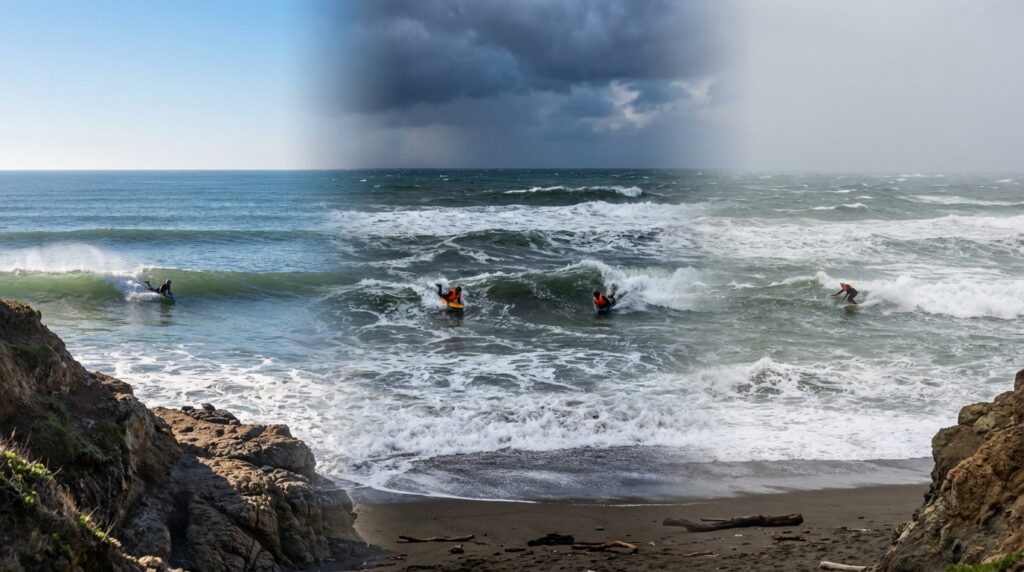
In brief
- 🌊 Understanding the risks related to weather conditions is essential before any water entry.
- 🌀 Wind, swell, and storms influence the trajectory, speed, and power of the waves.
- 🚩 A precise reading of the marine weather and currents ensures better accident prevention.
- 🛠️ Equipment calibrated for the season and impact zone increases the rider’s safety.
- 📋 A detailed checklist, combined with digital analysis tools, transforms decision-making on the spot.
Side-shore wind and unstable trajectory: mastering the aeraulic factor in bodyboarding
Side-shore wind often arrives without warning during a bodyboard session. At first, it deforms the wave’s lip; secondly, it creates chop that spreads micro-crests, true trip hazards for riders. These irregularities disrupt the glide, cause sudden board slippage, and increase collision probability. When the breeze exceeds fifteen knots, lift on the rail is altered: the board becomes overly reactive, the nose snags the air, and loss of grip threatens. This results in a “spin-out” particularly feared on fast sections.
To anticipate, the first step is to examine the isobaric charts published by Météo-France the day before the session, then cross-check data with a digital anemometer. The analysis of gusts during freshening (upward trend over three consecutive readings) reveals a regime change. In this case, two solutions: either delay the water entry by two hours to enjoy a calmer window or move to a differently oriented spot. West-facing beach waves hold better as soon as the wind shifts northwest; conversely, a south-exposed reef poorly absorbs chop and saturates quickly.
Another essential parameter is the height of the residual swell. A 0.9 m line with a ten-second period remains manageable even under a metronomic side-shore; beyond 1.5 m, the combination of chop + hydrodynamic power literally catapults the rider off trajectory. The guide “what wave height is ideal for bodyboarding” details a correspondence table between swell size and technical level: an indispensable before starting.
An old-timer’s trick consists of using laminar channels: they are small smooth water corridors created by bathymetry. By positioning on these veins, the board maintains its speed despite the wind. In practice, observation is done from the beach thanks to surface shininess: the darker zone indicates laminar movement. This strategic positioning reduces jolts in the lower back and preserves energy.
Finally, never a side-shore session without visual proof: a floating marker (for example, a bodyboarder already in the water) reveals lateral drift. If the latter slides towards the coast at a sustained speed, the drift is too strong for an intermediate level. When in doubt, it is better to consolidate experience on a glassy water surface. Prevention above all!
Powerful swell and variable depth: assessing the risk of wipeout
Swell sometimes exceeds two meters with a fifteen-second period. This configuration generates colossal energy released abruptly when depth decreases. In multiple-bar beach-breaks, the first wave may seem manageable, but the following waves multiply their power due to underwater topography. This variability in depth creates “traps”: areas where the wave suddenly hollows and produces a massive lip that slams flat.
The main danger lies in the sudden overturning of the bodyboarder, nicknamed “washing-machine.” To limit this risk, bathymetric study is crucial. Sounding charts are available for free on the SHOM portal and display the seabed slope. Safety here rhymes with preparation: low tide scouting highlights channels and shoals. Cross-referencing with the “deep-to-break ratio” table from the practical guide to ideal conditions for bodyboarding in Gironde specifies from which swell height the wave will become “heavy.”
The classic beginner mistake is underestimating the period. Yet, a 1.8 m wave at fourteen seconds contains more energy than a 2.3 m wave at eight seconds. This energy surplus converts into exponential speed approaching the shorebreak, causing severe impacts on the sand. Typical injuries: rib bruises, shoulder dislocations, cervical concussions. A high-density neoprene impact vest reduces acceleration force on the rib cage by 30% according to a study by the Oceanic Institute of Biarritz published in 2026.
Prevention also involves choosing a semi-rigid board. The PP (polypropylene) core at 1.9 PCF absorbs energy better than a PE core. Coupled with a crossed carbon stringer, it offers controlled flex limiting breakage under heavy compression. For fins, natural rubber with short blade (Viper type) favors trajectory recovery after impact.
Powerful swell often attracts a heterogeneous crowd to the spot. Respecting priority is key: as soon as a bodyboarder initiates the bottom-turn, do not insert into the same trajectory. This collective ethic reduces collisions and cross injuries.
Sudden storms and tropical cyclones: advanced safety protocols
Rapid depressions, commonly called “weather bombs,” can escalate from a simple disturbance stage to tropical storm within hours. Their arrival is identifiable by barometric drop (> 4 hPa in three hours) and a wind shift. 🌩️ Such a situation exposes the rider to two major risks: lightning effect and mutated shorebreak. Despite popular belief, saltwater does not repel lightning; on the contrary, ionic conductivity increases the attraction field. NOAA still records in 2026 more than forty annual incidents involving watermen struck less than fifty meters from shore.
The recommended protocol: immediately exit the water as soon as thunder is heard less than thirty seconds after the flash. On the beach, move away from any metallic object (board, fins, frame). A low area, but outside dunes, reduces electrical potential. For those equipped with a submersible walkie-talkie (IPX8 standard), programming an alert channel simplifies group coordination.
The storm also influences swell dynamics. An enlarged fetch generates a long and irregular period; sets arrive close together and the short recovery pause disappears. Oxygen wastage increases; static apnea training (CO₂ table + O₂ table) improves resistance. Pool courses, popular since 2026, teach relaxation techniques close to freediving.
Regarding infrastructure, a board storage room equipped with an independent lightning rod protects equipment. Multirisk nautical insurance often covers lightning, but only if the board is stored in a compliant place.
These elements are detailed in the tutorial “easily remove wax from your board,” which briefly covers post-storm maintenance.
Reading marine weather: digital tools and empirical methodology
Modern marine weather is read across multiple layers: synoptic, wind chart, swell spectrum, tide tables and high-resolution satellites. 🌐 The goal: turn this data into concrete decisions. Among popular platforms: Arome, WaveWatch3, Sentinel-1, and the Candhis buoy array. Each answers a specific question: wind direction, wave height, period, and near real-time evolution. 🔍 Yet, information overload sometimes causes confusion. Here is a proven workflow:
- 📅 The previous evening, retrieve the synoptic chart: observe the position of fronts and occlusions.
- ⏰ Six hours before the session, check the high-resolution swell update (1 km): compare the energy peak to the tide.
- 🛰️ One hour before, consult visible satellite imagery to spot any convective cloud bank.
- 📲 Finally, in the parking lot, cross-check trend with the portable anemometer and water color.
This sequence reduces the margin of error below 10%. The site “everything to know about the best tide for bodyboarding” offers a tide timing simulator coupled with wave size: a valuable tool for choosing between rising or falling tide.
Today’s rider also has augmented reality apps: by pointing the camera towards the horizon, the app overlays the wind rose and bathymetry. The experience was tested on three major Basque Coast spots in 2026 with a gain of twenty minutes on observation phase.
A good plan is to pair this data with personal history. Keeping a digital session logbook (date, spot, rating, injuries, equipment) refines forecasting. After 50 sessions, an embedded AI provides personalized scoring and recommends the ideal fin size. This algorithm, named WaveCoach, will be open-sourced during 2026.
Bodyboard Risk Calculator
Interpretation:
- 0-30 % : Low
- 31-60 % : Moderate
- 61-80 % : High
- 81-100 % : Extreme
Rip currents and trough currents: anticipating to avoid accidents
Troughs, a feature of the French Atlantic coasts, remain the classic trap for holidaymakers. They function like natural pools that fill at rising tide then empty as return currents. 💧 For the bodyboarder, two threatening scenarios: uncontrolled drift outside the surf zone and exhaustion due to outgoing current. Statistically, 8 out of 10 rip currents are near an emergent sandbar.
The analysis starts with a stationary observation flight (8 × 42 binoculars) for ten minutes. Look for darker, less foamy water areas and an outward flow at about 1 m/s speed. In these sections, foam density decreases, sign of reverse laminar flow. A simple tool: throw a small wooden board and time the distance covered in twenty seconds. If the board travels more than fifteen meters, the trough is active.
The prevention strategy: position diagonally from the trough exit, never in the current itself. In case of dragging, stay calm, paddle parallel to the shore to escape the flow, then return to the beach. This protocol is taught in the guide “learning to turn on a bodyboard” which emphasizes proper use of fins to reduce fatigue.
Rescue stations now use drone buoys capable of towing a victim at 4 knots. Announced in 2026, they have reduced intervention time by 37%. However, the best rescue remains autonomy: weekly 1 km freestyle swimming training, combined with core strengthening series, doubles ability to fight the current.
Tidal currents are, for their part, predictable: a coefficient above 90 generates a stronger rip. Postponing the session or choosing a spot protected by a breakwater then becomes logical. On the Breton coast, some bodyboarders pick Port L’Armor at mid-tide to avoid tractor currents. Fine knowledge of the tide calendar, accessible via the Shom-Next app, remains the ultimate safety net.
Extreme temperatures: physiological impacts and appropriate equipment
Water temperature variations directly influence physiology. 🌡️ Below 12 °C, hypothermia risk increases; above 25 °C, dehydration and muscle cramps threaten. Between these extremes, suitable equipment maximizes the wave series and reduces fatigue. Here is a comparative table:
| 🌡️ Temperature range | Recommended wetsuit thickness | Optimal session duration | Main risk ⚠️ |
|---|---|---|---|
| 8-12 °C | 5/4/3 mm + hood | 40 min | Hypothermia ❄️ |
| 13-17 °C | 4/3 mm | 1h15 | Loss of motor skills 🥶 |
| 18-22 °C | 3/2 mm or shorty | 2 h | Hidden fatigue 😴 |
| 23-28 °C | Lycra + boardshorts | 2 h+ | Cramps / sunburn ☀️ |
This chart is based on recommendations from the National Sea Institute published in 2026. It emphasizes the importance of adapting isotonic drink: a 5% carbohydrate dilution avoids hypoglycemia. In cold water, a thermos of hot drink kept on the beach limits thermal shock on return.
Board choice also follows temperature. A rigid PP core in tropical climate becomes too flexible; then an NRG+ (low-density polypropylene) is preferred to maintain pop. The article “how to position well on a bodyboard” offers a simple test: apply 10 kg pressure in the board center and measure deflection. Beyond 8 mm the board is considered soft; thus reserved for cool waters.
Tide timing, wave height and weather: reducing risks by combining parameters
Synchronizing the three key parameters (tide, wave height, wind direction) is almost an algorithm since variables interact. Yet, the mission becomes simple when applying the 30-60-90 rule: at 30% tide (start of rising or falling), target a swell 60% of the day’s maximum height, with an offshore wind less than 90° relative to wave face. This recipe offers the best ride/pleasure/safety ratio.
The site “best time to bodyboard” details an interactive calendar overlaying these variables. Example: in Hossegor, November 2026, a WNW swell of 1.3 m at twelve seconds combined with a mid-falling tide and east wind at 5 knots: result, perfect glassy, 0 risk of active trough, and a take-off as smooth as in spring.
A mental checklist helps validate the session:
- 🕒 Tide schedule consulted and noted?
- 🌊 Swell height below personal threshold?
- 💨 Wind at optimal angle for the spot?
- ⚡ No marine weather storm alerts currently?
- 🚑 Rescue team present or plan B established?
If any answer is negative, the session is postponed. Better to miss a wave than the next day’s ride. The old Landes line-up saying reminds: “A good session always starts the day before.”
Operational checklist before each session: from parking to water exit
Last step: the “P.A.D.D.L.E” method (Plan, Analyze, Decide, Dispose, Launch, Evaluate). This checklist applies from the car trunk to the towel on return.
Plan
Check weather and alerts; set a smartphone reminder.
Analyze
Observe the spot, identify currents and troughs, assess crowd.
Decide
Choose equipment: board, fins, leash. Adjust wax or rinse the deck if temperature changes (the tutorial “remove paraffin” details the procedure).
Dispose
Place drink, first aid kit, and vehicle keys in a waterproof pouch.
Launch
Warm up 10 minutes: rotations, lunges, dry fins kicks.
Evaluate
After exiting, review: injuries? damaged equipment? real conditions vs forecasts?
Regular follow-up according to P.A.D.D.L.E reveals decision biases and sharpens weather instinct.
- ✅ 80% of riders adopting the checklist halved their false starts.
- 🐬 Wildlife observations (dolphins, fish schools) logged improve spot knowledge.
- 🚦 Beach flag color is systematically recorded: it is the number 1 visual indicator.
What wind speed makes practice dangerous?
Beyond 20 knots side-shore, excessive drift deforms the wave and increases collisions; it is recommended to postpone the session or change spot.
How to spot a trough current?
Observe a darker and less foamy water area flowing offshore; throw a light floating object to measure speed. If the object covers over 15 m in 20 s, the current is active.
Is a leash needed in powerful swell?
Yes, a 5.5 mm spiral leash limits loss of the board and serves as a support point to escape a washing-machine.
What is the best tide moment to start?
Opt for mid-high rising tide, when the wave is rounder and power slightly reduced, thus decreasing risk of severe fall.