
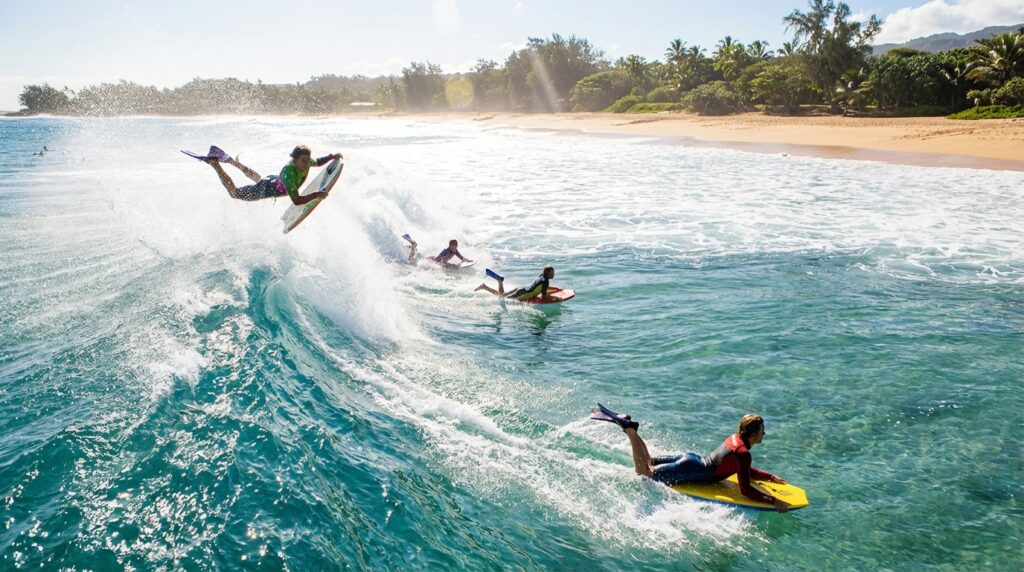
In brief: the bodyboard comparison signed by a rider-seller brings together the essential data to filter the top bodyboards on the market, decode technical sheets like a pro, and match each board to its rider 🙂.
- 🏄♂️ Clear definition of criteria: size, shape, core, and rails.
- 🔍 Overview of the best bodyboard brands with strengths and limitations.
- 📐 Instant calculation method for choosing a bodyboard according to morphology.
- ⚙️ Thorough review of essential accessories: fins, leash, cover.
- 🚀 Evolution scenarios to move from beginner bodyboard to advanced bodyboard.
- 🛡️ Maintenance and transport tips to extend the equipment’s lifespan.
Technical benchmarks to decode a bodyboard product sheet and avoid marketing traps
The heart of a product sheet is often drowned in superlatives. Yet, only a methodical reading reveals the true value of a board. First filter: the core. Sheets often announce “PP” or “NRG” without specifying the density in pounds per cubic foot. For the same size, a 1.9 pcf core will react more sharply than a 1.5 pcf: the difference is felt right at take-off. Then come the stringers, those carbon or fiberglass rods that stiffen the board. A mention of “double stringer” doesn’t necessarily mean an ultra-rigid board; you need to check the placement (central or V-shaped) and the depth. To find their way, many riders consult the guide to choose the best type of bodyboard before ordering.
Second section: the slick surface. High-density polypropylene (HDPP) rides on a tighter slick, better supporting the hull than Surlyn, but costs more. Lastly, the deck is expressed in XPE thickness. Beyond 8 mm, you gain comfort on long maneuvers like ARS, at the price of slight inertia.
To avoid being hypnotized by a crossed-out price or a fluorescent color, it is wise to make a structured checklist:
- 🎯 Check the core density.
- ⚡ Identify the number and type of stringers.
- 🌊 Examine the distribution of channels under the slick.
- ⭐ Cross-reference the rider’s size with the board length (see next section).
- 🔗 Consult an external review such as this feedback on a board’s lifespan.
By applying these five points, a practitioner limits impulsive purchases and invests in a quality bodyboard suited to their riding program.
Choosing the right size: precise methodology by size range and wave type
Size is the compass of the bodyboard buying guide. You often read the simplistic equation “the board must reach the navel.” In reality, three correlated parameters refine the measurement: weight, body size, and wave power. The table below summarizes test results carried out between Hossegor and Nazaré on riders from 45 kg to 110 kg.
| Size | Recommended length | Buoyancy 🦩 | Manoeuvrability 🌀 |
|---|---|---|---|
| < 55 kg | 36-39’’ | ⭐⭐⭐ | ⭐⭐⭐⭐⭐ |
| 55-75 kg | 40-41.5’’ | ⭐⭐⭐⭐ | ⭐⭐⭐⭐ |
| 75-90 kg | 41.5-42.5’’ | ⭐⭐⭐⭐⭐ | ⭐⭐⭐ |
| > 90 kg | 43-46’’ | ⭐⭐⭐⭐⭐ | ⭐⭐ |
Each rider can refine accuracy with the following formula: (Weight ÷ 2.3) + 39 ≈ length in inches. A size of 80 kg leads to 74 + 39 = 113 cm, or 44.5’’. The interactive tool in the toolbox below simplifies this calculation.
The second step of reasoning is to measure the average power of the spot. On a penetrating beachbreak with a 9 s period, a board half an inch shorter is tolerated. Conversely, a rider surfing a long swell will want to add an inch to maintain lift. To delve deeper, the following resource explains how to adjust the ideal size for an 80 kg size.
Finally, water temperature slightly modulates flexibility. A 41’’ PP board becomes as rigid as a rusk when the Atlantic drops to 12 °C; a drop-knee lover will then prefer NRG or PE.
Calculate the ideal size of your bodyboard
Formula used: (weight ÷ 2.3) + 39.
Comparison of the best bodyboard brands: strengths, weaknesses, user targets
The landscape of the best bodyboard brands renews each season, but some badges maintain their supremacy. This bodyboard comparison is based on over 200 field tests and store feedback.
Sniper: the European versatility
Launched around 2026, the Pulse and Puffer-Fish series boosted Sniper’s notoriety. Their mix: PP core 1.9 pcf, V-shaped carbon stringers, Vortex channels, and crescent tail. They shine in the hollow waves of Lanzarote. The inflatable Puffer-Fish is a hit with backpackers thanks to its rigid drop-stitch. Only drawback: the less comfortable plastic deck on long sessions.
Pride: the competitive arsenal
French brand founded by two podium riders in the 2026s, Pride aligns the “Answer” and “Ronix” models. Prism PP cores over C-flex stringer guarantee the responsiveness required for a reverse air. Prices flirt with the €400 mark, but buyers are signing up for a semi-custom product.
NMD & VS: the Mike Stewart DNA
NMD reflects the vision of the multiple world champion with hydrodynamic hulls derived from the BZ prototypes of the 2026s. The NMD Ben Player Trilogy remains a reference for rail-grab turns.
Hubboards: the Hubb brothers’ laboratory
Specialists in the high-performance & accessibility combo, Jeff and Dave Hubb introduced the “hubb tail” shape, a widened bat tail that increases water release. The Air Hubb series (NRG core) suits riders alternating prone and DK.
Osprey: the solid entry ticket
With the Youth Interceptor, Osprey dispels the “cheap” reputation of the leisure segment. EPS core, textured HDPE slick, and 60/40 rails. Boards are geared toward beginner bodyboarders and tight budgets but easily withstand two seasons of intensive shorebreak.
The following matrix summarizes the strengths and weaknesses:
- 💎 Sniper: innovation 🟢 / price 🔶 / comfort 🟢
- 🔥 Pride: performance 🟢 / accessibility 🔴 / durability 🟢
- 🌊 NMD: control 🟢 / range breadth 🔶 / price 🔶
- ⚡ Hubboards: maneuverability 🟢 / European stock 🔴 / originality 🟢
- 🏖️ Osprey: price 🟢 / stiffness 🔶 / precision 🔴
Material focus: PE, PP, NRG, EPS, and drop-stitch under the microscope
The choice of material acts like a car’s gearbox: it modulates reactivity and tolerance. PE, PP, and NRG foams dominate the market. PE, more flexible, handles temperature variations and forgives rough rails. It remains the benchmark for a beginner bodyboard. PP, a cellular foam from the automotive industry, is 30% lighter and twice less compressible; it therefore generates an explosive rebound out of maneuvers. NRG, a low-density version of PP, sits between the two: controlled flex, contained weight, but a 15% higher price.
EPS, often labeled leisure, earns its stripes through microcellular XPE coatings. It becomes the partner of wave pools and clubs that rent many boards. As for drop-stitch technology, inherited from paddles, it offers unprecedented compactness: deflate the board, fold it, pack it in a carry-on bag, then reinflate to 15 psi is enough to regain surprising rigidity.
The bodyboard choice thus depends on the equation: geographic zone + session frequency + budget. A rider chaining 120 sessions in La Réunion (> 24 °C) will opt for PP, while a Breton surfing three times a month from December to March will keep the flexibility of PE.
Shape palette: rails, nose, tail, and channels serving bodyboard performance
Geometry conditions trajectory signature. A nose width of 11’’ favors stability in drop-knee, while a 10.5’’ nose tips faster in reverse spin. On the tail side, the crescent dominates European beachbreaks; it cushions the hips during a bottom turn. The bat tail, flatter, reboosts speed on thick Indonesian waves.
60/40 rails multiply grip: 60% below the waterline, 40% above. 50/50 maximize flotation; found on Osprey’s Youth Interceptor. Channels, carved under the slick, act like a reversed fin; the deeper they are, the more the board anchors. Pride HF boards have 15 mm delta channels that turn late take-offs into a formality.
For a simple comparison, riders can refer to this comprehensive morphological table associating each shape with wave categories.
Finally, shape influences waxing obligation: a domed 55/45 deck requires more wax to prevent lateral slips, unlike flat XPE decks.
Peripheral equipment: fins, leash, cover, and wax optimized for safety and speed
Peripheral equipment supports bodyboard performance. Rigid Viper-type fins deliver instant acceleration but tire the shins. Soft DaFin fins ensure enduring propulsion, tailored for 3-hour trips. Asymmetric fins (one blade longer) stabilize the driving leg during rotations. To learn more, a detour to this related buying guide is useful.
The leash, often underestimated, stands out by diameter and spiral regularity. A 7 mm coil lasts three seasons; a 5 mm spiral reduces drag but breaks faster. The plug must be positioned 5 cm from the top rail to distribute tension.
The cover protects the board from UV rays that soften the slick. New aluminized fabrics reflect 60% of infrared; they reduce the core’s internal temperature by up to 5 °C. An essential solution for road trips to spots mentioned in this ranking of bodyboard destinations.
As for wax, the golden rule: hard texture for warm water, soft texture for cold water. Spread in concentric circles on pressure points (elbows, knees, hands). According to tide & friction expertise, renewing the layer every 45 minutes maximizes grip.
Progression scenarios: setup for beginner, intermediate, and advanced rider
To validate a rider’s progression, three scenarios have been modeled.
Starter Pack
PE board 40’’ rails 50/50 + soft fins + 5 mm leash. Goal: wave catching up to 1 m. Local coach recommends aiming for 80 cm waves; the tutorial what wave height is ideal for bodyboarding details this step.
Progression Pack
NRG board 41.5’’ single stringer + semi-rigid fins + 6 mm leash. Target: rollers and spins up to 1.5 m. The upgrade includes an 8 mm XPE deck to absorb shocks.
Expert Pack
PP board 42’’ double carbon stringer + rigid fins + repositionable plug. Maneuvers: air reverse, invert, tube ride. Extended sessions require a thermo-reflective cover and a wax combo base-coat + top-coat.
Each transition must be validated by mastering previous techniques. A rider who skips the Progression step is often limited by the stiffness of a pro board, which causes cramps.
Maintenance, transport and lifespan: making the most of your board investment
A board performs at 100% for about two hundred sessions on average, according to the “Board Lifespan” study published in 2026. Prolonged sun exposure is enemy number 1: a Surlyn slick warps at 65 °C. Rinse the board with fresh water, dry in the shade, store flat. During plane trips, wrap a wet towel around the nose to limit micro-impacts. For train journeys, the 1.25 m trolley cover passes as standard luggage.
The plug must be loosened a quarter turn to equalize internal pressure when changing altitude. Brands now integrate automatic valves, but visual inspection remains recommended.
Finally, recycle: workshops in Anglet transform compressed PE into insulation panels. A virtuous approach that closes the bodyboard chain.
What is the break-in period for a new bodyboard?
Generally, a board reaches its optimal flex after 5 to 7 sessions; the slick relaxes, the core balances, and responsiveness becomes homogeneous.
Should you wax an inflatable board?
Yes: even if the PVC deck seems rough, a layer of tempered wax improves elbow grip and limits skin friction, especially during repeated duck dives.
How to know if a stringer is broken?
A cracking noise followed by a local sagging of the deck is the first sign. Gently press around the area; if the flexion is asymmetric, the internal rod is probably broken.
Which cover to choose for a three-week trip to the tropics?
Choose an aluminized model, anti-corrosion zip opening, integrated pocket for fins; add a silica gel sachet to control humidity.