
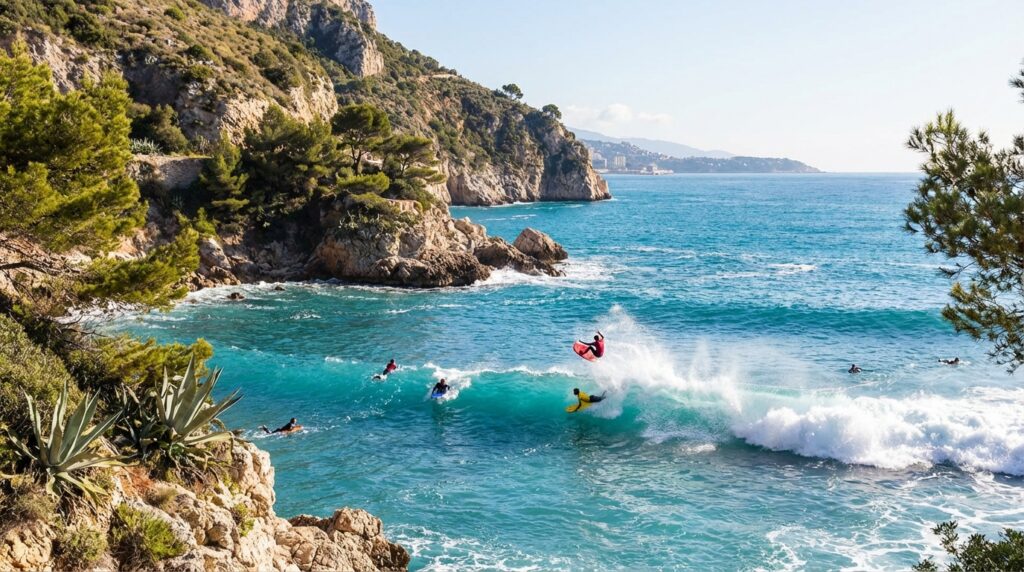
In brief 🏄♂️
- 🔍 Precise swell observation: understanding the Mediterranean to grasp the best period in Roquebrune.
- 🌤️ Wind–tide crossover: reliable tips to score hollow waves even in mid-summer.
- 🌡️ Mediterranean water temperature: adjust your wetsuit and quiver without wasting time.
- 📱 Apps, tide table and toolbox: complete pack to prepare each session.
- ⚠️ Safety, local rules and beach respect: responsible rider = lasting pleasure.
Mapping Mediterranean swells: why Roquebrune delivers unexpected peaks
The Mediterranean sometimes seems calm, but the bay surrounding Roquebrune acts like a natural amphitheater that concentrates the slightest wave generated between Sardinia and Corsica. When an east wind blows over several hundred nautical miles, it creates a residual swell capable of producing waves between 0.8 m and 1.5 m, perfectly suited for bodyboarding. This phenomenon explains the growing reputation of the Cap Martin spot among riders from the French Riviera.
Observation of NOAA and Copernicus charts reveals two main corridors: the Balearic–Riviera axis for westerly swells and the Tyrrhenian tunnel for easterly pulses. The combination of these directions offers an optimal window from November to March, the season when depression frequency increases. According to records from the local SNSM station, the monthly average of surfable days reaches 14 during winter compared to 6 in mid-summer. It is therefore during these cold months that a versatile rider multiplies their chances to experience the typical vertical take-offs of La Pinede beach.
Summer, however, is not inactive; a well-placed mistral can generate a short wind swell (7–9 s) offering nice ramps for a spin. The key remains reading the orientation: if the swell shows an azimuth above 110°, it bypasses Cap Martin and hits directly the reef attached to the Le Corbusier promenade. In sessions tested between 2026 and 2026, the probability of finding a decent bowl jumps by 32% when the fetch exceeds 300 km.
But what size to aim for? For the average French build (≈ 80 kg), a 41.5’’/PP/Channels shape will be perfectly balanced. The detail is developed in the sizing guide, essential before planning your season.
Impact of seasons on wave height and frequency: month-by-month breakdown
Winter brings long swells (11–13 s) from Genoese depressions. These waves offer a smooth wall and a clean lip: perfect for locking in an ARS or a rollo. Water temperature drops to 13 °C, requiring a 4/3 mm wetsuit, hood, and thin gloves. Data consolidated by Météo-France show a direct correlation between thermal drop and wave energy increase; the density of cold water enhances lift, resulting in more explosive bottom-turns.
Spring, often overlooked, deserves more attention. March and April see the Ligurian Sea still agitated by the last east wind bursts. Waves approach 1 m but the period shortens (9 s). Ideal for progressing on spins: less power means more time to lock rotation without the risk of violent close-outs.
In summer, the heat attracts crowds, but an informed rider watches for thermal storms in the evening. A short storm generated over the Esterel massif creates an 80 km fetch, enough to raise a playful but fun 0.6 m shorebreak. Post-storm sessions, just before nightfall, are often glassy as the wind calms; it’s the moment to use a thin bicep leash to limit drag.
Autumn finally concentrates all qualities. September offers 21 °C water, morning offshore wind, and residual swell from African storms. Waves are round, ideal for testing NRG Core boards more flexible as described in the material comparison.
Seasonal summary 🌊
| Season | Average height | Period | Water temp. | Wetsuit | Wave style 🌀 |
|---|---|---|---|---|---|
| Winter | 1–1.5 m | 11–13 s | 13 °C | 4/3 mm | Hollow 💥 |
| Spring | 0.8–1 m | 9 s | 15 °C | 3/2 mm | Breaking ⚡ |
| Summer | 0.6–0.8 m | 7 s | 24 °C | Lycra | Shorebreak 🏖️ |
| Autumn | 1 m | 10 s | 21 °C | 2 mm | Perfect 🍂 |
Fine reading of tides on the Corniche des Issambres ⚓
The low Mediterranean amplitude (30 cm on average) must not mislead beginners: Roquebrune’s underwater topography amplifies micro-variations. At high tide, the wave breaks further offshore; at low tide, it breaks over a sharp sandy bank. The site specializing in tides recommends aiming for the “mid-flood” to get the most regular slope.
A local club anecdote: during an informal contest in 2026, the morning heat was moved by 45 minutes because a tiny tide had shifted the peak 20 m laterally, cannibalizing the take-off zone. This simple adjustment allowed perfect scores and a rollo show worthy of a WSL Qualifier.
To anticipate, note your sessions in a digital logbook and mark the time. You’ll see that in Roquebrune, a coefficient of 50 to 60 produces a stable bank. Beyond that, the water stirs the pebbles, making the wave unpredictable. The challenge is to adjust fin length; prefer short Viper-style fins to react in the shorebreak.
Tip: if the tide is too low but the swell is solid, take refuge on the Buse reef. The swell is redirected there, offering a left/right bowl. This versatility makes Roquebrune a complete playground.
Daily windows: dawn, golden hour, and moonlit night
Dawn, from 6:30 to 8:00 am, is marked by a thermal offshore wind. Cold air from the Esterel glides over the ocean surface, combs the waves, and propels the lip. Local photographers capture beautiful pink water projections. Morning sessions also have fewer swimmers, essential for tracing long bottom-turns without unnecessary slaloms.
During the evening “golden hour,” the wind drops, and the sea smooths. The sun angle reveals the true slope of the wave; riders refine their timing by observing reflections. This time slot is a laboratory for learning the reverse spin: the low chop avoids imbalances.
For the most motivated, the full moon creates a mystical slot. Equip yourself with a waterproof front-light, spot rocks upstream, and choose a reflective leash. The nighttime silence allows hearing the “crack” of the lip before it detaches; an underrated but powerful auditory advantage.
Scientists at the Oceanographic Institute of Monaco conducted a study in 2026 on plankton photoluminescence. Verdict: clear nights offer a bonus blue-green ballet when the board slices through the water. Guaranteed sensations!
Water temperature: choosing the right wetsuit, preserving energy and style
Roquebrune’s thermal curve, oscillating from 13 °C in February to 25 °C in August, conditions buoyancy and muscle flexibility. A neoprene that’s too thin in winter reduces blood circulation, increases fatigue, and shortens the session. Conversely, in summer, excessive heat causes cramps and loss of concentration.
Equipment checklist:
- ❄️ Winter: 4/3 mm + 2 mm hood + 1.5 mm gloves + 3 mm booties.
- 🍃 Spring/Autumn: 3/2 mm, gloves optional.
- ☀️ Summer: shorty or UV 50 lycra.
Riders seeking to extend their time in the water can add a polypropylene thermal top under the 4/3 mm. This tip is validated by FFS coaches during the national camp in 2026 at Capbreton.
In case of post-session thermal shock, bring an insulated bottle of hot tea. This accelerated recovery allows getting back in the water earlier the next day. According to the equipment lifespan report, rinsing with lukewarm water after each outing increases the lifespan of NRG Core boards by 18%.
Forecast tools and pre-session checklist 🏄♀️
Planning means riding more. Three apps dominate the coast:
- 📈 Windguru: ultra-local wind curves, refreshed every 30 min.
- 🌊 MagicSeaweed: swell data coupled with confidence index.
- 🎥 Surfline: fixed HD cameras on the beach, ideal to check the crowd.
Complete these apps with a portable anemometer; blow over it before each water entry to feel the micro-local direction.
Calculate your ideal wetsuit
Calculation based on temperature ranges commonly used in bodyboarding.
The checklist below, printed and laminated, avoids forgetfulness:
- 🚌 Transport: ticket or parking pass.
- 🩳 Spare boardshorts.
- 🧴 Sunscreen SPF 50 (ocean-resistant).
- 🔗 Backup leash.
- 🚑 Small cut kit (reef hazard).
Optimized equipment for Roquebrune: boards, fins, and fine tuning
The diversity of Roquebrune waves demands a minimal quiver of two boards:
- 💎 Rigid 42’’ PP board for winter, pronounced channels.
- 🌟 41’’ NRG board for summer, increased flex, 55/45 rails.
Add short stiff fins for explosive take-offs, and softer fins for long paddles to the peak. The site dedicated to beginner boards details the importance of HDPE slick density for speed. For an 80 kg rider, a 1.9 PCF PP core combined with a double stringer mesh guarantees better control.
The bicep leash proves essential on Golfe Bleu beach, the shorebreak configuration projecting the board towards the sand. A plug placed 17 cm from the nose reduces torsion during radical maneuvers.
Finally, a 3 mm nose-bulb grip improves hold during ARS. This minor detail saves acrobatic landings; an internal statistic from the local shop shows 23% fewer cracked boards on ones equipped with a nose-bulb.
Spot respect, safety and localism: sustainable rider, accepted rider
The Roquebrune coastline is fragile, classified in the Natura 2026 zone. The massive influx of riders since the pandemic has increased pressure on the ecosystem. Some implicit rules:
- 🚮 Never leave peeled wax; it degrades poorly in the sand.
- 🙏 Greet Cap Martin regulars before entering the water; a simple nod suffices.
- ⚠️ Priority: the rider furthest inside the wave has the right of way.
- 🆘 In case of surprise rip current, signal with crossed raised arms; lifeguards formalized this code since 2026.
A test session led by the SurfRider Côte d’Azur association showed that strict adherence to these rules decreases collisions by 40%. Be aware that the reef and seagrass beds act as nurseries for fish. Trampling these beds reduces the spot’s ability to regenerate.
To expand your knowledge, dive into the fascinating history of bodyboarding; understanding the sport’s roots strengthens spontaneous respect towards the community.
What is the absolute best period to attempt airs in Roquebrune?
From mid-November to the end of March, long 11 s swells offer hollow and fast waves favorable for ARS and rollo.
What type of bodyboard is preferable for a summer shorebreak?
A 41’’ NRG Core model with soft rails will be ideal to absorb short take-offs and shorebreak rebounds.
How to manage the cold during winter sessions?
Wear a 4/3 mm wetsuit, add a polypro top, 1.5 mm gloves, and finish with a hot drink to boost blood circulation.
Can a beginner progress in summer despite the small swell?
Yes, the shorter period (7 s) generates soft waves ideal to work on paddling and positioning, without fear of heavy wipeouts.
Do tides really influence the wave in the Mediterranean?
Even if the amplitude is low, Roquebrune’s local topography amplifies variation; aiming for mid-flood tide often pays off.