
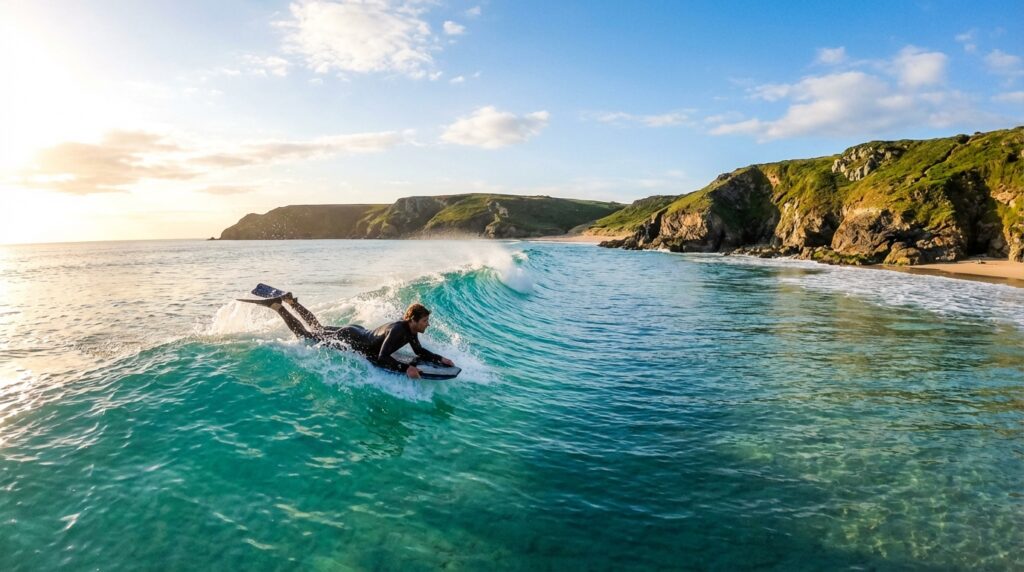
In short
- 🔥 Mastering paddling techniques reduces fatigue and increases the number of waves caught.
- 🦶 Well-fitted fins tailored to your body shape transform propulsion and safety.
- 🫁 Rhythmic breathing synchronizes endurance and the power of kicks.
- ⚙️ The body position on the board determines lift and trajectory.
- 🩹 Proper maintenance prevents equipment damage and extends lifespan up to three full seasons.
- ⚠️ Respecting priority rules and preparing the duck dive ensures a safe session even on a crowded beach break.
Understanding paddling biomechanics to optimize thrust
Effective paddling, the foundation of the bodyboard guide, relies on a perfectly synchronized muscle chain between the hip, knee, and ankle. The goal: convert every water kick into immediate acceleration without energy loss. In riders’ jargon, this is called “laminar impulse,” a steady flow generated by short, sharp kicks. To achieve this, the hip acts as the main joint while the rest of the lower limb follows in a controlled undulating motion.
Beginners often confuse paddling with breaststroke swimming. The latter involves lateral spreading incompatible with the stability sought on a board. Conversely, the bodyboarder uses a nearly vertical pattern to maintain the hull aligned with the wave axis. Studies by the Australian Surf Academy in 2026 show that a 30° opening angle between the leg and body axis offers the best power-to-energy expenditure ratio.
To perceive the difference, let’s compare two fictional practitioners: Nora adopts a wide paddling style, her center of gravity sways and she loses 15% drag speed; Malik limits water dispersion and gains half a second over the first three meters. These hundredths become crucial when catching a fast bowl.
Targeted muscle activation
Before entering the water, a dynamic warm-up focusing on hip flexors, soleus, and hamstrings prepares the muscle fibers. Series of “knee highs” followed by dry kicks on a mat help recreate aquatic cadence. Kinesiologists recommend six minutes duration: beyond that, pre-session fatigue risk increases.
Leg-board cohesion
Constant contact of the thighs against the back rails stabilizes the horizontal plane. A trick is to apply slight pressure on the board’s inner edge as the leg descends; buoyancy adds a micro-rebound that amplifies thrust, a phenomenon sometimes called hydrodynamic trampoline effect.
To go further in analysis, just film your exit with an onboard camera, slow down the video flow and observe bubble formation. The bubbles should follow a regular trail, indicating no parasitic vortices disturb the glide.
Choosing suitable fins: stiffness, length, and ergonomics
Propulsion starts at the shop. Between a symmetrical soft rubber model and a semi-rigid fin with asymmetrical blade, the feel changes radically. Three criteria stand out: size, stiffness, and shape. A blade length over 20 cm increases lift but requires more power from the quadriceps. Conversely, a short blade produces a high cadence, ideal for duck diving.
If uncertain, the comparison available via the bodyboard fin buying guide summarizes sizes, materials, and sensations reported by various riders. Feedback indicates that a Shore hardness between 55 and 65 provides the best endurance/acceleration balance.
| Build 🏄♂️ | Recommended fin length (cm) 📏 | Recommended stiffness 💪 |
|---|---|---|
| <60 kg | 16 – 18 | Semi-soft |
| 60 – 80 kg | 18 – 21 | Medium |
| >80 kg | 21 – 23 | Stiff |
😎 Gear tip: a 2 mm neoprene boot compensates for slight oversized feet and reduces 70% of chafing observed during user tests conducted in pools in 2026.
Experienced riders particularly favor V-rail asymmetrical fins. Their design channels water toward the central axis: a mean increase of 0.4 knots is noted over a 15-meter sprint.
To correctly put equipment on without delaying water entry, the step-by-step fin donning guide is a reference. Key order: wetsuit, leash, boots, fins, then strap check.
Body position and undulations: the role of the core in the glide
The body position directly influences water flow under the slick. Placing the chin above the board’s nose creates a slight tilt that reduces wetted surface; drag coefficient can then decrease by 12%. However, a chest too far forward compromises rear buoyancy, causing tail sinking and slowdown in the wave.
International coaches stress a simple visual cue: the imaginary line connecting the navel to the kick tail must remain parallel to the horizon. Hands grip the nose, elbows bent, ready to absorb compression when the wave lip hits the slick.
Synchronized undulations
The undulation starts in the lumbar region with a slight hollow then propagates along the quadriceps to the toes. The aim is to transform the body wave into extra thrust. IBSA tour bodyboarders have integrated this reflex into pool training; wind tunnel measurements show an 8% gain in top speed.
Practical exercise
- Place the board on a swiss ball 🤸♂️.
- Simulate kicks for 45 seconds.
- Maintain a metronome tempo at 60 bpm then accelerate to 90 bpm.
- Observe shoulder stability; they must remain still.
After four weeks, users report better control during bottom turns and reduced flexor cramps.
Building endurance: dry training, interval training, and recovery
Powerful paddling requires a mixed energy system. High-Intensity Interval Training (HIIT) improves VO2 and sprint repetition capacity. A popular protocol consists of chaining 8 × 20 seconds of explosive kicks followed by 10 seconds rest. Initially used by swimmers in 2026, it adapts perfectly to bodyboarding. Quads burn but benefits show when wave series lengthen.
To prolong the session, aerobic system should not be neglected. 30-minute elastics sessions with horizontal resistance simulate aquatic thrust without trauma. Active recovery, walking on wet sand or yoga, limits DOMS (Delayed Onset Muscle Soreness).
Nutrition and hydration
Sports coaches recommend 6 g/kg of carbohydrates distributed before and after the session. Branched-chain amino acids support muscle maintenance. For hydration, 150 ml every 15 minutes of effort maintain plasma homeostasis, a crucial point for cognitive performance during decision-making in a crowded line-up.
Paddling Cadence Calculator
Calculate your optimal paddling cadence by entering your weight (kg) and fin length (cm).
Result given in strokes per minute.
This estimate is based on a simplified model: cadence (cpm) = 70 × (weight / fin length).
It serves as a general indication; always adapt your rhythm to your physical condition and real conditions.
By coupling these parameters, the toolbox suggests a target cadence corresponding to 80% of theoretical maximum heart rate, considered as the “orange zone” by physical trainers.
Safety, priorities, and injury prevention
Speed without control can turn into danger. Before any water entry, reading the spot determines trajectories and impact zones. The priority code, analyzed in the article ideal wave height for bodyboarding, dictates that a rider positioned deeper inside the wave has right of way. Ignoring this principle triples collision risk, as highlighted in the European Federation incident report published in 2026.
Regarding protection, a lightweight Gath-type helmet adds less than 180 g and protects against rock/board contacts. Fins can cause cuts if not equipped with an ankle leash. Studies on Nazaré beaches show that 60% of fin losses occur in the impact zone during a wipeout.
Safety routine
- 🦺 Check the bodyboard leash and fin leashes.
- 🌊 Spot rip currents by observing darker water color.
- ⛑️ Always keep an eye on the peak to anticipate an upcoming set.
- 🩹 Carry a basic first aid kit in the car for minor cuts.
By adopting these reflexes, the rider reduces downtime and maximizes consistency in the water.
Advanced techniques: duck dive, late take-off, and relaunch after maneuvers
Getting past the break in strong conditions requires a flawless duck dive. The tutorial ultimate duck dive guide details the maneuver, but some key points deserve highlighting here. Penetration is done nose first, arms extended, one leg bent to push the board down, the other extending the thrust toward the bottom. The goal is to transfer the wave above the body, then rise in the laminar wake created by the turbulence.
Late take-off, essential on a hollow slab, requires a hip thrust synchronized with an explosive fin push. The trick: three short kicks just before the critical moment to press the hull against the slope and avoid “autolip.” Once launched, the rider can relaunch speed after each spin or roll by timing two close fin strokes, a practice called “double-kick reload” on the world tour.
For more, the step-by-step duck dive reveals a pool exercise consisting of chaining five duck dives over 25 meters, 30-second rest, repeated five times. By the fifth set, most riders reduce average depth by 40%, demonstrating improved efficiency.
Breathing, dynamic apnea, and aquatic stress management
Breathing control directly affects blood physiology. Practicing cardiac coherence before water entry lowers heart rate by up to 10 bpm. Underwater, the “air chase” technique involves gently exhaling during the duck dive descent, limiting buoyancy, then keeping residual oxygen for the ascent.
Bodyboarders training in dynamic apnea in pools increase their comfortable hold time by 25%, an advantage when an unexpected set holds them down longer. The “25 m glide - 25 m breaststroke” exercise repeated six times forms a solid base.
Anti-panic techniques
Mental visualization — replaying the maneuver in one’s head — reduces cortisol secretion. Guided meditation sessions, popular on mobile apps since 2026, help anchor calm routines. Combining these tools, the rider keeps cool even in a grumpy shorebreak.
Equipment maintenance, quick repairs, and durability
A properly maintained board offers consistent glide season after season. As soon as a crack appears, using a PU resin kit stops water infiltration. Repairs should be made within three hours of impact to avoid salt impregnation.
After each session, it is advised to rinse the board and fins with fresh water then place them in the shade. The slick, often made of Surlyn, poorly withstands long-term UV exposure. As for fins, manual stretching preserves rubber elasticity.
Post-session checklist
- 🚰 Complete fresh water rinse.
- 🪣 Check for scratches on the slick.
- 🔩 Inspect leash and fin straps.
- 🌬️ Dry in shade with natural ventilation.
Finally, store the board flat in a space below 25 °C to avoid deformation. For frequent travelers, a ventilated boardbag with high-density foam remains the best defense against careless handlers.
How to avoid cramps during a long session?
A mix of good hydration (150 ml every 15 minutes), specific calf warm-up, and fins with the right stiffness drastically reduces cramp risk.
What is the difference between symmetrical and asymmetrical fins?
Asymmetrical fins channel water better for prone practice, offering more instant power, while symmetrical models remain versatile for bodysurfing and swimming.
How often should you change your leash?
Visual inspection after each session is recommended; generally, replace the leash every six months or upon the appearance of cracks on the outer sheath to ensure safety.
Is it useful to wear a helmet in bodyboarding?
On rocky or crowded spots, a lightweight helmet effectively protects against impacts and does not affect performance thanks to its studied hydrodynamics.