
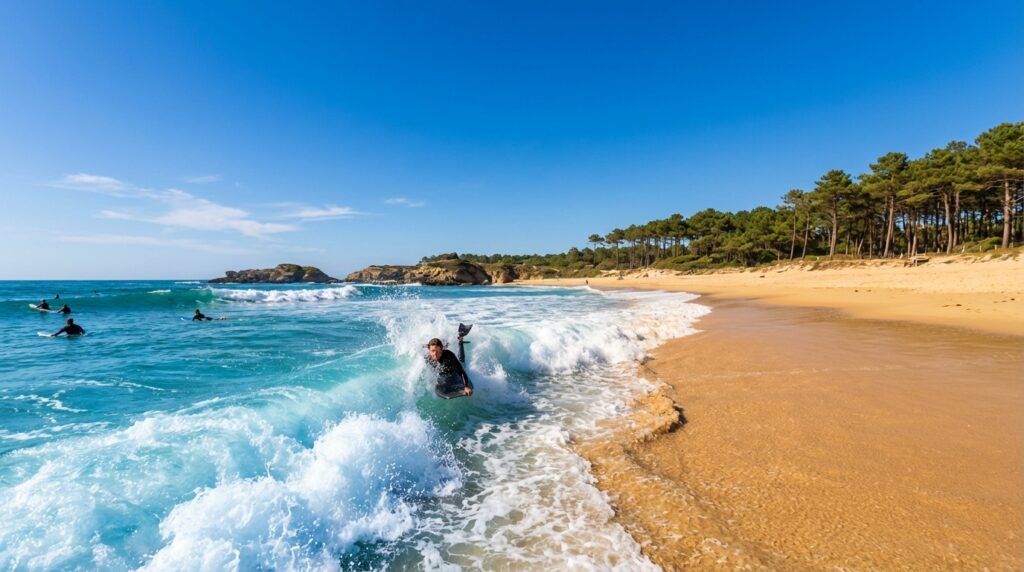
In brief :
- 🔍 Precise reading of the weather forecast before each session;
- 🌊 Selection of sandbanks and management of tides to harness the power of the waves;
- 🌡️ Checking the water temperature to adjust the wetsuit;
- 💨 Understanding wind direction to find the ideal conditions;
- 🛡️ Systematic application of safety and ecosystem respect rules;
- 🛠️ Optimization of the bodyboard equipment according to the rider’s size and level.
Mapping bodyboard spots in Gironde: coastal reading and strategic choice
The Gironde coastline stretches nearly 126 km, dotted with shifting sandbars and channels created by the Garonne current. This morphology creates varied peaks, ideal for adjusting the skill level. In the northern area, Soulac and Montalivet offer consistent waves, perfect for beginner riders: the regular beach break provides a gentle slope, often usable with one meter of swell and a period oscillating between eight and ten seconds. Further south, Carcans and Lacanau reveal typical tubular sections, supporting a more substantial swell thanks to a steep sandy bottom. At Lacanau, the peaks migrate almost daily; spotting the rip current exit at rising tide is an advantage for positioning at the peak without paddling against the current.
Dynamic observation of the shorebreak is a daily exercise. When the swell hits the outer sandbar at low tide, the wave splits: the first section, soft, acts as an accelerator; the second quickly hollows, offering the ideal ramp for an el rollo or an ARS. To estimate the day’s potential, it is enough to analyze the water coloration. Milky water indicates recently churned sand: the bar is moving, exit channels are unstable, and the lateral current is stronger. Conversely, a uniform and dark hue reflects a formed but orderly swell, synonymous with more predictable conditions.
An experienced rider completes their scouting with free webcams from municipalities, coupled with a preconfigured Windguru alert for 1.2 m swell and offshore wind under 15 knots. Thanks to these settings, they often anticipate the best time slots before the crowd. To go further, the article dedicated to the selection of bodyboard destinations offers useful comparisons to plan a surf trip outside Gironde.
Decoding forecasts: swell, period, and wave height for successful sessions
Seasoned bodyboarders know that a single value – height, period, or swell direction – is never sufficient. The interaction between these data shapes the real power. A one-meter swell with a seven-second period produces a gentle ripple, ideal for repeating take-offs or learning the bottom turn. Conversely, the same height coupled with fourteen seconds delivers energy equivalent to a short two-meter swell; the water moves faster and creates hollow waves.
Gironde mostly receives swells from the west and northwest. From 280° direction, the fetch extends up to Labrador and often generates long sets. The period then reaches fifteen seconds, turning Carcans into a true aquatic skatepark. Under these conditions, a 5-knot offshore wind is enough to “glass” the wave face and create the famous mirror effect, beloved by line-up photographers. The long swell + light offshore combination remains the supreme setup to line up tubes but requires impeccable reading: the rider must take off one meter earlier and press the rail before pivoting on the lip.
Recent applications integrate artificial intelligence to weigh these factors. The user sets their comfort range – height 0.5-1.2 m, period 9-12 s, max wind 15 km/h – and receives a push alert as soon as the algorithm detects alignment. This feature saves many unnecessary trips. To deepen the notion of ideal wave size, consult the special report on appropriate wave height.
Water temperature in Gironde: optimizing wetsuit and thermal comfort
The annual average ranges between 11 °C in winter and 22 °C at late summer. However, the upwelling phenomenon, frequent after a prolonged north wind, can drop the water temperature by 5 °C over a single night. An unprepared rider risks cramps and hypothermia within half an hour. The trick is to maintain a set of three suits: 5/4 mm full wetsuit for winter, 3/2 mm for mid-season, and 2 mm shorty in full summer. Experienced surfers often replace the 3/2 mm with a longer 4/3 mm, sacrificing freedom in exchange for unlimited water time on big spring swells.
Neoprene technology has evolved: limestone now replaces traditional petrochemical, reducing the carbon footprint. Internal graphene fibers amplify heat retention without thickening the foam. To test the heat/flex ratio, just put on the jacket dry and rotate the arms: if the seam under the armpit pulls, the suit lacks stretch. Fins also deserve special attention: a 3 mm neoprene bootie eliminates chafing and prevents cold foot sensation during early morning winter sessions.
Many practitioners consult thermal bulletins provided by Surfline in advance. A sudden drop in water temperature combined with an east wind intensifies wind chill. The number of calories burned rises; hence the importance of slipping a thermal hot drink into the bag. The sizing charts provided in the board size guide also explain the influence of neoprene on buoyancy.
Tides, rip currents, and sandbanks: mastering dynamics to stay at the peak
Atlantic tides display a range close to four meters at spring tide. At low tide, rip currents form: real basins where water rushes in then evacuates through a lateral channel during the rise. This outgoing current can exceed 3 knots. A clear-minded rider takes advantage of this flow to paddle back to the line-up without exhaustion, provided they know the exit axis. The sharp eye spots the smoother zone, tinted with a slightly different color. Once reaching the peak, one just needs to move away from the current’s angle to station in the waiting area.
Tide timing: Gironde offers a one- to two-hour slot before high tide when the shorebreak aligns perfectly on the sandbanks. The slope becomes steeper, and the wave throws at the right height to fit an ARS without fearing lip return on the neck. This slot varies from spot to spot: at Hourtin, the optimum is often thirty minutes before high tide; at Lacanau, a full hour.
The article on the best tide for bodyboarding details favorable coefficients. The principle sums up as: low coefficient = longer, rolling waves; high coefficient = fast peaks, more exposed banks, and hollower sections. For riders favoring aerial maneuvers, a coefficient above 80 combined with a light east wind represents the dream setup.
Wind influence: offshore, onshore, and side-shore in the quest for ideal conditions
The basic rule remains immutable: light offshore = smooth face and projected lip; strong onshore = choppy surface, unpredictable take-off. However, an onshore wind below six knots can create a micro-chop useful for rotational tricks, as the lip crumbles just enough to catch the board. Conversely, a steady side-shore stabilizes the wave on a section, allowing a longer run. Local competitions benefit from these thermal breezes to schedule heats in the afternoon; the salt rotation on the lips gives a very photogenic “refracted” aspect.
To anticipate, the method is to analyze wind evolution in three-hour slices. A northwest → east shift often signals the approach of a summer anticyclone. Forecasts then show a decrease from 20 km/h to 5 km/h in twelve hours: a perfect slot for early risers. The Windguru “star – wind drop” algorithm visually confirms the window, while the Cap-Ferret weather station transmits the max gust in real time, crucial to avoid drift during horizontal paddling.
In the quest for progress, the rider uses wind strength as an ally. A side-shore right gust gently pushes toward the peak: measured paddling keeps the angle in the bottom turn, opening the trajectory for a frontside 360°. Thanks to these adjustments, tricks gain amplitude without extra effort.
Bodyboard equipment: board, fins, leash, and maintenance for durability
The board-fins-leash triptych forms the basis of a high-performance quiver. The board must match the rider’s size: from shoulder to navel when placed vertically. A PP (polypropylene) core offers rigidity and responsiveness, ideal for summer; an EPS core provides buoyancy in cold water. Gironde, with its temperature ranging between 11 °C and 22 °C, often requires a hybrid core – PP with PE slick. The concave channels under the hull improve grip on the wave face and prevent drift in bottom turns.
Fins, for their part, are chosen according to leg power. Too soft a bootie limits thrust; too stiff, it causes cramps and tendinitis. Bi-density models solve this dilemma: a flex bootie of natural rubber and a reinforced composite blade. The biceps leash is a must for the Gironde shorebreak, as the wave often returns the board toward the body; fastening the attachment on the biceps, higher than the wrist, reduces elbow strain during wipeouts.
Equipment longevity partly depends on rinsing. Fresh water removes the highly hygroscopic salt that alters slick density. Drying in the shade avoids delamination. To know the average lifespan of a board, the technical focus on the bodyboard lifespan details the core’s flexion cycles.
| 🔧 Component | 🎯 Main function | 🚀 Estimated lifespan |
|---|---|---|
| PP board with HDPE slick | Rigidity and responsiveness in warm water | 2 to 3 years |
| Bi-density fins | Propulsion & maneuverability | 4 years |
| Biceps leash | Safety & recovery | 1 year |
Safety, ethics, and respect for the marine environment: pillars of the modern rider
Safety is the key to serene sessions. Bodyboarding presents a reduced risk compared to stand-up surfing, but impact with the lip remains potentially traumatic. The soft EVA foam helmet is gradually becoming the norm, especially among juniors; French competitions already require it in U14 categories since 2026. Gironde spots are patrolled by lifeguards from late June to early September; outside this period, the rider must paddle in pairs and check for a phone on the beach.
Line-up ethics: yielding priority to the first engaged avoids collisions. Many accidents occur when a second bodyboarder tries to catch a section already occupied. The color code can help beginners: on the same wave, two riders must never be on the same rail line; if one is ahead, the other steps back. Respecting the surf zone also avoids disturbing bathers, notably during peak summer hours.
Ocean protection: most plastic waste floats on the surface offshore before washing ashore. Picking up three pieces of trash per session reduces visible beach impact. Some local brands offer boards incorporating 25% recycled foam; an additional argument to combine performance with environmental consciousness. To understand the discipline’s heritage, a dive into bodyboarding history recalls the importance of the link between riding and nature.
Bodyboard Speed Calculator
Formula: v = (√(2·g·h·0.65) × 3.6) × (80 / weight)0.05 where g = 9.81 m/s².
Planning your sessions: checklist, apps, and dry training
The best rides start out of the water. A rigorous checklist guarantees a productive session. First step: consult three weather sources – MagicSeaweed, Windguru, and the municipal webcam – to cross-check information. Second step: prepare equipment according to water temperature and tide. Third step: ten-minute dynamic warm-up: squats, shoulder rotations, and simulated fin kicks. This routine limits strains and increases paddling cadence.
Mobile apps now offer personalized alerts: height × period × wind index. A score above 80% on the selected time window triggers a notification. Geolocation then proposes the fastest route considering roadworks on the D6 or traffic jams toward Lacanau. Local social networks, such as Gironde riders’ private Telegram groups, share real-time reports; just post a photo and time mention to receive feedback on swell consistency.
- ✅ Before leaving: water + cereal bars, appropriate wetsuit, high-temp wax, fitted fins 🔑
- 🌐 On the way: listen to a technical podcast on drop-knee, spot scouting via GPS 🗺️
- 💪 On the beach: warm-up, mental visualization, scouting rip currents 👀
- ⏳ After the session: stretching, equipment rinsing, tide calendar check for tomorrow 🗓️
For novices seeking a first purchase, the first board buying guide gathers morphological advice and budgets. Specific sizes, like 80 kg, can consult the focus on ideal size for 80 kg. Finally, for parents, the comparison on the board suitable for six-year-olds eases family choice.
What is the minimum swell to start bodyboarding in Gironde?
Half a meter of swell with a period of 8 to 10 s constitutes a comfortable threshold: the wave remains soft, speed gain is easy, and the risk of closing out is limited.
What wetsuit to wear in April?
In April, water temperature oscillates around 13-14 °C. A 4/3 mm full wetsuit, combined with a thermal top or windbreaker for windy times, ensures comfort and freedom of movement.
How to spot a dangerous rip current?
A water surface smoother than the rest and an outgoing current towards the sea indicate the presence of a rip current. Observing for 5 minutes from the beach allows identifying the channel before entering the water.
Should I prefer a wrist or biceps leash?
For the Gironde shorebreak, the biceps leash is preferred: it keeps the board closer to the body during wipeouts and reduces the risk of wrist twisting.
Is bodyboarding suitable for children?
Yes, from age 6 provided they can swim and use size-appropriate equipment: short board, soft fins, and warm wetsuit to maximize buoyancy and safety.