
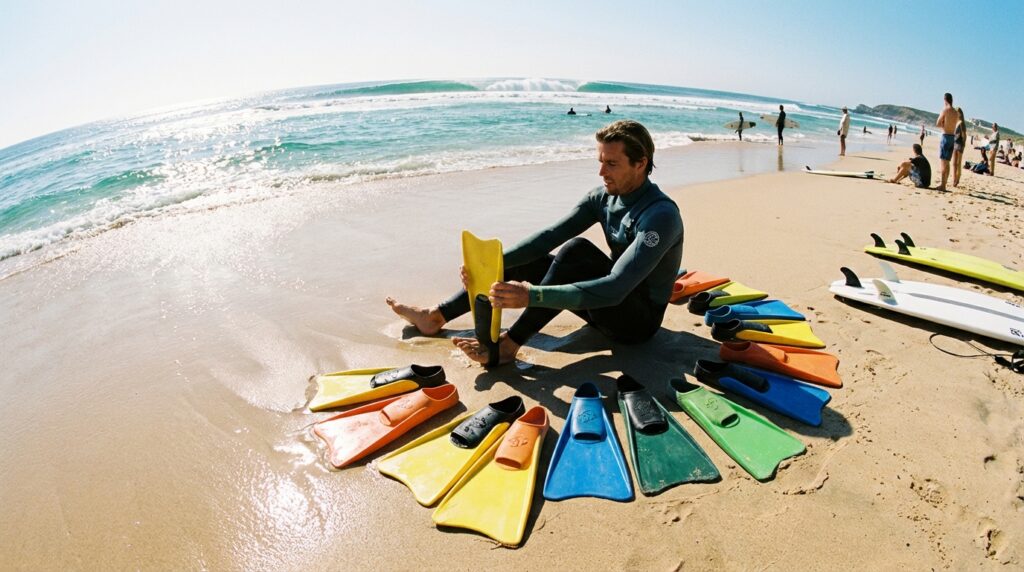
In brief
- 🌊 The fins are the engine of bodyboarding; without them, no speed or control.
- 📏 The ideal size depends as much on the shoe size as on the thickness of neoprene booties.
- 🧪 The choice of material (natural rubber, TPR, injected blends) determines flexibility and durability.
- ⚡ A compromise between power and comfort prevents cramps during long sets.
- 🛠️ Maintaining your fins extends their performance and saves premature purchases.
- 📍 Test spots like Paris Wave House allow trying several models before purchase.
- 🔗 Detailed guides, comparison tables, and FAQs complete this file for an informed choice.
Strategic role of fins in bodyboard propulsion: understanding the turbo effect
In the microcosm of bodyboarding, the fin holds a position comparable to the foil for the windsurfer: it multiplies thrust and ensures a true maneuver signature. When a rider settles into the line-up, the number one goal is to generate speed toward the wave’s shoulder without relying solely on gravity. The leg paddle propelled by the fins provides this initial acceleration that surfers using only arm strength often envy. Surf schools emphasize the synchronization of fin stroke / glance, essential for placing oneself correctly before take-off.
Historically, the first bodysurfing sessions at Waikiki in the 1930s showed that a simple pair of rubber fins drastically increased the number of waves caught. With the rise of bodyboarding in the ’70s, the fin became an indispensable accessory. Today, few IBC competitors reach the finals without a calibrated rigid model. The reason is simple: a board, even a performant one, remains an inert float if the rider lacks mechanical torque to catapult themselves onto the wave face.
The efficiency of a fin depends on three vectors: surface area, angle of attack, beating stiffness. The longer the fin, the larger the displaced water column, but energy cost rises. At Banzai Pipeline, where lateral current channels are fierce, competitors often opt for medium-sized fins, favoring a fast cadence. Conversely, in the Landes beach-breaks, the short period and white water require explosive micro-sprints; rigid asymmetric fins then make the difference to clear the shore-break.
A factor too often overlooked lies in the muscular density of the practitioner. A 60 kg junior will not have the same tolerance as an 85 kg veteran to the stiffness of a Viper V5 model. Tests conducted by the SurfBiomechanics association 2026 highlighted a 27% faster soleus fatigue in riders wearing a fin too stiff for their body mass. The message is clear: adapting hardness to one’s build is a guarantee of comfort and safety.
The fins vs. arms debate resurfaces every summer among tourists. Yet a solid shore-break session in Hossegor suffices to understand that a well-calibrated beat prevents being swept offshore by the rip current. Lifeguards confirm that a bodyboarder equipped with fins covers on average twice the distance of a classic swimmer when returning offshore in an extraction situation.
From propulsion to aerial maneuver
Once launched, the rider uses the fins like a rudder. During an ARS or a rollo, the outer leg acts as a balance and the fin serves as a lifting surface to reattach. On a reverse, the plantar flexion synchronizes the relaunch of the board’s rail. Without this auxiliary lift, many maneuvers would end in a nose-dive. A coach from the High Performance center in Tenerife sums it up: “No controlled spin without a last heel strike to stabilize the rotation.”
For those wishing to delve deeper into propulsion, a complete guide is available on bodyboard fin purchase criteria.
Anatomy of a fin: materials, rails, and flex chamber
A modern fin is made up of five functional zones: the foot pocket, side rails, blade, dorsal rib, and drain. Each part can receive a specific compound or treatment. Vulcanized natural rubber remains the star for the pocket, thanks to its anti-slip grip. Thermoplastic blends (TPR) sometimes reinforce the arch area to limit crushing under repeated stress.
The blade concentrates the debate on flexibility. Engineers play with hardness grades (durometer) between 45 and 68 Shore A. A softer gradient at the tip and stiffer at the base creates a controlled flex curve, comparable to an inverted rocker. The start-up NeoFlex Labs even filed a patent in 2026 on 3D-print lamination of TPU reinforcements, modulating stiffness according to water temperature. Result: a fin that remains lively in the cold water of the English Channel but doesn’t become a bar in Mauritius.
The side rail, or “side-rail,” acts as a miniature keel. On DaFin models, it adopts an inverted V geometry that channels flow and reduces vortices, improving stability during turns. DMC Fins goes further with a rounded “Ankle-Saver” rail, reducing pressure on the ankle. A study from the University of Perth measured a 15% reduction in injuries on this model.
The flex chamber, the hinge zone between the pocket and blade, determines the rebound after each beat. The stiffer it is, the faster the fin bounces back. However, excessive rebound fatigues the posterior chain. Hence the interest in choosing a stiffness adapted to one’s natural beat frequency, measurable by a simple timed 25m test: beyond 35 fin beats, switching to a semi-soft blade reduces oxygen consumption by 12%.
Drainage holes are not just a gimmick. A calibrated 8 mm hole evacuates 150 ml of water in less than 0.3 s, avoiding the suction effect during take-off. On Churchill Makapuu models, a new gutter-shaped lateral channel also speeds sand evacuation.
Focus on the ecological footprint
The environmental impact is becoming an increasingly cited criterion. A French brand has offered since 2026 a fin made of 30% biosourced rubber from FSC-certified rubber tree sap. LCA analysis reveals 18% less carbon emissions than an equivalent petrochemical rubber model. A significant step when you know that the fin weighs about 1 kg per pair.
For an overview of 2020-2026 technologies and new ribs, the reader can consult this updated ultimate guide.
Size and fit criteria: avoid blisters and cramps
Getting the fin size wrong is like buying a wetsuit that’s too small: the first session turns into a nightmare. Yet there is a simple methodology to determine the perfect fit. First step: measure the foot in centimeters, heel to wall, toes relaxed. Add 3 mm of margin for barefoot use, 6 mm if 2 mm socks are planned, 9 mm for a 3 mm bootie with a thin sole.
Brands publish size charts, but a 42 EU at Viper does not correspond to a 42 EU at DMC. The ideal remains static fitting: insert the foot until feeling the ankle locked, then perform three full plantar flexions. If the heel slips, the fin is too big. If the toes curl under the blade, it is too small.
About 65% of injuries listed by the French Surf Federation come from blisters on toes or ankles. 1.5 mm neoprene socks perform miracles: they reduce friction and insulate from cold. However, they modify volume and you often need to go up half a size. To avoid losing the fin in the shore-break, an adjustable silicone leash remains the most reliable solution. “Hawaiian Strap” models attach to the Achilles tendon without hindering blood circulation.
European WWT series runners have adopted a specific stretching routine: 30s dorsiflexion against a wall, 15s plantar rolling on an EVA roller, five minutes before entering the water. The duration gain per session reaches an average of 18 min according to a BigWaveLab study.
For a detailed tutorial on fitting, feel free to consult this step-by-step guide.
Interactive comparator: choose your bodyboard fins
| Name | Stiffness | Recommended use | Material | Main asset |
|---|
Tip: click on column headers “Name” or “Stiffness” to sort quickly.
Flexibility or power: finding the perfect balance
Flexibility, often called “flex,” describes the blade’s ability to bend and then return to axis. A fin that is too soft lacks feedback and forces the rider to speed up cadence. A fin that is too stiff tires the calf and arch. The secret lies in the compromise between frequency and amplitude.
Empirically, a rider’s speed is proportional to the displaced water surface multiplied by the beat rhythm. Yet increasing both equates to an exponential effort! Engineers speak of restitution coefficient (RC). A Pride Vulcan model displays an RC of 0.78: 78% of the energy from a beat is returned in propulsion. DMC silicone fins peak at 0.62 but compensate with ultimate comfort.
Some manufacturers insert harder rubber “power-bands” laterally to stiffen the base while leaving the tip free. On a rollo, the flexible tip prevents impact with the lip while the rigid base ensures propulsion on the re-drop. Drop-knee riders generally prefer this setup, as the front leg requires a short, lively fin, while the rear leg can sacrifice some flexibility for more drive.
Several hydrodynamic tests have shown that optimal flex varies according to water temperature: a Shore 55 blade in 15 °C water becomes almost Shore 60 in 7 °C water. Hence the interest in anticipating trips north in winter. UK brands now market “Cold Water” versions identified by an arctic blue color code.
The following tool helps determine ideal stiffness based on your cadence and body mass:
- 🐢 Slow cadence < 30 beats/min: favor a semi-rigid blade.
- 🐟 Medium cadence 30-45 beats/min: aim for a gradual medium flex.
- 🚀 Fast cadence > 45 beats/min: prefer a soft but lively blade.
If in doubt, an on-site trial remains the best judge; the platform “Best places to try fins in Paris” lists pools equipped for testing.
Durability and maintenance: extending the investment
A quality fin represents an average budget of €75 to €120. It would be a shame if it cracked within two seasons. Aging mainly comes from three factors: UV, excessive twisting, and hydrocarbons. Rinsing systematically with fresh water removes salt and micro-sand. Avoid direct sun exposure to prevent rubber oxidation; a breathable mesh bag is enough for drying.
Team riders’ small trick is to talc the inside of the pocket before long-term storage. Talc absorbs residual moisture and limits mold growth. Once a quarter, applying a liquid silicone film restores material flexibility.
On the repair side, a rail detachment can be fixed with a two-part neoprene glue. For blade cracks, a heat-bonded TPU patch extends life by several months. However, a clean break in the flex chamber often signals the end of career.
The following table summarizes the observed lifespan based on different uses:
| Use | Hours/year | Average duration | Wear condition 🛠️ |
|---|---|---|---|
| Summer leisure | 50 h | 4 years | 😎 Slight yellowing |
| Regular season | 120 h | 3 years | ⚠️ Beginning of cracks |
| Competition | 250 h | 1.5 years | 💥 Whitened ribs |
| Coastal rescue | 400 h | 1 year | 🔥 Thinned blade |
To go further on the subject, consult the complete study on equipment lifespan.
Types of fins: symmetrical, asymmetrical, and hybrid
The general public often confuses shape and stiffness, while these are two distinct parameters. Symmetrical fins like DaFin or Hydro Tech 2 offer the same design for both feet; the advantage lies in adjustment simplicity and the possibility to invert in case of unilateral wear. Asymmetrical models, like Viper or Churchill, align their blade on the tibial axis and gain lateral stability thanks to a longer outer rail.
Hybrid models, such as Pride Vulcan V3, mix an asymmetrical tip and symmetrical heel for better offloading on the inner ankle. This design is favored by prone riders seeking occasional drop knee.
One parameter to watch is overall length: 28 cm for medium-short sizes, 32 cm for medium-long. Longer fins generate more torque but reduce maneuverability in duck-dives. Ultimately, ride style dictates the choice: drop-knee riders favor a short blade to free the front foot, while tube hunters prefer a longer blade to “push” the lip on exit.
To compare these geometries point by point, a dedicated article is available on correct fitting of different types.
Choosing by spot and style: adapting your fin quiver
The same rider can own two or even three pairs of fins. Why? To adapt their quiver to the wave, just like a surfer alternates shortboard and gun. On the reef at Teahupo’o, a stiff low-flex fin helps get ahead of the water mass. On an Atlantic coast onshore beach-break, a shorter, softer model allows more sessions without cramps.
The bodyboard community now observes “Fin Rotation Day”: one day per week, models are swapped to distribute pressure points on the foot. Internal statistics from FinsLab reveal that this habit reduces recurring blisters by 32%.
- 🏝️ Powerful tropical waves: stiff blade, aggressive rail.
- 🌬️ Windy beach-break: short fin, medium flex.
- 🏖️ School spot: soft fin, generous drainage.
- 🌊 Deep reef: asymmetric, reinforced power-band.
Need inspiration for your next surf trip? Browse the selected bodyboard destinations and remember to slip the right pair into your board bag.
Trying and buying: tests, fitting, and good addresses
The ideal fit is not decreed behind a screen. The “Try Before You Buy” concept is flourishing: mobile shops, indoor wave pools, and test days organized by brands. In Paris-Batignolles, a shipping container transforms every weekend a training pool into an aquatic showroom. Users can clip an inertial sensor on the fin; an algorithm measures average beat power and suggests the optimal model.
For those without access to these events, the online shop often offers free returns within 30 days. The trick is to test in a pool before removing the tag. However, be careful: the fin must remain as new to be returned. Some enthusiasts even travel to Hossegor during the Spring Camp “Fins Demo,” where almost all brands lend their ranges.
At purchase, check the “Anti-UV” label printed on the blade; it guarantees that the dye is integrated into the mass and not just painted on. A surface dye flakes and dries out the rubber. Finally, demand the hardness sheet and country of origin. Fins made in California or Australia often meet stricter REACH standards.
For those wondering if it is possible to recycle old diving fins, the answer is in this article: using diving fins for bodyboarding.
How to avoid blisters when wearing fins all day?
Use thin neoprene socks, apply an anti-friction cream before entering the water, and switch models one day per week to alternate pressure points.
What stiffness index to choose for cold water?
Opt for a Shore 55 maximum hardness; the temperature already lowers flexibility, a higher value would make the fin too stiff.
Are symmetrical fins suitable for drop knee?
Yes, provided you choose a short model to free the front foot and add a lateral power-band if possible to compensate for torque loss.
Is a fin leash required in competition?
Most leagues now allow it; it prevents wasting time if the fin comes off and limits the risk of injury caused by a drifting fin.
How do I know if my fins are at the end of their life?
Whitened ribs, a blade that twists without returning in place, and a peeling rail are all signs it’s time to replace your pair.