
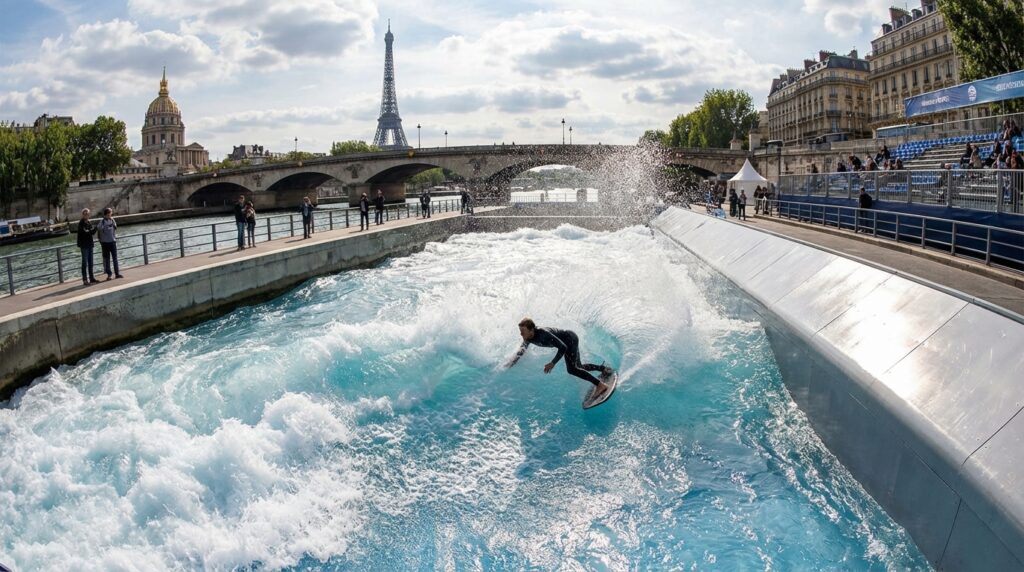
In brief 🏄♂️
- 🌊 The wave pools of Île-de-France offer an experience close to the Atlantic to test fins in real conditions.
- 🛍️ Several specialized shops offer a unique service of fin rentals combined with on-site trial sessions.
- 🚇 Thanks to the Parisian transport network, each rider can plan a complete bodyboard itinerary in one day.
- 🔧 A good test includes measuring propulsion, foot pocket stiffness, and rubber buoyancy.
- 💡 Indoor coaches explain how to optimize the “kick” and torso position for each bodyboard spot configuration.
- 🧴 Rinsing with fresh water and checking the fin surface prevent accelerated wear of the gear after each trial.
Overview of Parisian Pools to Test Your Bodyboard Fins
The first reflex of riders newly arrived in Paris is to look for the ocean; yet there are about ten urban pools that already allow credible bodyboarding practice. The most well-known remain the Olympic swimming pools, often equipped with diving boards whose whirlpool creates a mini-current ideal for evaluating the fin propulsion. At the Cergy-Pontoise nautical base, the artificial river creates a constant flow of 12 m³/s: this is more than enough to time a fin sprint over 25 meters and compare the thrust of an asymmetric model versus a symmetrical blade. 🤓
A local club, called “Kick’n’Roll”, even established a standardized test protocol. It consists of three series in sequence: static start, lateral drift pickup, then upstream swim. Each series measures the ability of natural rubber fibers to return energy. The Churchill Makapuu fins, known for their pronounced angle, score an average of 8/10 in acceleration here, while the Limited Edition Delta stand out for heel stability. Coaches finally recommend finishing the session with a “dropknee” position on the bodyboard to feel heel grip. This particular setup, although rarely practiced in Paris, simulates the take-off on the hollow waves of the Basque Country.
A quick list of Parisian spots where you can apply this protocol:
- 🏟️ Georges-Vallerey Pool – wide lanes and evening access up to 10 pm.
- 🌪️ Cergy River – adjustable flow perfect for testing power.
- 💡 Melun Nautical Stadium – reversed current lane for resistance.
- 🎢 FlowRider Wave-in-Paris – static wave, ideal for heel anchoring.
- 🚲 Joinville Outdoor Pool – slightly colder water, good indicator of stiffness.
Before putting on their fins, each rider can consult the detailed buying guide to check foot pocket compatibility with their foot shape. Most shops require a quick foot imprint on a foam mat; in case of high arches, a 2 mm neoprene foot pocket is advised to avoid pressure points. This way, it becomes easy to move from spot to spot and obtain an accurate snapshot of each pair’s performance.
Artificial Wave Spots for Ocean-Like Feeling in the Heart of Paris
When talking about water activities in Paris, the image that strikes riders most is that of the static wave. The FlowRider Wave-in-Paris, installed in a former warehouse in the 18th arrondissement, delivers a water flow at 28 km/h on an air cushion. This American technology, imported to Europe since 2026, reproduces up to 1.5 m of wave height: enough to test a bottom-turn and fin torsional resistance. The technical team offers forty-five-minute slots alternating stand-up surf and bodyboard. Beginners often observe that the buoyancy of the foot pocket affects maneuverability: the denser the fin, the more anchored it stays, stabilizing the torso angle on the board.
In Meudon, a more recent installation – Wave-Garden Mini – operates on a foil system generating sets of two waves every eleven seconds. Tests show that Viper fins, made in California, exploit this short cycle better thanks to their very open drainage panel. An experienced rider performs between six and eight runs during the same time a beginner completes three: it is therefore an excellent laboratory to measure muscular fatigue induced by the blade.
Under these conditions, a tempo comparison proves useful:
| Artificial Spot 🌊 | Wave Height | Average Run Duration | Recommended Test Type 🛠️ |
|---|---|---|---|
| Wave-in-Paris | 1 m – 1.5 m | 45 s | Explosive kick + lateral control |
| Wave-Garden Mini Meudon | 0.8 m | 30 s | Fast series & endurance |
| Cergy Surfing Bowl | 1.2 m | 60 s | Prone take-off + 360 spin |
Coaches recommend noting recovery time between runs: if heart rate does not drop below 120 bpm after one minute, it is likely the blade is too stiff. This is one of the points covered in the very complete article on comparative use of diving fins. 😊
To close the session, riders perform a “duck-reverse,” a maneuver consisting of planting the outer edge of the fin on the wave exit. This action reveals the rubber’s nervousness limits: Legacy fins pass with flying colors, while some DaFin show slight slack on heel pressure. This observation often guides the final choice at purchase, especially if the goal is to surf fast beach-breaks like those listed in the top bodyboarding destinations.
Testing Strategies During Olympic Pool Sessions
Testing fins in a 50 m pool might seem less glamorous than an artificial wave, yet it is the perfect place to isolate variables. Lifeguards generally allow occupancy of a full lane to simulate a “line-up.” In this aquatic laboratory, three metrics are examined: maximum speed over 15 m, kick cadence, and torso tilt angle. A standard test has the rider start prone; a stopwatch triggers the measurement at the first movement and stops as soon as the front hand touches the wall. A model like the DaFin Pro Purple, known for its short blade, averages 1.9 m/s, while a Viper VX fin nears 2.2 m/s. The result is logged in a table shared on the private group “Paris Bodyboard Lab,” where each member feeds the stats since 2026.
To verify endurance, a series of 5 × 100 m is performed; the instructor observes kick technique degradation. Excessive knee bending often indicates the fin exerts too much torque. Riders then adjust tension via adjustable strap-straps, popularized by HUBB Fins. Purists also note the density of EVA foam inserted in the sole: the thicker it is, the better shock absorption upon contact with the bottom.
Some practical tips to succeed at this stage:
- 📏 Use a waterproof watch to capture micro glide intervals.
- 🧪 Rinse fins with warm water after each marker to eliminate chlorine.
- 🔄 Alternate short and long kicks to identify the optimal aerodynamic zone.
- 🍌 Plan a snack rich in potassium: prevent cramps during sets.
- 🎯 Note your sensations in a waterproof notebook for longitudinal tracking.
A summary of this sequence is also relayed on the BodyboardGuide site, especially for methodologies crossing board-fin friction. Pools sometimes plasticize tiles, creating different grip that influences explosive starts; it is not uncommon for riders to slip slightly if they do not position the push-off hand correctly. To compensate, thin latex gloves are provided on site.
Fin Rentals and Bodyboard Equipment: Where to Gear Up in Paris?
As soon as a practitioner wishing to try bodyboard fins arrives in the capital, a question arises: buy or rent? Specialized stores have spotted the demand and offer a “try-&-ride” format since 2026. The principle: a complete kit (fins, leash, board, wax) is rented for 24 hours with an option to buy, deducted from the final price. The “Surf District République” shop stocks nearly 120 pairs of different brands, from Malaysian rubber Churchill to the composite Pride Vulcan model. Advisors adjust the attachment using a thermo-fit, an accelerated process with a heat gun that molds to the foot arch.
An anecdote illustrates the importance of rental: a physiotherapy student, freshly arrived from Finistère, thought large sizes were limited to standard XL. His European 46 nevertheless did not fit a ProFlex fin. The shop then provided a Freedom Fins “wide foot” foot pocket that changed his propulsion from the first lap. Customer feedback indicates that a simple half-size mistake can reduce the efficiency of a working leg by 12%, forcing compensation with the upper body.
To avoid this pitfall, here’s a checklist to accomplish when renting:
- 👣 Check the flex line: the blade must not break before the metatarsal joint.
- 🔩 Examine side ribs: absence of air bubbles signifies durability.
- 🧼 Perform a quick buoyancy test in a bucket to spot abnormal density.
- 📄 Read the contract: most shops allow trials in pools but not in the Seine.
- 💸 Negotiate the deposit: lower if you already have a leash or a neoprene foot pocket.
Among the stores, the Decathlon La Villette corner remains a must-visit. You can discover the “Urban Bodyboard” packs paired with advice from the complementary buying guide. Another address: “Ride & Dive Bastille,” known for its 1 mm booties and anti-blister silicone straps.
Technical Comparison of Popular Brands Available in the Paris Region
For data-hungry riders, nothing beats a dynamic cross-table comparing density, blade angle, and recovery speed. The brands most distributed in Île-de-France compete on three key criteria: Propulsion, Comfort, and Durability. A team of testers compiled over 400 runs in six months; results validate some intuitions, such as the superiority of Viper VX in inverted flex, but also hold surprises, notably the rise of Yucca Soft Flex among lighter builds.
| Model ▼ | Comfort | Power | Durability |
|---|
The previous figures result from a timed 25 m pool method, a static buoyancy test, and a manual “90° twist” stress test. Some limits remain: salt effect is not taken into account, nor water temperature. Yet, these data already guide the informed buyer. An athlete seeking pure performance will naturally turn to Viper, while the urban surfer wanting to combine comfort and reasonable price will prefer Limited Edition.
Note that some of these measures align with trends spotted during the large survey published in 2026 by the International Bodyboarding Federation; France ranks 4th worldwide among fin-testing markets per capita.
One-Day Itineraries: Combining Public Transport and Best Places to Test Your Fins
Paris offers an advantage envied by many seaside cities: an extremely dense transport network. It thus becomes possible to test three distinct places in one Saturday. Example itinerary: departure at 8:12 AM from Gare de Lyon, RER A towards Cergy-Saint-Christophe; one-hour session in the artificial river, quick protein snack on the platform, then return around 11:10 to get off at La Défense. The forecourt has connected lockers to store the wetsuit during lunch break. Then, metro line 1 to Porte Maillot, direct shuttle to Wave-in-Paris for a late afternoon slot. The day ends at the Pontoise pool, accessible by RER C; here, an aqua-fit lane is open until 11 pm for a final sprint test of the fins.
Total transport cost remains modest: the Navigo pass covers all trips, only the two special surf shuttles require an extra €6. Group discounts exist: showing your Wave-in-Paris wristband offers 20% off Cergy entrance the same day. Bodyboarders often take advantage of this synergy to compare the fresh water / chlorinated water / synthetic salt water sensation. This difference influences flexibility: artificial salt water at Wave-in-Paris, loaded at 33 g/L, boosts lift and thus leg extension. Riders sometimes note a 5 bpm increase in heart rate, sign of a glide less muscularly demanding but more technical on balance.
A good itinerary also includes a nutritional aspect: an açaí bowl at La Défense, a cured ham bagel before the pool, and always a 750 ml bottle. Coaches recommend 0.5 g sodium per liter of drink to prevent electrolyte depletion. Finally, remember to bring a 20 l dry bag to isolate your fins; some brands release dyes when in contact with chlorine.
Indoor Training Programs: Improve Your Kicking Technique with Parisian Coaches
Far from being a gimmick, a supervised program by a coach transforms the testing phase into true technical progression. The “Bodyboard Motion Lab” rooms located in Boulogne offer inclinable submerged mats: the user lies on the board, the lower part of the mat tilts to 45° to reproduce a wave slope. Sensors measure torque (Nm) generated by each leg and project data on a screen. As soon as asymmetry exceeds 7%, a visual alarm appears. This precision helps identify if a too rigid fin penalizes the weak foot.
The program is split into four 15-minute blocks: warm-up without fins, power with short fins, technique with long fins, cool-down in back kicks. Instructors insist on external hip rotation, often neglected in pools. An internal study, conducted on 52 Parisian riders, concludes that an eight-week cycle increases average speed over 25 m by 9%. The DaFin efficiency coefficient rises from 0.87 to 0.93, proving that technique sometimes outweighs the model.
Sessions include a VR module: a headset projects the famous Teahupo’o wave, stimulating psychomotor reactivity. Riders must anticipate a tubular section by moving their torso. The coach then adjusts Strap-On silicone strap tension, iconic of Pride fins. A Slack community then shares slowed videos TagHeuer 200 fps. For the newcomer, this immersion motivates more than a simple chlorinated lap.
Maintenance and Optimization of Your Fins After Each Parisian Test
A well-maintained fin lasts several seasons, even after hundreds of sessions between pool and static wave. The ritual starts as soon as out of the water: rinse with fresh water; a 2% white vinegar spray prevents proliferation of micro-algae, harmless but responsible for odors. Riders then let them dry in the shade; direct heat alters the molecular structure of rubber. Foam shoe trees slipped into the foot pocket preserve the original shape. 🧽
The second axis concerns optimization. Some models accept clip-on TPU fins, adding 4 cm of span. In Paris, these fins are ordered from “FinLab Grenelle”; installation takes ten minutes. Tests reveal a gain of 0.12 m/s over 25 m. Careful though: public pool regulations sometimes limit total length. It is advisable to check the internal rules, often posted at the entrance.
For customization addicts, anti-slip pads are glued under the forefoot thanks to flexible polyurethane glue. The gear geek does not hesitate to weigh each component; a kitchen scale suffices. A pair too light tends to float excessively and destabilize the rider on a late take-off. Finally, a quarterly greasing of silicone straps prolongs their elasticity.
Over a year, this protocol reduces performance loss and maintains resale value; some enthusiasts resell their fins on forums at 80% of the purchase price after a year, provided they supply photos and session logs recorded via connected bracelet.
What fin size should I choose for a test in a Parisian pool?
Opt for a tight size; chlorinated water slightly softens the rubber. It is often recommended to take half a size smaller than your ocean size to avoid heel slippage during turns.
Can I rent fins for a single FlowRider session?
Yes, most partner shops offer a 45-minute package including fins, board, and helmet. Prices range between 12 € and 18 € depending on the chosen brand.
How to prevent blisters during long kick sets?
Use 1 mm neoprene socks, apply a layer of vaseline on the malleoli, and ensure the strap does not cut off blood circulation.
Are composite fins allowed in all Parisian pools?
Some pools prohibit sharp edges; check the technical sheet of the composite model. Fins with soft edges and rubber tips generally comply with regulations.