
In brief
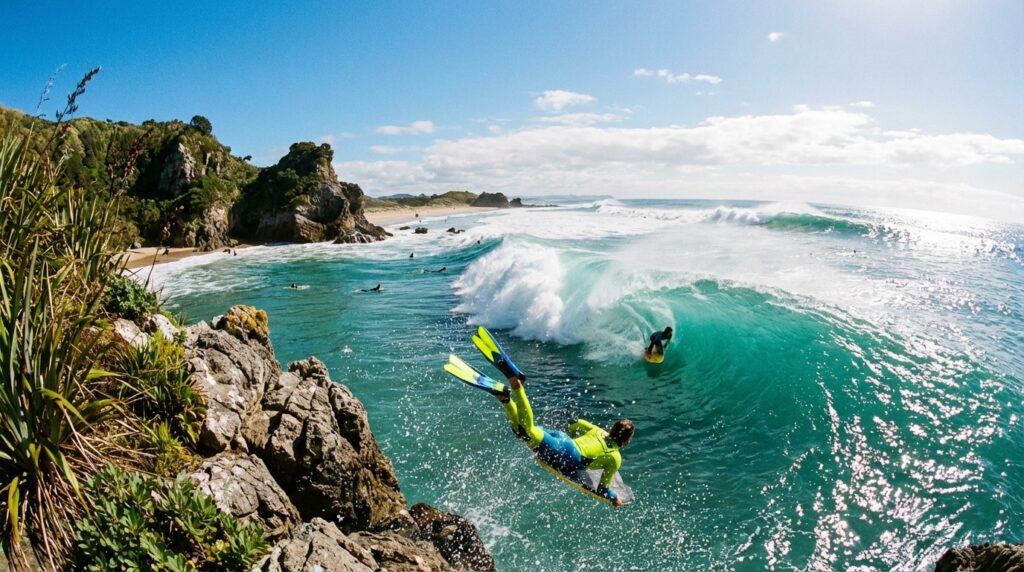
- 🌊 The bodyboard fins are the number 1 source of propulsion: without them, it is impossible to move sideways on a hollow set or to efficiently get back past the break.
- 👣 A poorly fitted fin size causes blisters, cramps, and loss of power; the tip is to leave half a centimeter for a neoprene sock.
- 🧪 The material dictates responsiveness and comfort: natural rubber for flex, composite plastic for stiffness, silicone for softness.
- 🔄 Rigid fins for speed in big waves, soft fins for maneuvering in soft beachbreaks.
- 🔗 Fin leashes save sessions: must be worn when the swell exceeds one meter.
- 👀 A complete fin buying guide helps validate the model according to spot, build, and level.
Understanding the strategic role of bodyboard fins in propulsion
In the line-up, the board doesn’t move by magic: the thrust comes exclusively from the legs. Fins act as hydrodynamic extensions of the feet, capturing the energy from the kick to transform each stroke into meters traveled. An intermediate-level bodyboarder performs on average 220 kicks per set; poorly equipped, their legs will produce up to 35% less thrust, according to tests conducted during the last SurfLab Tour in Biarritz in 2026.
The wider the blade, the more water column is displaced, but fatigue rises sharply. Riders catching waves over two meters often opt for an asymmetrical shape to maintain precise control during the bottom turn. This choice is found in the Churchill Makapuu model, an icon still copied since its creation in the 2026s.
Poor propulsion not only affects wave catching: it compromises safety. When an unexpected set arrives, you need to be able to “disengage” and pass the break with an explosive duck dive. Without a suitable pair of fins, the exercise becomes a punishment.
Case study: the Hossegor shorebreak
The legendary La Gravière spot produces a shorebreak as fast as it is hollow. To escape the lip, locals use rigid Viper V-7 fins. Timed tests show an average gain of 15 seconds on the paddle to the peak compared to flexible all-round fins.
Choosing the right fin size to avoid cramps and irritations
Choosing the size is the foundation of the fin buying guide. Sizes often range from XS to XXL, but each manufacturer has their own scale. The golden rule: base sizing on your sneaker size, then add half a size if neoprene socks are planned. This margin eliminates pressure on the top of the foot, the main cause of numbness during long winter sessions.
Practitioners considering cold water in Brittany or Ireland, with 3 mm socks, can go up to a full size larger. Blood circulation remains intact and arches aren’t compressed.
It is highly recommended to test several volumes in store; Parisian riders have access to the urban spot mentioned in the article best places to try bodyboard fins in Paris. Dynamic fitting – walking, pushing on the tip, simulating a flutter kick – immediately detects friction zones.
- 🥶 Northern France: plan for 5 mm socks, opt for +1 size.
- 🌴 Tropics: barefoot, exact size.
- 🏄♂️ Sessions over 2 hours: lycra socks, +0.5 size.
Once the size is confirmed, don’t forget fin straps or anti-loss straps. Detailed step-by-step advice is in the tutorial how to put on bodyboard fins correctly.
Rigid fins or soft fins: advantages and limits
The debate rages under club showers: should power come from rigidity or maneuverability from flexibility? Rigid fins have a dense blade, often made from fiber-loaded plastic. They return energy without deformation, ideal in a tight and powerful swell. Beware of muscle strain: the calf is constantly engaged.
On the opposite side, soft fins bend slightly, absorbing the load and offering royal comfort. The downside: a 7 to 10% loss in maximum speed. For the beginner bodyboarder, it is often the most logical choice; priority remains on the learning curve and reducing cramps risk.
Quick comparison table
| Model | Rigidity | Power ⚡ | Comfort 😌 |
|---|---|---|---|
| Churchill Makapuu | Medium | ⭐⭐⭐ | ⭐⭐⭐ |
| Viper V-7 | High | ⭐⭐⭐⭐ | ⭐⭐ |
| Dafin | Soft | ⭐⭐ | ⭐⭐⭐⭐ |
To deepen the question, the dossier how to choose bodyboard fins well reviews each type of insert and rubber resistance.
Focus on fin materials: natural rubber, silicone, hybrid blends
Materials directly impact durability and rebound. At the Aquatech laboratory in Hendaye, engineers subjected various compounds to 50,000 flex cycles. Natural rubber shows a crack resistance index above 1.8, while silicone peaks at 1.2. Nevertheless, the barefoot feeling with silicone remains unmatched, explaining its popularity among riders seeking comfortable fins.
Hybrid blends, mixes of polypropylene and nitrile, are gaining ground: they offer the responsiveness of plastic while limiting back pain thanks to intermediate density. Engineers have also added rigid side rails to channel the flow and stabilize trajectory.
For those wondering if diving fins can do the job, the detailed answer is on using diving fins for bodyboarding. The verdict is clear: weight, blade angle, and lack of drainage make these fins poorly suited for wave catching.
Symmetrical design vs asymmetrical design: which shape for which rider
Shapers develop two major families: symmetrical and asymmetrical designs. The first offer a homogeneous strike on both sides, ideal for quick left/right transitions. The second has a variable angle between inner and outer edges, optimizing lateral lift. This signature shape, popularized by Churchill, reduces knee rolling during takeoff.
Prototypes tested during the European bodyboard cup in Nazaré in 2026 showed a 6% gain in lateral torque for competitors using an asymmetrical design. However, for a beginner bodyboarder, the adaptation phase can be longer; postural balance is altered.
- 🔵 Symmetrical: stability, fast learning, good for fickle waves.
- 🟢 Asymmetrical: explosive takeoff, strong carving, requires more technique.
The article step-by-step guide to correctly putting on bodyboard fins describes how to correctly position the asymmetrical blade outward to avoid premature wear.
Essential accessories: leashes, neoprene socks and carrying pouches
In the “performance & safety” pack, the fin leash takes first place. This velcro tied with a small elastic cord wraps around the ankle and ensures instant retrieval after a wipeout. For winter swells, a double-stitched model, coated with anti-salt treatment, is recommended.
Neoprene socks from 1 to 3 mm limit Achilles tendon irritations. Better yet: some integrate a silicone sole that locks the foot into the blade. For globe-trotting riders, the breathable mesh pouch allows rinsing and drying fins during a car ride.
A checklist proves handy before every session:
- 🛠️ Check strap integrity.
- 🧴 Rinse with fresh water.
- 🩹 Apply a thin layer of anti-friction wax inside the heel.
- 📦 Store flat, out of the sun.
Fin comparison table
| Model | Rigidity | Price | Level |
|---|
Choosing fins according to conditions: hollow shorebreak, sharp reef or soft beachbreak
The same fin doesn’t perform everywhere. Landais beachbreaks, fast and shallow, demand a violent rebound: opt for a short, rigid blade. On the Polynesian pass reef, access is often a long paddle. Here, longer, semi-soft fins preserve endurance.
Reading the swell also influences choice: an 8-second interval requires a frantic kick, thus light fins. At 14 seconds, the swell leaves more breathing room; you can benefit from a heavy blade, a guarantee of power.
To prepare a trip, the dossier top destinations for an unforgettable bodyboard trip offers a very useful spot-equipment matrix. Example: Nazaré, monstrous reef, ultra-rigid fins required; Fuerteventura, windy beachbreak, medium fins suffice.
Maintaining your fins to extend performance session after session
Even the best blades wear out if not cared for. After each outing, rinse carefully, then let drain out of the sun. UV radiation accelerates rubber crystallization, causing cracks and loss of flex. Storing vertically on a rack prevents bending.
Each quarter, apply a food-grade silicone spray to restore elasticity. Inspect side rails: even the smallest crack should be filled with two-component neoprene glue. For a detailed maintenance plan, bodyboard lifespan expert advice also discusses the synergy between board and fins.
In case of foot pain, don’t wait: the trick is to lightly sand the internal edge with 400-grit paper. For other hacks, the practical guide relieve foot pain caused by bodyboard fins lists physio tips and strap taping.
- 🔧 Repair any crack as soon as it appears.
- 💦 Rinse systematically.
- 🌬️ Dry in the shade.
- 📅 Monthly strap check.
What is the average lifespan of a pair of bodyboard fins?
With regular maintenance, systematic rinsing and storing in the shade, rubber fins usually last two to three intensive seasons. Composite plastic models can exceed four seasons but lose flexibility.
How to avoid cramps during long sessions?
Hydration the day before, targeted calf warm-ups, and choosing a slightly softer blade greatly reduce risk. 1 mm neoprene socks also improve blood circulation.
Is it absolutely necessary to use a fin leash?
Yes, as soon as wave height exceeds one meter. The leash prevents the fin from being lost during a wipe-out, avoiding walking back to the beach on one foot and premature session end.
Are asymmetrical fins suitable for beginners?
They offer excellent lateral thrust but require an adaptation period. For a beginner rider, a more forgiving symmetrical shape is often preferable, at least for the first season.