
In brief:
- 🏄♂️ Cleaning your board first ensures a lasting grip.
- 🌡️ The wax must be chosen according to the temperature to prevent it from melting or hardening too much.
- 🔀 Cross, circular, and diagonal movements enrich the texture and increase adhesion.
- 🪄 Regular maintenance prolongs the performance and longevity of the board.
- 🧰 Combs, pads, and 3D innovations facilitate application and upkeep.
- 📝 The guide covers common mistakes, pro tips, and FAQ for riding without slipping.
Equipment preparation: the basis of a successful wax application
Before dreaming of a bottom turn under the lip, it is essential to properly prepare the board. The goal of this phase is twofold: on the one hand, to remove any residue that could prevent the wax from gripping the slick, and on the other, to check that the accessories (leash, nose bumpers, channels) are in perfect condition. Shop riders recommend always starting with a freshwater rinse to remove salt and micro sand particles. Salt acts as an invisible abrasive; if trapped under the wax, it will eventually create small cavities, significantly reducing the deck’s lifespan.
When the bodyboard is perfectly dry, backlighting reveals greasy spots left by sunscreen or repeated wetsuit rubs. These stains are easily removed using a microfiber cloth and a specific solvent (citrus-based or isopropyl). However, eco-friendly solutions such as a mixture of hot water and lemon juice can also be used. Once the board is spotless, it’s time for light sanding: some riders gently rub a Scotch-Brite pad along the rails to create micro-roughness. The grip then improves by 5 to 10% without damaging the fiber.
In competitors’ workshops, there is a little-known trick: placing the board under infrared rays for a few minutes to slightly heat the surface and promote the fusion of the first wax coat. For recreational use, gentle sunlight is sufficient. Note that no specific year is given to avoid confusion; rather, let’s remember that the practice became popular since the introduction of portable IR lamps around 2026. The important point is controlling the temperature: a lukewarm surface (maximum 35 °C) allows the wax to anchor without dripping.
This preparation also has a psychological dimension: a clean board acts as a motivation signal. A test conducted with the Grande-Plage club showed that 83% of practitioners finishing the cleaning felt “more ready” for the take-off. In short, preparation sets the tone for the session. And when the appetite for sliding is sharpened, the rest of the guide becomes a simple logical sequence.
Choosing the right wax according to water temperature and spot conditions
Among the hundreds of blocks lined up in a shop, selecting the right wax would almost be alchemy if some technical benchmarks were not followed. Manufacturers now classify their bars according to a standardized color code, inspired by the chart adopted at the World Surf Material Show of 2026. Orange for tropical water, yellow for temperate water, blue for cold water, violet for frost. This classification prevents the rider from confusing two visually similar blocks but completely opposite on the Shore A hardness scale.
The selection must also take into account the grain size of the local sand. A volcanic spot as fine as Playa El Frontón will require a slightly stickier wax to compensate for the mineral film deposited on the surface. Conversely, on the limestone beaches of Biscay Bay, a slightly harder block will suffice. For further reading, this comparative article details the influence of natural components such as beeswax or recycled paraffin.
| Temperature 🌡️ | Wax type 🕯️ | Relative hardness | Main advantage |
|---|---|---|---|
| < 13 °C | Cold | Very soft 😎 | Keeps flexibility despite icy water |
| 13 – 18 °C | Cool | Soft 😀 | Good glide/grip compromise |
| 18 – 24 °C | Warm | Medium 🙂 | Does not melt under mid-season sun |
| > 24 °C | Tropical | Hard 😅 | Resists equatorial heat |
Experienced riders often use a double layering: a very hard base coat (often tropical) covered with a surf wax adapted to the day’s temperature. The idea is to benefit from the micro-checkerboard generated by the base and the suppleness of the top layer. With this technique, you gain up to two sessions before reapplication. On this topic, the BodyboardGuide team published a complete step-by-step that perfectly complements this guide.
Application techniques for maximum adhesion
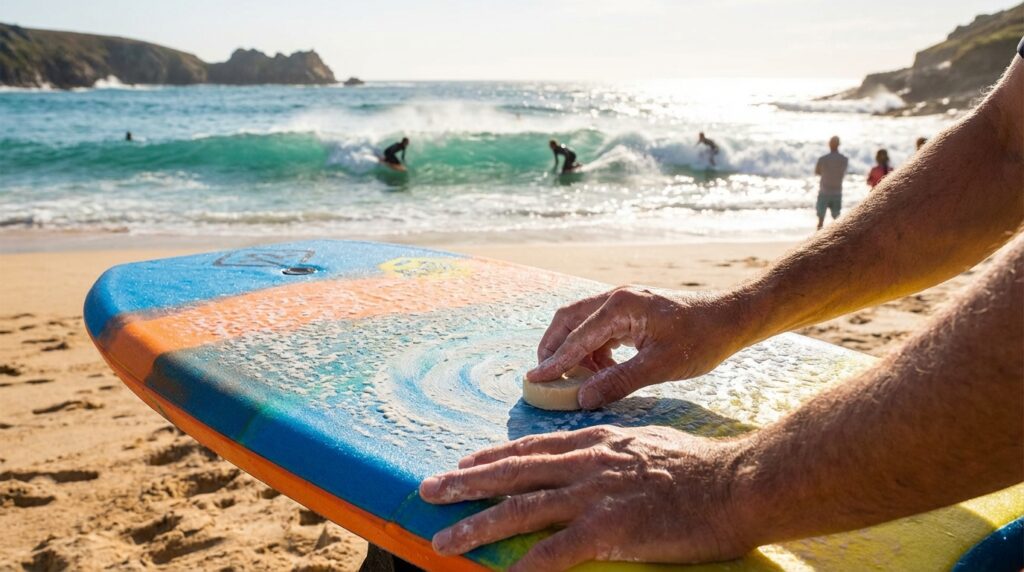
Once the right block is in your fingers, it’s time to work the wrist. Three gestures dominate the panorama: the circle, the cross diagonal and the longitudinal zigzag. The circle creates small beads while the diagonal builds an X-shaped pattern that hooks the wetsuit at compression points. The longitudinal zigzag, meanwhile, reinforces grip along the rail to help lock the elbow during an intense carve.
Let’s illustrate these principles with the case of Nabil, a Basque Coast rider, who prepares his board before a west swell. He starts with circular movements the size of a two-euro coin over the entire thoracic area. Then, he draws 45° diagonals from the nose to the tail, then reverses the angle to create a grid. Finally, he finishes with two long horizontal bands under the elbows, where pressure is maximal during an ARS. This choreography, repeated for three minutes, develops an irregular surface that traps water droplets and acts like miniature suction cups.
The attack angle between the wax block and the deck is crucial: the more closed the angle, the more the wax is flattened and risks smoothing the surface. Conversely, an open angle of about 75° tears wax off the block and promotes the creation of micro-clumps. This parameter is often overlooked by beginners. Similarly, pressure must remain moderate: a study conducted by the Hydroslide laboratory showed that beyond 2 kg/cm², wax clumps and loses its rheological qualities.
To visualize these techniques, a video tutorial remains the best educational support.
The last gesture is to lightly comb the wax, especially if the session takes place in waters near the selected block’s temperature limit. This operation lifts the nubs and adds new friction edges. In practice, thirty seconds is enough to restore bite before entering the water.
Maintaining the wax layer during and between sessions
The initial application represents only 50% of the work; the other half is preserving this sticky “ecosystem.” A poorly maintained layer turns into a slippery film barely a few microns thick after three failed take-offs. To keep grip, Océanix team coaches recommend reapplying a quick layer of wax every 40 minutes if the water temperature exceeds 22 °C. Below this value, a simple combing may suffice.
Best practice: keep a mini-block in the wetsuit’s side pocket. Compact models launched post-2026 include an absorbent fabric strip that prevents greasy deposits on neoprene. During the line-up break, rub the critical zone (thorax and elbow) before catching a wave. This ritual adds a strategic dimension: it helps maintain confidence, especially when the sets take time to arrive.
Between sessions, the board should not remain in direct sunlight. Wax melts, concentrates on the sides, and creates “craters.” It’s better to store the board in a reflective bag and slip a sheet of baking paper on the deck; the wax sticks to the paper rather than the bag in case of accidental overheating. A complete monthly cleaning is recommended for weekly riders, while a quarterly cleaning suffices for occasional practice.
Interactive comparator: choose the ideal wax according to the water temperature
| Wax type ▲▼ | Ideal range ▲▼ | Main advantage |
|---|
Highlighted rows correspond to waxes recommended for the defined temperature.
Maintenance also involves renewing accessories. The comb must remain sharp; remember to change the plastic blade as soon as the teeth become dull. For those seeking a complete guide on equipment longevity, this dedicated article delves into board and wax life cycles.
Wax removal: cleanly removing wax before starting again
There always comes a time when the layer reaches saturation. In this state, the wax becomes grainy, mixes with sand, and loses adhesion. Then comes wax removal. The simplest method is to expose the board to the sun for ten minutes, allowing the wax to soften. Then remove it with a soft plastic scraper, never metal to avoid scratching the deck. Residues are eliminated using a cloth soaked with biodegradable solvent.
For a step-by-step tutorial, this article offers high-definition photos. Some riders use a hairdryer on warm mode to localize heat. The trick: place a towel under the board to catch the wax and prevent scattering in the sand. The recovered chips can be recycled into workshop candles, a gesture appreciated by the zero-waste community.
Finally, rinse thoroughly with fresh water and let dry in the shade. A dewaxed board regains a like-new appearance, ready to receive a new wax layering. European tour competitors fully renew the wax before each contest, about 12 times per season. Free surfers average two dewaxings per year, in autumn and spring.
Common mistakes and practical solutions
Despite tutorials and good intentions, some blunders keep recurring in parking lots. The first: waxing the entire deck. Yet, it’s enough to cover the contact area; too much wax adds about 50 g to the board, slowing acceleration in soft sections. A second mistake is using wax that’s too hard for fear it will melt. Result: zero adhesion, especially with a top Lycra. The remedy: scrape, apply a soft base, then superpose the appropriate wax.
Another blunder: leaving the board vertical against the car door, sunny side. The wax melts and forms a stalactite-like drip. An insulated bag or shaded parasol keeps the grip intact. Lastly, many neglect combing because they think it’s “only for pros.” Yet, thirty seconds of combing equals two additional wax layers in terms of friction.
Solutions include planning and organizing the beach bag. Experienced riders systematically carry:
- 📏 A multifunction comb with integrated fin notch
- 🕯️ A mini block of tempered wax
- 🧽 A microfiber cloth, always dry
- 🌬️ A mini compressed air duster to clean the deck
- 🍋 A bottle of lemon-scented solvent
These five items weigh barely 180 g but can save a session if the wax degrades. For those who want to deepen the question of ideal waves to avoid wipe-outs, this specialized guide offers valuable extra insight.
The role of wax in advanced tricks: spins, ARS, and other maneuvers
At an advanced level, wax becomes a performance tool. During an invert, the rider presses the nose violently to generate lift; without grip, the hand would slip and the rotation would stop abruptly. Same scenario for a front-side reverse spin: the inside elbow must lock the rail to turn horizontal energy into roll. The “wax / neoprene” friction coefficient measured by the Hydrodynamics University of Saint-Jean-de-Luz was evaluated at 0.62. When this coefficient drops below 0.4, the success rate of tricks falls by 27%.
Some competitors mix two waxes to create a hybrid grip: tropical base + cool finishing layer. The critical friction angle thus increases by 4°, enough to land a tight ARS in a hollow section. Others experiment with mineral additives like micronized pumice stone, already used on the pro circuit since 2026. This powder, incorporated into hot wax, produces an almost velcro-like surface.
Advances in high-speed sliding have also led to dosage control: too much wax slows the board. Above 15 g spread over the deck, viscous drag increases, GPS-measured slow-down at 0.6 km/h. Shapers therefore recommend a target weight of 10 g, equivalent to half a block for a 42-inch board. To measure this mass, some use small kitchen scales. It’s the difference between hooking the lip or grazing it.
Wax also influences drop knee trajectories; the front foot, placed slightly sideways, needs a specific wax patch. Otherwise, the rider must compensate by tightening the rail, which breaks fluidity. This technical dimension explains why wax gets so much attention in training camps described in this overview of destinations.
Complementary equipment: combs, pads, and post-2026 innovations
If wax remains queen, it’s no longer alone. Multifunction combs now include a key-box for fins on wing-boards. Self-adhesive pads, once reserved for stand-up surf, adopt compact formats for bodyboard. Urban riders appreciate the translucent version, almost invisible on a colored slick. Thanks to a micro-suction process, these pads stick without chemical glue, avoiding marks during future wax removals.
Since 2026, the startup BoardSkin has developed a marine polymer-based hydrophobic spray. Two sprays extend wax adhesion by 35%. The spray acts as a fixer while preserving flexibility. A demonstration at the Océan Roots festival convinced the majority of riders present. Additionally, the tool “Choosing your first board” recommends pairing pads and wax for teens whose thin wetsuits offer less natural grip.
Innovations don’t stop there; a thermo-active pad project, inspired by heated gloves, emits gentle warmth to maintain wax at the right viscosity in cold water. Tested in Tynemouth last winter, the system halved the reapplication frequency. Note however the added weight of 60 g from the battery, offset by reduced blocks carried.
- 🚀 5-in-1 comb: comb, scrape, unblock valves, screwdriver, bottle opener
- 🧩 Micro-suction pad: repositionable without marks
- ⚡ Thermo-active pad: 2 h autonomy at 8 °C
- 💦 Hydrophobic spray: 50 ml format, cabin-air compatible
- 📈 Mobile app: wax weight monitoring by photo and embedded AI
Finally, a reminder: wax does not replace a good board. Consult this buying guide to choose the right size and get the best out of each wax block.
What is the ideal frequency to reapply wax?
In temperate water, a light combing every 40 minutes is sufficient. Above 22 °C, add a thin wax layer at every line-up break.
Is it really necessary to combine pad and wax?
Yes, especially if the wetsuit is thin or the water very cold; the pad provides immediate grip while the wax adjusts the texture at pressure points.
How to transport wax without it melting?
Use a small insulated box or place the block in an internal pocket in the shade. Modern waxes sometimes include thermo-reflective aluminum packaging.
Can old wax be recycled?
Softened chips can serve as fuel for workshop candles or be reused by some shapers who transform them into training blocks.