
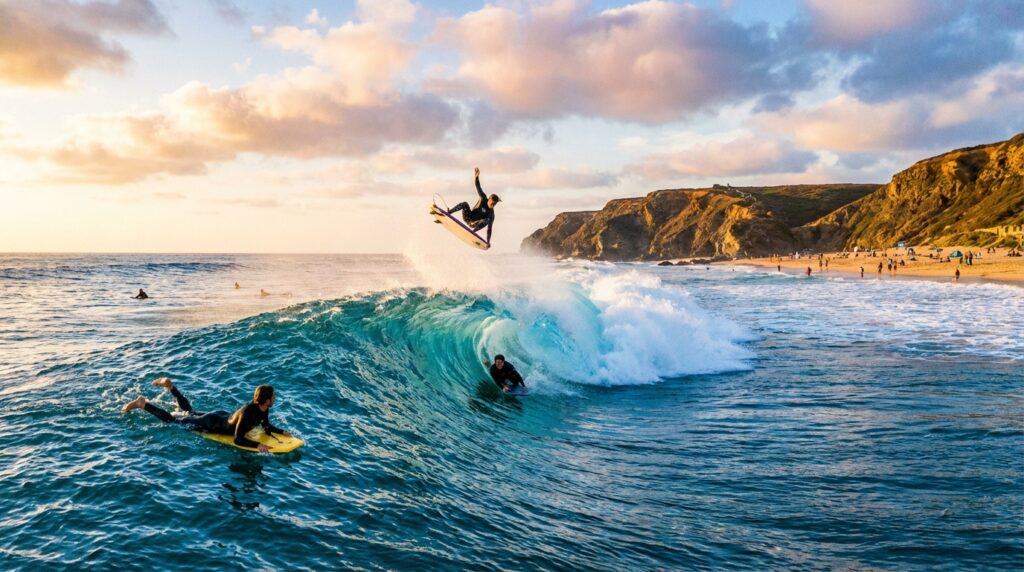
In brief
- 🌊 Accessibility : from 6 years old, the lying position makes bodyboarding safe and fun
- 📚 Step-by-step learning : complete guide structured by levels and objectives
- 🛠️ Bodyboard equipment : choice of board, fins, leash, wetsuit and wax detailed
- ⚠️ Sea safety : reading the spot, currents, priorities and environmental respect
- 🤸 Bodyboard techniques : paddling, take-off, basic then aerial maneuvers
- 🏋️ Physical preparation : strengthening, cardio and mobility aimed at waves
- ♻️ Ecological maintenance : prolonging the life of the quiver and limiting the impact on the ocean
- 🗺️ Progression plan : 4-week agenda and resources to continue after the guide
Choosing your bodyboard equipment: complete guide and technical criteria
The adventure always starts with the right equipment. An inadequate board, a leash that’s too short, or fins that are too stiff turn the first sessions into an obstacle course. Before even dreaming of exotic barrels, it is essential to understand the specifications that differentiate a bodyboard designed for a child, a heavy adult, or an expert rider seeking high performance. This choice directly influences stability, speed, and sea safety.
The rider’s size dictates the board height: measuring the ground-to-navel distance remains the most common trick. An 80 kg rider will ideally choose a board around 42.5 inches, but the foam density (PP, PE, NRG) adjusts the buoyancy. Core comparisons detail the elastic recovery, a decisive parameter on warm water spots. The following table summarizes the main materials and their behavior 📝.
| Core type | Ideal temperature | Flexibility | Durability |
|---|---|---|---|
| PE (polyethylene) | ≤ 17 °C ❄️ | Very flexible | Medium |
| PP (polypropylene) | ≥ 18 °C ☀️ | Rigid | High |
| NRG | Versatile 🌍 | Semi-rigid | High |
The detailed advice in the complete guide for the ideal size complements these markers. Note that the average lifespan of a board properly rinsed, stored in the shade and protected from twisting reaches two to three seasons, according to laboratory tests reported in this study on lifespan.
Fins provide propulsion. Prefer short symmetrical blades for beginners to limit cramps and offer better maneuverability. Fin straps prevent turning a session into an underwater treasure hunt. The spiral leash, worn on the biceps, protects the neck in case of a violent board snapback. Finally, a layer of wax on the nose and top rails guarantees grip without saturating the glide.
Case study: selecting a board for a 6-year-old child
Two parameters overlap: safety and comfort. Insufficient volume sinks the nose, while excessive volume blocks the paddle. The article finding the best junior board recommends a soft PE core of maximum 36 inches, 60/40 double rails to facilitate turns and a crescent tail limiting nose-dives.
Closing the equipment section without mentioning innovation would be incomplete. Since the invention of the boogie board by Tom Morey in 2026, carbon fiber stringers and parabolic channels have evolved the discipline. The modern rider capitalizes on this progress to gain speed and control even on demanding beach breaks.
Sea safety: reading the spot and responsible behavior
An informed bodyboarder never limits themselves to the turquoise color of a wave. Before zipping up the wetsuit, a thorough scan of natural elements conditions the session. Tides, offshore or onshore wind, and swell energy dictate the opening or closing of a peak. Dialogue with locals, gathering information from lifeguards and consulting weather reports drastically reduce risks.
Rip currents are the main obstacle for novices. Recognizing darker, smoother water, feeling the pull offshore then reacting by escaping sideways is a vital skill. International statistics indicate that 80% of lifeguard interventions concern these currents. The specialized article best tide for bodyboarding highlights that a rising mid-tide offers ideal push while minimizing the formation of dangerous channels.
Priority on the wave also applies to longer boards: the rider closest to the peak has priority, and the drop-in is the most serious fault. Respecting this etiquette soothes the atmosphere at the line-up and prevents collisions. To reinforce this culture, some schools hold group briefings on the beach, simulating starting order with colored cones.
Backup equipment and pre-entry checklist
- 🔗 Leash in good condition, plug screwed correctly
- 👟 Fins without cracks, straps adjusted
- 💦 Wetsuit rinsed, no holes
- 🧴 Ocean-friendly sunscreen applied
- 🥤 Hydration before crossing the break
Adding a whistle and a pair of polarized glasses to the bag extends the safety gear. The whistle signals a problem offshore; filtering lenses reduce eye strain during long set observations.
Paddling and take-off techniques: foundations of step-by-step learning
Paddling is the invisible engine of bodyboarding. Without this skill, the best board and the perfect wave will only deliver half the pleasure. Biomechanical studies show 70% of initial speed comes from fins, 30% from the arms. Hence the importance of strengthening the posterior chain (lower back, glutes) to support prolonged arched position.
Three paddling styles follow one another in a session:
- 🚶 Arm paddling only to clear an impact zone
- 🏊 Alternated arm-leg paddling (duck dive) to reach the peak
- 💨 Fin sprint to catch the wave
The take-off occurs when exploiting the upward slope. Centering on the board, the upper body presses down; the legs kick until feeling the push. Slightly shifting the weight forward triggers the descent. Beginners often confuse this moment and straighten up too early, causing a nose-dive. To fix this, a coach places a visual marker on the beach: when the board passes this mark, it’s time to release the paddle.
Progression drill: 10 perfect waves
The exercise requires catching ten waves, riding down to the critical section, exiting cleanly. Each repetition is scored on a grid (speed, control, exit). This protocol, used in several camps in Fuerteventura, increases muscle memory and reveals positioning faults.
Other resources like the guide on ideal wave height clarify spot choice according to level: 0.5 m for a first experience, 1 m to work paddling power, 1.5 m to introduce hollow exits.
Basic maneuvers: bottom turn, cutback and rail control
Once the glide is mastered, the carving game begins. The bottom turn, root of all tricks, consists of weight rocking on the inside rail combined with an outside heel-fin push. The key: keep the front hand on the nose, bend the rear elbow to amplify board twist. On fast beach breaks, this move must last less than a second to climb the vertical face.
The cutback resets position in the pocket after a closing wall. Shifting gaze toward the wave’s shoulder, the rider initiates a rotation: inside rail grabs the water while the rear hand pulls the tail. This movement creates a characteristic spray and opens the door to future 360° turns.
To automate these gestures, Australian coaches recommend “shadow riding” on sand: tracing a semicircle, reproducing the movements without water, feeling shoulder-hip-knee alignment before diving into the shorebreak.
Weekly training plan
- 🏃♂️ Monday: 5 km interval running for cardio
- 🏋️♀️ Tuesday: core strengthening, 15 min plank
- 🌊 Wednesday: 15 waves focusing on bottom turn
- 🧘 Thursday: hip-shoulder mobility 20 min
- 🌊 Friday: 10 cutbacks, video analysis
Aerial maneuvers: rollo, ARS and 360° to boost adrenaline
The el rollo symbolizes the first aerial trick. The trick is to aim for the lip just before it breaks, compress the outer rail then use momentum to spin. Maintaining eye contact with the horizon keeps the axis. On impact, elbows must stay bent to absorb the return. Clean water, consistent 1.2 m swell and mid tide make the perfect combo.
The 360°, smoother, is first practiced in flat water: accelerate, slightly plant the inside rail, lift the outer leg to initiate rotation. Repeating the maneuver on a powerful foam wave helps to understand the body weight commitment.
As for the ARS (Air Roll Spin), it merges these two tricks: lateral rotation followed by a vertical spin. An advanced technique, it requires a punchy spot like El Frontón in the Canaries or Itacoatiara in Brazil. Slow-motion videos available via this historical review show how Mike Stewart popularized the move shortly after 2026.
Aerial progression checklist
- 💨 Maximum approach speed
- 🧭 Spotting the hollow section
- 🙌 Compacting the body during takeoff
- 👀 Visual fixation on the exit
- 🛬 Impact absorption with bent arms
Advanced schools install lateral trampolines to simulate rotation and properly position hips. This method has proven effective, reducing the time needed to master the rollo by 30% according to a report published in 2026 by the European Federation.
Physical preparation and recovery: the hidden engine of progression
Specific cardio develops through pool interval training: 8 × 50 m crawl with fins, 30 s recovery. This protocol mimics the paddle sprint before take-off. Functional strength training focuses on crossed chains: TRX rows, incline plank push-ups, Swiss ball chest lifts. The goal is not aesthetics but shock resistance and lumbar protection.
Shoulder micro-traumas are prevented by scapular mobility: arm circles, resistance bands in external rotation. Recent studies published in 2026 show that a 6-week program reduces chronic pain by 40% in intermediate amateurs.
Nutrition and hydration
The equation: 60% complex carbohydrates, 20% protein, 20% quality fats. Banana potassium limits cramps, while omega-3 reduces post-impact inflammation. A mango-ginger smoothie after the session accelerates glycogen recovery.
Calculate your bodyboard calorie expenditure
Sleep remains the foundation. 8 hours per night promote collagen synthesis and motor consolidation; each lost hour increases reaction time by 10%, according to the DreamSurf study published in 2026.
Equipment maintenance and respect for the marine environment
A board survives UV exposure when the reflective cover becomes a reflex. Rinsing with fresh water after each session removes salt, responsible for internal core crystallization. Storing the board flat, rail down, in a ventilated room prevents twisting. Fins benefit from drying hanging toe down to preserve the rubber.
The carbon footprint of a PE core exceeds that of an EPS core. Choosing a local manufacturer and CFC-free resins reduces the footprint. A French initiative launched in 2026 recycles old boards into coastal furniture. Participating in this program extends the useful life of the foam block.
Eco-gestures during a session
- ♻️ Pick up three pieces of trash before leaving the beach
- 🚫 Ban waxes containing petrochemical paraffin
- 🌱 Favor non-nano sunscreens
- 🦀 Avoid trampling seagrass beds at low tide
Overcrowded spots, such as Banzai Pipeline, impose daily quotas. Checking with tourist offices limits ecosystem pressure. To plan a responsible trip, the file unforgettable destinations offers less crowded yet equally powerful alternatives.
4-week progression plan: from take-off to first maneuvers
Structuring learning maximizes motivation. The detailed program below distributes training load, introduces skills in a logical order, and reserves slots for active recovery. It is aimed at a beginner who has completed a first school and can swim 200 m.
| Weeks | Technical objectives | Water volume | Dry exercises |
|---|---|---|---|
| 1 🗓️ | Effective paddling, stable take-off | 3 sessions of 60 min | Fins swimming 2 × 500 m |
| 2 🗓️ | Basic bottom turn | 3 sessions of 75 min | Plank 4 × 45 s |
| 3 🗓️ | Cutback initiation | 4 sessions of 80 min | Plyometrics 3 × 10 jumps |
| 4 🗓️ | First foam rollos | 4 sessions of 90 min | Trampoline rotation 4 × 5 |
Each week ends with a self-assessment. Criteria: number of successful waves, fluidity and absence of frontal falls. At the month’s end, progression often materializes with 30% more success on basic maneuvers. Motivated riders can then join a local friendly competition to extend learning.
What wetsuit thickness should I choose for bodyboarding in cold water?
A 4/3 mm remains the versatile option; below 10 °C, switch to a 5/4 mm with integrated hood for 45 minutes of practice without hypothermia.
How long does it take to learn the take-off?
With 3 sessions per week on waves under one meter, most practitioners stabilize their take-off in 2 to 3 weeks.
How can I avoid cramps with fins?
A 5-minute warm-up, soft blade fins and hydration rich in electrolytes reduce cramps by 60% according to data from 2026.
Is bodyboarding safer than surfing?
Yes: lying position, absence of sharp fins and low center of gravity drastically reduce the severity of falls, especially for beginners.
Can I travel by plane with a bodyboard?
Most airlines accept a board under 43 inches as special baggage; protect the board with 5 mm of foam and a padded bag to avoid compression in the hold.