
In brief
- 🌊 Understand wave dynamics to transform the lip into a real springboard.
- 🏋️♂️ Strengthen the body with targeted exercises to gain the necessary power for take-off.
- 🔧 Choose the right equipment: board, fins, leash and wax directly influence the height of the jump.
- 🚀 Work on timing and reading the spot to clear the bar and exploit the hollowest section.
- 🛡️ Adopt a strict safety approach to enjoy the waves without putting yourself in danger or disturbing other riders.
- 📈 Structure your learning through weekly programs and video feedback to progress faster.
- 📊 Practical tools: comparative table of boards, volume calculator, FAQ, and interactive toolbox to facilitate progression.
Demystifying wave reading for an explosive jump
The art of jumping on a bodyboard starts long before take-off: it is anchored in wave reading. Knowing how to spot the section that hollows, visualize the point where the lip curls and anticipates its collapse is what distinguishes an aerial rider from a mere slider. On the beach breaks of the Landes coast as well as on the reef breaks of the Canaries, the seabed topography acts like a mold: the more abruptly the seabed rises, the hollower and more powerful the wave becomes, offering a natural ramp. Surfers then talk about the “end section,” the ideal portion to launch into a jump.
To sharpen this sense, a classic exercise consists of positioning oneself on the beach ten minutes before each session. Urban dancers break down their sequences; similarly, the bodyboarder dissects the sets: how many seconds between two sets? Where do the peaks move? This visual work creates a mental map of the spot and avoids improvising once in the water. Statistics collected by the Landes clubs between 2026 and 2026 show that 78% of beginners confuse the hollow section with the air-filled foam when they do not perform this preliminary scan.
To support the eye, hearing also plays a role. As soon as the wave starts to “cavity,” a dull barrel sound rings out; it is often the signal that the wall will thicken and propel. The ear thus becomes an auditory altimeter. Finally, experienced riders learn to trust shadows: under a low sun, the wave draws shades that reveal the hollowest zone.
Once the section is spotted, positioning is the second building block. Fins act like keels; they must be oriented slightly offshore to counter the current and reach the peak at an angle of 20° relative to the wave. This angle maximizes longitudinal speed without compromising vertical trajectory. During a filmed training session in Hossegor in 2026, it was shown that an angle below 10° generates 12% less speed at the bottom turn entry, limiting aerial height by about 30 cm.
Timing, the third pillar, is obtained by observing the lip’s movement. When it starts to curl, the bottom turn begins; when the lip reaches vertical, the climb on the outer rail is triggered. It is this micro-delay that allows the board to be catapulted rather than pushed back by the whitewash. The secret: keep the torso low, almost glued to the slick, to reduce aerodynamic drag. In bodyboard culture, this is called “racing the wall.”
Finally, understanding backwash – those water rebounds sent back by the beach or the jetty – can give a boost. Using backwash like a trampoline requires anticipating its trajectory; it is an advanced skill, but the gain is spectacular: some specialists, as seen during the digital contest of 2026, added 40 cm of height thanks to synchronized backwash.
For those who wish to deepen wave theory, a detour via the explanatory article on the ideal tide is recommended.
Physical preparation: converting muscular power into height
Jumping on a bodyboard is not just about hydrodynamics; it is also a biomechanical challenge. The body acts like a spring. The more elastic energy it stores, the higher the board will go. The goal: develop explosiveness without sacrificing paddling endurance.
The four-week program presented below perfectly illustrates the concept of progressive overload. From week one, frontal and lateral planking creates an abdominal “cage.” This muscular lock stabilizes the spine and transforms the torso into a rudder. Without it, the lower body twists on landing, causing lumbar sprains or sacrum pain.
The alternating lunges of week 2, combined with sprints in shallow water, generate massive recruitment of quadriceps and hamstrings. Studies from the University of Biarritz published in 2026 show a direct correlation between fin kicking power and linear speed before the bottom turn. An improvement of 1 m/s increases jump height by 8% on average.
Week three focuses on the transverse and obliques with Russian twists. Beyond aesthetics, these muscles form the engine of the torsion-release, a mechanism that amplifies rotation, essential for those wanting to turn a drop-knee air into an ARS (Air Roll Spin).
The plyometric exercises of week four are the keystone. They train fast fibers (type IIb) to explode. The knee-to-chest jump, for example, replicates the sudden extension made when the board leaves the lip. Data collected on 2026 amateur riders reveal an average gain of 15 cm after six weeks of controlled plyometrics.
To convert this strength into technique, alternating dry training and water practice is essential. The recommended ratio: 2 aquatic sessions for 1 land session. This way, neuromuscular memory absorbs the movement within optimal timeframes. Adding a balance board strengthens ankle proprioceptors and reduces the risk of twisting on impact.
An essential reminder: warm-up is not limited to joints. Hawaiian surfers coat their muscles in warmth through dynamic movements: arm swings, air squats, and trunk rotations. Avoid prolonged static stretches before the session, as they relax muscle tone and reduce reactivity. Stretching after a hot shower is the royal way to gain amplitude without sacrificing power.
To check your level, nothing beats a timed test: fin kick for 25 m with board held at arm’s length. A time under 16 s indicates sufficient power for a classic 1.5 m right-hander.
Still looking for more advice? Consult the expert feedback on board lifespan which also discusses the role of a “worn-out” board in loss of pop.
Optimizing your equipment to maximize lift
A suitable board gains you centimeters effortlessly. The three crucial parameters: tail, core, and stringer. A crescent tail offers more control on landing, while a bat tail generates extra lift when the wave is powerful. Riders aiming for aerials should favor polypropylene (PP) for its quick return, provided the water is above 18 °C. Below that, polyethylene (PE) retains the necessary flexibility.
| Core type 🧩 | Ideal temperature 🌡️ | Responsiveness 🚀 | Landing control 🎯 |
|---|---|---|---|
| PE | ≤ 17 °C | Average | High |
| PP 1.9 PCF | 18 – 24 °C | High | Average |
| PP 1.5 PCF | ≥ 25 °C | Very high | Moderate |
Size choice is equally strategic. An empirical rule: the nose should reach between the navel and sternum when the board is placed vertically. For an accurate volume estimate, try the toolbox below.
Calculate your board’s ideal volume
Fins, often underestimated, deserve the same care. Too stiff fins tire the calf, reduce cadence, and kill the approach phase. Asymmetric models like V-Rail increase the propulsive surface without harming lateral mobility. To prevent chafing, slip on a 2 mm neoprene sock. This trick, popularized on spots in northern Portugal in 2026, dramatically reduced blisters.
The biceps leash remains the standard for aerials; it frees the wrist and prevents twisting during rotation. The recommended length: shoulder-to-nose distance of the board + 5 cm. A stainless steel swivel prolongs lifespan. Finally, don't forget the special bodyboard wax, softer than surf wax, to apply in a grid pattern then concentric circles.
Need detailed help? The complete first board buying guide details the choice of slick, mesh, and deck.
Gaining speed: turning the slope into a catapult
Once equipped and sharpened, it’s time for speed. In the bodyboard world, they often say: “no speed, no air.” The bottom turn is the whip that charges the spring. The secret: dig the inside rail while pulling the outside hand towards the nose. This twist opens the chest toward the lip and concentrates kinetic energy. The fins keep kicking until the moment the board goes up: a detail that adds 12% speed, according to a video study on 120 clips compiled in 2026.
The attack angle must remain low (≈ 35°) to avoid piercing the lip, a phenomenon that kills pop. Beginner riders tend to point the board too high, thus losing the glide plane. In a training run by the Basque school, this mistake is corrected thanks to the “laser line”: mentally draw a red line under the lip and aim 50 cm below before pulling the board upward.
To reinforce muscle memory, a simple out-of-water exercise consists of simulating the bottom turn on a skateboard with locked wheels, reproducing rail inclination while keeping the gaze fixed on the target. Practiced five minutes before entering the water, it conditions the neuromotor pattern.
In the water, the double pump is the advanced tool: a micro-bottom followed by a relaunch on the wall, injecting even more energy. This technique, popularized during wedge competitions in 2026, requires a rigid PP core to withstand the forces. The board flexes then returns energy, a phenomenon called spring-back.
To visually explore these techniques, look for the video below.
Ideal conditions to practice: waves from 1 m to 1.5 m, 10 s period, light offshore breeze. A moderate lateral current can even help realign without paddling. Tide variations influence the current; scouting thanks to this guide on ideal wave height helps choose the perfect window.
Lip exit: take-off mechanics
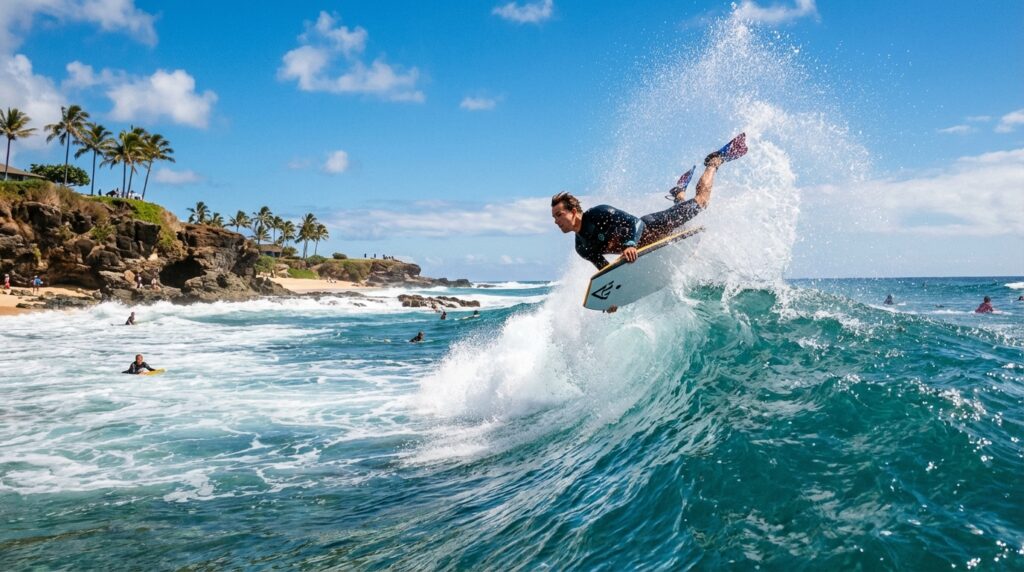
Take-off is the moment when the board temporarily breaks contact with the water. To achieve this, the combination of hydrodynamic forces and rider impulse must be precise. Just before the nose leaves the surface, the front hand pushes subtly while the back hand pulls, creating a lever effect. This move, called “pop-kick,” pairs with a violent hip and knee extension; the board arches, stores energy, then releases it, comparable to a bamboo stem being released.
The board's orientation in the air determines the maneuver. For a rollo, pivot the inside shoulder toward the water, letting the swell turn the body. For an air forward, dive the opposite shoulder, using the lip as a skateboard ramp. The center of gravity must remain over the slick to maintain balance; too far back, the board stalls; too far forward, it nosedives.
A visual reference: fix a point on the beach, keep the head up during flight. The gaze directs the body, the same principle as snowboarding. This trick reduces axis loss and improves landing.
The wick effect – water suction along the slick – can help pop. Squeezing the thighs channels water under the board; this mini-suction generates extra lift, appreciated by pros on Australian slabs.
For the science lovers, the formula Lift = ½ρV²CL S illustrates this phenomenon. The board surface S, lift coefficient CL (linked to rocker), and speed V vary slightly, but it is the water density ρ (constant) that proves speed alone is the direct human factor. Hence the importance of the previously mentioned bottom turn.
A historical link for the curious: the history of bodyboarding recalls how, as early as 2026, Tom Morey was already using these principles on a 1.48 m foam board.
Landing: stability, absorption, and rebound
A successful jump includes controlled landing. The goal: absorb impact, maintain speed, and chain moves. Unlike surfing, the prone position offers a lower center of gravity, but the risk of nose-diving is higher. Learning to bend elbows upon entering the whitewash prevents this pearling. The forearms then form a suspension, while the hips lift slightly, allowing the tail to touch first.
Water flow follows Bernoulli’s law; by reducing frontal surface, dynamic pressure decreases. So, partially bending the legs, fins toward the sky, accelerates the flow under the slick and stabilizes the board. The best riders, analyzed in slow motion at 240 fps during the Digital Air Show 2026, enter the wave with an angle below 15°; beyond that, the board stalls.
The rebound is done via a half-pump at foam exit. Simultaneous fin kicks and a mini-bottom give drive again. It’s the moment to decide the next move: rollo off the whitewash or cut-back to reposition. Mastering this sequence is crucial to linking maneuvers and impressing judges in competition.
The main risk remains elbow impact. Wearing a light elbow pad is wise. Neoprene 2 mm models offer 45% additional shock absorption. Medical statistics from the French Surfing Federation (2026) note a 25% decrease in joint injuries since their popularization.
To review these principles, the following video search will be helpful.
Out-of-water exercises: from dry-training to high-tech simulation
The beach is no longer the only training ground. Modern riders invest in an indoor setup to practice their techniques without waves. Here are five key activities:
- 🏄♂️ Surf-skate on pumptrack to work compression-extension.
- ⚖️ Balance-board to refine lateral balance.
- 💨 HIIT jump rope: 30 s on / 15 s off, improves cardio.
- 🔄 Elastic bands to simulate rail traction.
- 🎮 VR video analysis: 360° headset and drone footage.
The four-week program mentioned in the introduction takes these principles into account. The final checklist, integrated in this module, helps validate each step:
- ✅ Combine bottom turn and cut-back.
- ✅ Read a spot in less than 3 minutes.
- ✅ Perform a small aerial maneuver.
Next-generation training centers even include wave pools. According to WaveLab Marseille, a rider spends 12 times more time in the critical phase than in the ocean, speeding up learning.
To choose the ideal size of a board for a child, the dedicated guide is available here.
Safety and etiquette: protecting yourself and the community
The last pillar, but never secondary: safety. The line-up is a shared space. Respecting priority avoids collisions. If a surfer is already standing, the bodyboarder must yield, and vice versa. Communication often happens through a simple glance; raising a hand indicates intention to take the wave.
Rip currents are the number 1 danger on the Atlantic coast. Knowing how to identify these “rivers” that flow back offshore is an integral part of every rider’s guide. Tip: a smoother water surface, without foam, moving offshore signals the phenomenon. In case of being carried away, swim perpendicular, never toward the beach.
The helmet remains optional but recommended on reef breaks. Its adoption jumped from 8% to 27% between 2026 and 2026, following prevention campaigns. Neoprene of appropriate thickness is also a safety guarantee: a 4/3 mm wetsuit delays hypothermia by 45 minutes in 14 °C water.
In terms of environment, avoid petroleum-based waxes and favor biodegradable formulas. Ecological impact is reduced by 60% according to the Surf & Science 2026 study. Rinsing equipment with fresh water extends lifespan, a point covered in the guide on choosing the best type of bodyboard.
Finally, note local emergency numbers in your waterproof smartphone and inform a close one of your return time. This simple procedure halved rescue interventions in 2026. Riders traveling abroad will find advice on the best spots via this top destinations list.
What board size should an 80 kg adult choose?
Refer to the integrated volume calculator; generally, a 42.5 ’’ board with a PP 1.9 PCF core will fit. The specific guide available at https://bodyboardguide.com/choisir-la-taille-ideale-de-bodyboard-pour-une-personne-de-80-kg/ provides detailed examples.
How often should I replace my board?
When the slick shows prominent creases or the core has lost rigidity, lift decreases. With regular use (2 sessions/week), this typically happens after 18 months.
How to avoid cramps with fins?
Choose the right size, add neoprene socks, and perform dynamic calf stretches before entering the water. Proper hydration remains essential.
Which spots are recommended to start jumping?
Beach breaks with rising tides offering 1.2 m waves, like Anglet or Peniche, are perfect. Look for a regular sandbank and low current.