
In short
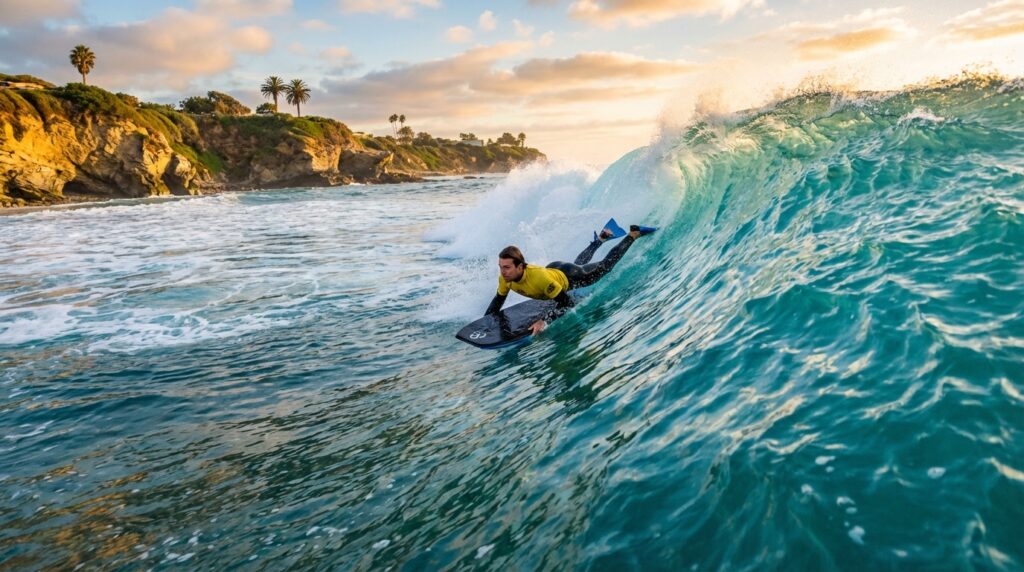
- 🌊 Fine reading of the waves and choosing the peak to engage an effective bottom turn.
- 🛠️ Calibrated equipment: board, fins, leash, and wetsuit optimize glide and safety.
- 🚀 Weight transfer and rail techniques: keys to a controlled cut back.
- 💪 Targeted physical preparation to stabilize balance and gain explosiveness.
- 🔧 Rigorous maintenance of the quiver to preserve pop and stiffness, session after session.
Understanding wave dynamics before any maneuver
Swell conditions guide the bodyboarding turning strategy. A hollow wave offers a steep face where the rider can press hard on the inside rail to accelerate, while a softer wave requires diagonal positioning to avoid stalling. Bathymetric surveys, available on marine weather portals, provide information on the spot’s topography; they illuminate the ideal trajectory to exploit even the smallest fast section. Anticipating the swell period and height is therefore essential. A visit to this resource dedicated to optimal wave height reminds us that beyond a certain threshold, the breaking speed increases faster than the average bodyboarder’s velocity, making the turn more technical.
Two natural markers serve as reference points: the impact point of the lip and the foam zone. Positioning at one-third of the face, just below the lip, guarantees enough slope to trigger an energetic bottom turn. Experienced local Óscar from Santa Rosa beach recounts having reduced his trajectories by 30% simply by observing the drift of seaweed to visualize currents. This sensory observation combines with theory: the Stokes propagation equation shows that group velocity influences the birth of fast sections; in practice, a long period often signals a bowl that breaks late, perfect for a reverse spin.
The tide finally modulates the wave’s consistency. On a beach break, a mid-rising tide tends to smooth the surface, favoring an elongated cut back. Conversely, the reef can be more playful at low tide, releasing vertical ramps where a 360° air can be engaged. Enthusiasts often consult the guide detailing the best tide windows to schedule their training sessions.
Choosing the optimal equipment for smooth turning
A high-performance turn starts in the shop rather than in the water. The board’s density, measured in Pounds Per Cubic Foot, determines the core’s flexibility. At a tropical spot where the temperature regularly exceeds 25 °C, a rigid polypropylene avoids the chewing-gum effect that dissipates energy exiting the bottom turn. Riders in temperate waters will prefer a softer NRG foam for increased responsiveness. To fine-tune volume, this comprehensive size comparison emphasizes the importance of preserving the curve: when placing the board in front, the nose should reach the navel level to guarantee the ideal leverage on the rails.
The channels under the hull generate laminar flow that stabilizes the trajectory. Converging double channels increase lift, facilitating the transition from one rail to the other; a relevant choice for beginners who still struggle to lock the edge. Additionally, stringers, fiberglass rods inserted in the core, stiffen the board. A double stringer offers consistent pop, even after several seasons – the resource dedicated to bodyboard lifespan details flexion tests conducted in laboratories.
Regarding fins, an asymmetrical foot pocket favors propulsion while allowing micro-adjustments during rotation. Rear straps, like power-straps, prevent losing the fin during a roll-out. The leash is ideally secured to the front wrist; this way, in case of wipe-out, the pull acts along the body axis, preventing the board from hitting the head.
Basic position: balance before rotation
The bodyboard is only a hydrodynamic extension of the body; posture plays a strategic role. Lying prone, the rider anchors the inside hip on the deckline to transfer weight onto the rail. This gesture is inspired by snowboard carving: the closer the center of gravity to the edge, the tighter the curve. Bent elbows act like two shock absorbers, absorbing vibrations, while the front hand lightly touches the nose to guide the gaze. This eye-hand connection promotes early anticipation of the trajectory.
The grip on the upper part of the bodyboard allows adjusting the attitude as soon as the wave is taken. Excessive pressure on the front causes the board to nose dive, while too much pressure on the rear locks the hull and slows the glide. Ideally, the balance point remains centered, marked by the wetsuit zip seam. To internalize this sensation, coach Hugo Monteiro proposes a simple drill: on the beach, place the board on a foam roller and maintain balance for 30 seconds without rails touching the sand.
- ⚖️ Inside hip pressure: engages rotation.
- 👁️ Gaze towards the target: anticipates the escape line.
- ✋ Rear hand – light pressure: stabilizes the hull.
The lower body provides continuous propulsion through fin beats. During rotation, a slight asymmetrical scissor helps maintain angular velocity, similar to a figure skater pulling in their arms to spin faster.
The bottom turn: start the glide with power
The bottom turn remains the strategic hinge between wave catch and more aerial maneuvers. From the descent, the goal is to transform gravity into horizontal energy. The rider bends the torso, contracts the core, and loads the inside rail like a spring. Simultaneously, the front hand moves forward a few centimeters to give more angle to the board; the rear hand presses slightly to seal the tail. At the lowest point, the outside shoulder opens toward the wave face, triggering a progressive rotation.
The ideal trajectory forms a quarter circle, neither too tight to avoid losing speed, nor too wide to avoid exiting the critical zone. Hydrodynamic studies published in the Journal of Surf Science demonstrate that an angle of 38° optimizes the lift-to-drag ratio on a standard bodyboard. Applied in practice, this angle is achieved by aiming for the bottom before the lip hits the water, then ascending without cutting the water line. Boards equipped with deep channels enhance grip, allowing stronger pushes without slipping.
During the ascent, a fin kick supports acceleration. The wave’s return towards the lip creates compression; it is advisable to release pressure on the rail just before hitting the next section. This timing, called “release,” provides the impulse needed to chain a cut back or a rollo. Riders looking for visual examples can consult the video analysis below.
Inspired by the Canarian school, young Santiago builds his style on an ultra-low bottom turn; he says he gains two knots of speed simply by tightening his knees, a sign that body and board work as a biomechanical unit.
Quiz: do you master turns in bodyboard ?
10 quick questions to test your knowledge.
Results
The cut back: returning to the pocket with style
After riding the face, the speed generated by the bottom turn must be recycled; that’s where the cut back comes in, a pivotal maneuver to reposition the board in the energy zone. The key lies in the counter-support. The rider first initiates rotation with the head: where the gaze turns, the board follows. The front hand briefly leaves the rail, sweeps through the air and lands higher on the nose to amplify torso twist.
Mid-arc, pressure shifts from the outside rail to the inside rail, a smooth transfer reminiscent of alpine skiing turns. The fins cross slightly, creating a human propeller that balances propulsion and pivot. An outer kick stronger slows the arc for gentle waves; conversely, on a hollow wave, leg action is reduced to avoid exiting the face.
Comparing two riders on the same wave reveals the equipment's effect. A board with a tight outline turns shorter, ideal for punchy beach breaks. At point breaks, a wider template maintains lift during trimming. Modern Polypro-Mesh shapes incorporate a central stringer and basalt lattice, limiting longitudinal deformation. Numbers from the BodyLab test bench show a 12% reduction in flexion during cut back compared to classic foams.
To progress, establishing a routine is recommended; the following list summarizes key points:
- 🎯 Visualize the pocket before engaging.
- 💥 Initiate rotation with the shoulders.
- 🌀 Gradually transfer weight.
- ⏱️ Release pressure just before the lip's rebound.
- 📸 Film yourself and analyze the trajectory in slow motion.
Training out of the water: strengthening the body for rotation
The gym becomes the invisible ally of the modern bodyboarder. Movements focused on the posterior chain (deadlift, hip thrust) develop the power needed to keep the board glued to the face. Anti-rotation exercises, like the pallof press, stabilize the core and prevent balance loss during a reverse spin. Osteopaths observe that strengthening the obliques reduces lower back pain, common among those who overarch excessively during the kick.
A typical cycle consists of 4 weekly sessions: two dedicated to strength, two to cardio-specific training. HIIT circuits, combining seated fin beats and horizontal sprints with elastic bands, mimic the intermittent effort of paddling. Yoga, meanwhile, provides thoracic mobility essential for shoulder rotation. During a workshop held in Hossegor, coach Marie Lagadec demonstrated that holding a simple twisting posture for 45 seconds improves amplitude by 9°, a measurable gain on the cut back curve.
To verify progress, a tracking table crosses lifted weight and dynamic apnea time:
| 🏋️ Deadlift load (kg) | 🌬️ Dynamic apnea (s) | 🌊 Estimated speed gain (knots) |
|---|---|---|
| 100 | 30 | +1.2 |
| 120 | 40 | +1.8 |
| 140 | 50 | +2.3 |
The table highlights that well-conducted physical work directly translates into glide performance.
Safety management and respecting priorities at the peak
A successful turn has value only if performed safely. Priority rules, codified by the international federation, demand that a rider closest to the peak has the right of way. Ignoring them causes collisions, especially when two trajectories converge in a cut back. Beginners are encouraged to review this historical reminder detailing how the culture of sharing forged these conventions.
A spot like La Gravière can host more than 40 riders simultaneously. In this chaos, the fluorescent vest tested by the Safe Wave association helps beginners' visibility. Figures show a 25% drop in incidents since its adoption. In parallel, mastering emergency ejection proves vital. When the section closes abruptly, triggering a lateral bunny hop by pushing on the rail prevents being caught by the lip.
Finally, knowing the current exit is fundamental. On beach breaks, rips evacuate water; taking this channel reduces paddling to return to the peak, but also the risk of exhaustion. The most visible signal remains a darker surface with less foam. Satellite analysis accessible on the BlueMaps platform indicates these zones at low tide, providing the bodyboarder with a tactical advantage.
Quiver maintenance: board, fins, wetsuit always at their best
A healthy board delivers full glide; conversely, a delaminated slick alters lift and penalizes turning. After each session, rinse equipment with fresh water, then store in the shade to prevent foam swelling related to UV exposure. To detect cracks, run your hand over the slick; a rough catch often signals water ingress. In this case, an EPOXY Clear repair kit combined with a mesh patch ensures durable sealing.
Fins, in turn, must retain rigidity. A simple test: bend the blade to 90°, it should return to the initial position without whitening. Neoprene foot pockets extend lifespan by distributing pressure on the back of the foot. Regarding the wetsuit, cold water washing and flat drying prevent fiber deformation. Consulting this buying guide provides a memo on materials to favor.
The quiver also evolves with the rider’s size. For an 80 kg athlete, this size calculator helps select exact volume, a criterion that influences ease of rotation. Parents wishing to equip their children can refer to the junior guide, to prioritize an HDPE hull more tolerant to impacts.
- 🧴 Specific wax: improves grip during maneuvers.
- 🔩 Stainless steel leash screws: resist oxidation.
- 🌡️ Insulated bag: protects the board from temperature spikes.
What is the difference between bottom turn and cut back?
The bottom turn is the first curve at the bottom of the wave, aimed at transforming vertical speed into horizontal speed. The cut back consists of bringing the board back towards the pocket after riding the face, thus recycling the accumulated energy.
What is the best tide moment to learn to turn?
A mid-rising tide generally provides a smoother and more predictable face, ideal for repeating maneuvers without being surprised by the shorebreak.
How to avoid losing your fin during a wipe-out?
Using power-strap attachments and choosing the right size limits risks. A neoprene foot pocket adds volume and ensures retention.
How many times per week should you train out of the water?
Four sessions suffice for an amateur rider: two for strength, two for cardio and mobility. Regularity prevails over occasional intensity.
Tip: click on a column header to sort.