
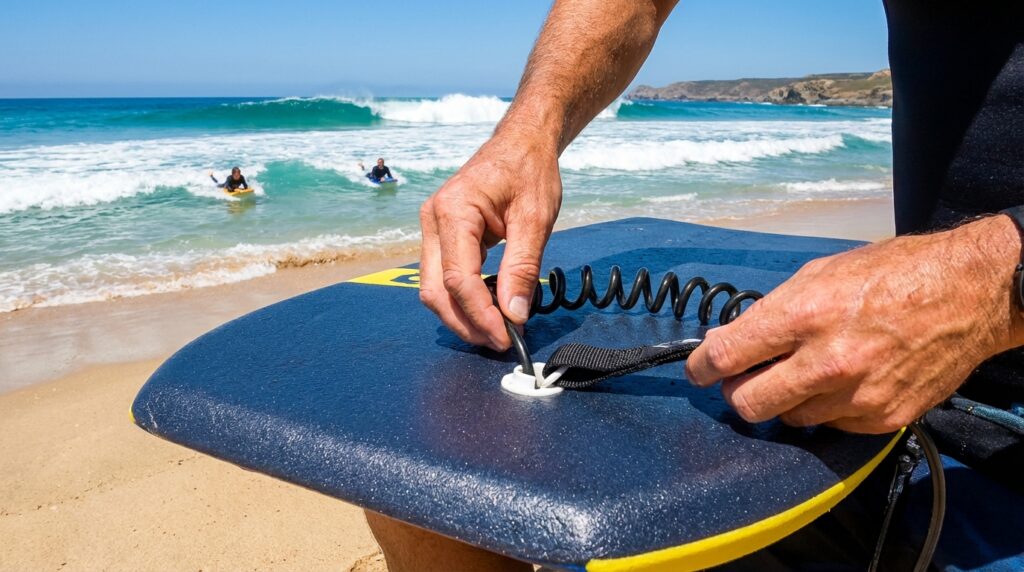
In brief:
- 🌊 Select a reliable leash: choose diameter, stainless swivels, and ergonomic neoprene foam.
- 🔧 Identify or install a solid plug without weakening the board’s core.
- 🤙 Master the attachment technique at biceps, wrist, or ankle to optimize paddling freedom.
- 🛠️ Follow a step-by-step guide for an installation without twisting or water ingress.
- 🧼 Maintain the cord after each session to extend its lifespan and avoid breaks during sets.
- 🚀 Anticipate the carbon & bio-resin material evolutions expected by 2026 for greener leashes.
Safety first: why a well-attached leash changes the session
Whether a rider charges a Breton beach-break or a volcanic slab in the Canaries, coaches insist on one primary rule: keep the board under control. The leash is the essential extension between the rider and their bodyboard; poorly attached, it turns an innocent wave into a risky scenario. On one hand, losing the board leaves the practitioner without a floater, exposing their body to rip currents or closing sets. On the other, uneven tension on the deck can tear the outer skin (slick) or cause water infiltration into the EPS core.
Two real-life cases highlight the stakes: in the middle of winter, Thomas was swept away by a lateral current at Cap-Breton after his leash broke at the first berm break. Without support, he fought for twenty minutes before reaching the beach, while his board drifted toward the rocky zone. Conversely, Clara, an experienced rider, had tightened the plug string poorly; during a spin at the Port-Louis peak, the tension sheared the slick, revealing a large hole difficult to repair. In both scenarios, a proper attachment would have prevented these scares.
Statistics published by the European Bodyboard Federation in 2026 confirm the trend: 68% of non-traumatic injuries recorded come from an uncontrolled board hitting the rider or a third party. This comprehensive report reminds that the leash must not only withstand the shock of a wipe-out but also retain its flexibility to absorb tension. Serious manufacturers announce an average resistance of 40 to 50 kg, but the anchor on the board must keep up!
Another major point: saving time. On a crowded spot, losing your board forces you to weave through foam lines to retrieve it, consuming precious energy. With a reliable attachment, a sharp pull is enough to bring the PE/PP sandwich against you, ready to start the next set without missing the golden set everyone dreams of.
Finally, a properly mounted leash also respects other users of the surf zone. A board ejected rapidly in the shorebreak can hit a young surfer or a swimmer. The code of conduct issued by Surf Prevention emphasizes: “Always check the string before paddling to the peak.” Moral: individual safety is always plural when the ocean hosts multiple disciplines simultaneously.
Required equipment: choose each component like a pro at the shop
A good assembly starts with an accurate inventory of parts. The basic triptych includes:
- 🪢 Leash coil in urethane, 7 mm or 8 mm diameter for hollow waves.
- 🔩 Double or single screw plug, ideally supplied in UV-treated ABS.
- 🧵 3 mm braided nylon string, 15 cm long, supple enough to make a flat knot.
Add to that a Phillips screwdriver, a 6 mm drill bit if the board lacks a plug, and a water-resistant marker. The home workshop thus requires few things, but each element demands a wise selection: urethane too thin breaks under the pressure of a two-meter lip, while an entry-level plug cracks at the first tightening.
To refine the choice of spiral cord, consult the step-by-step guide updated this year. It reveals that the 9/32’’ coil marketed by the Hawaiian brand Recon offers a 15% better elasticity/resistance ratio than the average, ideal for power surfing riders relying on strong compressions.
Let’s move to the plug: high-end boards now integrate a factory-molded insert, but many mid-range models continue to be sold without drilling. In this case, favor a “double face” style plug with a wide internal washer; it distributes compression on the foam and limits tearing. For those who love customization, some shops offer colored plugs matching the stringer or rails; a cosmetic detail that does not harm function.
Regarding the string, forget makeshift twine made from old shoelaces; it swells, loosens, then breaks at the first strong duck dive. The best cords feature a 12-strand braid, able to withstand more than 100 N. A simple double fisherman’s knot suffices to secure it, provided it is tightened on dry material.
Once all parts are gathered, settle on a flat surface, ideally covered with a towel to avoid scratching the bottom. A turned-off fan will limit dust on the slick while you drill the core.
Locate or install the plug: millimeter precision to preserve the EPS core
Novices often think it’s enough to aim “roughly forward” to place a plug. Yet, mispositioning this anchor point affects not only stress distribution on the board but also paddling comfort. Shapers recommend a placement 3 cm from the nose and 4 cm shifted toward the rail on the dominant arm side. This diagonal prevents traction from deforming the central deck zone while keeping the string out of the elbow area during the duck dive.
For a board without a plug, follow this protocol:
- 📍 Mark a cross with a permanent marker on the targeted area.
- 🦺 Put on gloves, then drill slowly with a new bit; moderate speed prevents foam overheating.
- 🌡️ Gently remove the foam cylinder, clean the cavity, and apply a drop of PU resin if the slick shows micro-cracks.
- 🔩 Insert the screw on the deck side, then place the wide washer against the slick before tightening firmly but never excessively; the washer should barely touch the polyethylene without crushing it.
This operation takes less than five minutes but conditions the board’s lifespan. In shops, riders tell stories of youthful mistakes: centered plug, board turned spongy; plug too close to the rail, board split after an aerial. Hence the importance of a well-thought attachment.
If your board already has an insert, inspect it. A cracked plug is easily replaced: unscrew, gently heat with a hairdryer to free residual glue, then install a new model. The new Venturi plugs, for example, include an O-ring reducing water infiltration by 30% according to the test published on Bodyboard Guide.
The above video report shows the real-time procedure; note the progressive screw rotation, never abrupt. This approach prevents the Phillips head from slipping and damaging the slick with an unwanted strike.
Choose the attachment point: biceps, wrist, or ankle?
The debate still fires up line-ups: some swear biceps leash totally frees the back leg, others defend the ankle to free the arms. The biceps option, however, dominates the prone scene since an ISA champion’s win in 2026 sporting a high-density neoprene strap. The reason: in paddling position, water flow runs along the arm’s axis, without creating drag on the slick. In the reverse spin move, the loop follows the rotation naturally, without getting stuck between torso and edge.
For drop-knee enthusiasts, the ankle (rear for a regular stance) remains relevant; the front shin rests on the deck while the back leg stabilizes the rail. A biceps leash might get caught in the bent knee. Breton surfing schools now teach both methods and let pupils decide after some test sessions.
There is also a market for wrist leashes, appreciated by young groms on tight budgets; the smaller strap costs 15% less. But beware: the wrist moves a lot, causing repeated twists that can prematurely wear the velcro. Tests by WaveLab magazine show an average lifespan of 18 months for wrist versus 24 months for biceps under equivalent use.
The table below summarizes strengths and weaknesses:
| Attachment point 🚀 | Advantages 💪 | Limitations ⚠️ |
|---|---|---|
| Biceps | Freedom of legs, low drag | Wider velcro, higher cost ↑ |
| Wrist | Reduced budget, quick donning | High shear, velcro wear |
| Ankle | Ideal for drop-knee, thick ankle pads | Increased drag in prone paddling |
For a deeper dive, the article easily attach a leash details feedback from pro riders who alternate depending on conditions: hollow reef? Compact biceps. Soft shorebreak? Ankle for drop-knee sliding.
Attachment steps on existing plug: the coil’s never-twisting step-by-step
Once the plug is installed, the operation involves eight gestures:
- 🧶 Thread the string through the plug eyelet, then make a temporary simple knot.
- 🪢 Make a double fisherman’s knot; tighten gradually while moistening the rope to prevent fiber fusion.
- 🔄 Check that the loop leaves 1 cm between the rope and the deck so the rail saver acts as a shield.
- 🔗 Clip the leash swivel carabiner into the loop, hook oriented toward the nose.
- 💧 Gently pull the coil to simulate wave tension; if the knot slips, tighten again.
- 🧑🔬 Check the double swivel alignment; both axes must remain parallel to prevent coiling.
- 🎒 Adjust the neoprene strap on your arm or ankle; position the tag outward for quick scratch release.
- 🩹 Cut the excess rope 5 mm from the knot and burn the tip with a lighter to seal the sheath.
Apply the same protocol as described in this illustrated guide, then test in your yard: throw the board forward, the coil should tension without twisting, return without a sharp snap. If twisting persists, check the swivels’ rotation; a grain of sand is enough to jam stainless balls.
The above tutorial highlights the crucial gesture: keep the board upright on its edge while tensioning so the rope aligns at the correct angle. Many beginner riders attach the board flat, creating latent twist from the start.
Maintenance, storage, recycling: making your gear and the planet last
Salt water, fine quartz sand, and UV represent the infernal triad of premature aging. Rigorous maintenance extends the leash’s life and thus that of the board. After each session:
- 🚿 Rinse with warm fresh water to remove salt and sand.
- 🌬️ Dry in shade, hanging by the strap to avoid kinks on the coil.
- 🧴 Quarterly application of food-grade silicone spray on swivels.
To store the board, coil the leash in a wide loop, loosely fix it with velcro then place it in a ventilated bag. Avoid closed covers in full summer; the sauna effect can soften the urethane.
Regarding recycling, several workshops like Re-Coil Project collect old leashes to turn polyurethane into SUP paddle handles. Since 2026, this structure has diverted 2 tons of waste from the classic channel. A good reason not to throw away your worn cord.
Longevity also depends on initial quality: the page life span expert advice reminds that an entry-level leash will logically show a reduced lifespan. Better to invest 5 € more than waste an epic session because a seam broke.
Common mistakes and quick fixes to stay zen at the line-up
The annual “Crash-Test Leash” workshop organized by Ocean Roots highlights the ten most frequent blunders:
- ❌ Simple knot on the rope; solution: switch to double fisherman’s knot.
- ❌ Plug tightened with an electric screwdriver; solution: calibrated manual screwdriver.
- ❌ Coil left taut in the hot car; solution: unhook and lay flat.
- ❌ Velcro not rinsed; solution: soft brush + systematic rinsing.
- ❌ Strap too tight causing numbness; solution: slip a finger under the strap.
These minor faults cause major issues. The best example remains Arnaud, whose sand-clogged velcro gave way during La Gravière shorebreak. Result: board thrown toward rocks, nose smashed. He has since adopted a dedicated toothbrush for his leash!
Brands innovate to limit human error. A Basque startup markets a self-cleaning velcro, while Austrian LoopTech tests a memory-foam coil reducing twisting by 50%. Watch for product launches, as worldwide release is announced before 2026.
Trends & innovations: toward the smart leash by 2026
Will future riding pass through digital? Prototypes displayed at the EuroSurf Expo give a glimpse. One model integrates an NFC chip housed in the plug; it records traction data to alert the user via smartphone when urethane fibers reach 80% of fatigue threshold. Coupled with an app, the feature even offers maintenance reminders.
On the ecological side, chemists focus on bio-based urethane from castor oil. Early tests show identical resistance with half the carbon footprint. ISA championships already require a minimum recycled material percentage for cord approval; sparking innovation.
Designers also revisit ergonomics. The Z-flex biceps strap adopts a 3D cut that hugs muscles without slipping, even under the 4/3 wetsuit. The promise: reduce micro-cutaneous lesions observed in 12% of riders according to a study published by the University of Porto.
Meanwhile, the ultimate guide to choosing the best board reminds that the leash is only one link in the system; a board too short or too long increases traction stresses. Weight/size matching tables, for example for an 80 kg build (choose ideal size), help balance the setup.
The latest avenue is called active hydrophobia: a nano-ceramic treatment applied on the coil repels water thus reducing drag. Early testers evaluated a +0.3 km/h gain on average paddling speed, significant during tight drop-knee contests.
At what frequency should you change your leash?
With regular use (2-3 sessions per week), a quality leash should be replaced every 24 months maximum or as soon as it shows significant coil thinning or velcro weakness.
Can you use a classic surf leash on a bodyboard?
Technically yes, but this increases drag and the risk that the board hits the rider; better to use a leash specific to bodyboarding, shorter and equipped with an adapted rail saver.
How to prevent the leash from twisting?
Choose a double swivel model, rinse it, lightly grease the bearings and fully unwind the coil before each session to reset its memory.
Can the plug be installed on any board?
Yes, provided the recommended axis is respected (3 cm from the nose, 4 cm from the rail) and the correct drill bit is used. Avoid very thin polypropylene honeycomb boards where threading may lack grip.