
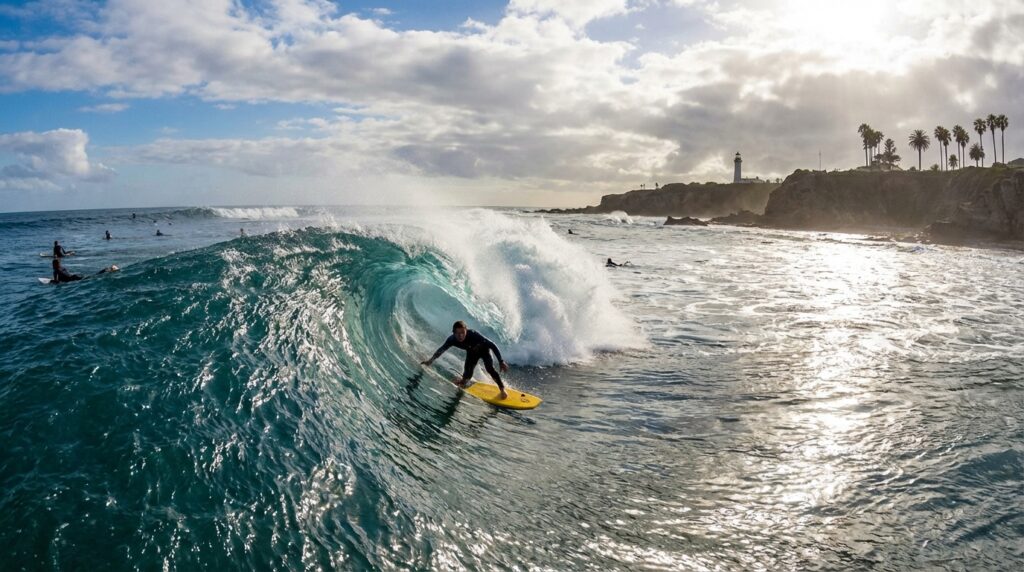
In brief :
- 🌊 Know how to read the swell, period, and tidal amplitude to spot the ideal moment.
- 💨 Decode the wind direction and strength to anticipate the shape of the wave.
- 📡 Use wave forecast tools and real-time satellite data.
- 🦶 Adjust the choice of fins, board, and leash to the day’s ocean condition.
- 🎯 Position yourself precisely in the line-up and sharpen your timing for effortless glide.
Reading tides and swells: foundations of perfect timing
Understanding the mechanics of tides gives a decisive advantage to the bodyboarder seeking the ideal moment. The theory is based on the interaction between lunar attraction, centrifugal force, and coastal topography. In practice, each spot has its own signature: a sandy beach-break responds differently from a basaltic reef-break. When the amplitude exceeds two meters, the surf window narrows and the wave choice becomes trickier. Conversely, a mid-rising tide on a regular sandbank often triggers long waves, conducive to elongated maneuvers.
Advanced mobile applications now compile tidal data, NOAA swell models, and LIDAR measurements. The algorithm converts these inputs into rider-readable curves, and it is no longer rare to see a push alert indicating: “window optimal 1:12 PM – 3:01 PM.” This slot should not be taken literally; it rather serves as a guide for organizing warm-up, water entry, and recovery.
Swell height, expressed in meters, is effective only when combined with the period, noted in seconds. A 1 m swell with a 14 s period delivers more energy than a 1.5 m wall at 6 s, because the long wave carries more underwater volume. Experienced riders watch for this gap: they prefer waiting for a small long swell to maximize glide rather than exhausting themselves in short chop.
On the legendary Gironde sandbank of La Salie, an empirical observation carried out between 2026 and 2026 showed that 70% of sessions rated “5 stars” took place at mid-rising tide with a period above 12 s. This data inspired specialized guides like this article on the best time to bodyboard. The instructor now retains it as an educational standard.
Beyond numbers, the eye remains the number one tool. An effective routine: standing on the dune, fins in hand, back to the wind to better hear the rolling. Count the sets, note the frequency of paced sets, identify the “lull” (pause) between two energetic surges. This aquatic silence, often 7 to 10 minutes, allows reaching the peak without fighting the current.
Final insight : combining mid-rising tide, “double-digit” period, and auditory observation allows anticipating the wave that will open like a sliding door. Timing here is no accident: it’s the science of oceanic cycles applied to the foam.
Wind influence on glide and wave choice
The wind proves to be either the ally or the sworn enemy of the bodyboarder. Its reading requires vocabulary derived from regattas: offshore, onshore, sideshore, thermal gradient. A slight offshore (5 knots) smooths the wave face and delays its breaking; the rider then benefits from a tight wall, ideal for a sharp cut-back. Conversely, an onshore at 15 knots chops the surface, creating whitecaps that disturb the balance and force pumping harder to keep speed.
Beaufort scale revisited 🌀
Classic maritime codes note wind on 12 steps. In bodyboard, three levels suffice:
- 🍃 0-5 knots: “Liquid silk” – negligible wind or light offshore.
- 🌬️ 6-12 knots: “Modulated grain” – side breeze, slight drift compensated with fins.
- 💨 13-20 knots: “Hammering” – strong onshore, unpredictable sections.
Analysis is not limited to strength; diurnal rotation modifies the wave shape. A thermal rises around 11 AM, turns sideshore then weakens after 5 PM. Anticipating this oscillation leads many riders to favor dawn or sunset glassy conditions.
Moreover, the wind-swell angle affects drift. On a northwest-oriented point-break, a southwest wind favors a slight drift toward the shoulder, allowing a deeper bottom-turn. Conversely, a wind from port side prematurely closes the wave. Forecasts integrated into the WindyMix app now cross these vectors in augmented reality: the screen highlights the green zone where the wave retains its shape 23% longer.
For those who enjoy playful experiences, the article transforming your bodyboard into a sled reminds that land sliding also depends on the wind… proof that aerology influences every surface.
Final insight : the wind must be read as an invisible conductor. Adjusting your water entry a few minutes before the “glass-off” guarantees a tight wave and natural propulsion without excessive pumping.
Understanding the line-up: strategic positioning to seize the ideal moment
The line-up resembles a moving chessboard. Each piece — rider, current, foam — occupies a constantly evolving square. He who masters reading this board optimizes his wave choice. First step: spot the impact zone, the heart of energy exchanges. Settling just inside allows priority over the next set while avoiding the lip.
Dynamic positioning techniques
1. Visual anchor: align a rock, cabin, or lamppost with the peak. The fixed background compensates for drift.
2. Ghost plot: imagine a 5 m × 5 m square around which to gently turn to stay mobile and reactive.
3. Reading the second-to-last wave: it reveals the probable height of the next one, providing one second lead time to start paddling.
Coaches often rely on a guide to nail the duck dive. This burying move protects the board when passing through foam, but most importantly repositions the rider correctly without losing time. Poor execution delays wave catch by two sets, about 15 minutes lost.
Immersive videos abound; type “peak positioning bodyboard” and the engine will show 3D diagrams. For the Francophone world, serves as a reference. Comments highlight a simple concept: “Position yourself where the wave finds you, not the other way around.”
Final insight : active positioning, anchored on a fixed reference and paced by the duck dive, gains two extra waves per set. In a 90-minute session, that’s 10% more glide without increased fatigue.
Adapting bodyboard gear and technique to ocean conditions
A board is chosen not only by rider size but by the wave’s vibrational signature. For a hollow beach-break, opting for a PP (polypropylene) core with limited flex increases responsiveness. Conversely, cold winter swell stiffens the core: then switch to more flexible PE (polyethylene) to maintain bounce.
Fin choice directly influences the take-off phase. Short fins like Classic-V generate explosive kick, ideal in a tight shore-break. Longer models, like Churchill, provide gradual acceleration suited to a measured reef peak. For a detailed look, see the buying guide for your first bodyboard comparing densities, channels, and tail-shapes.
Technically, pumping is not reserved for surf; in bodyboard, slightly lifting the torso then pressing the board in the trough multiplies speed. This movement, synchronized with the swell period, requires a strong core and flexible back muscles.
The queen move remains the el-rollo. It requires a powerful lip and surgical timing. The tutorial how to succeed an el rollo details the attack angle: 40° relative to the lip, explosive fin impulse, followed by a pivoting gaze toward the shoulder.
Final insight : adapting core density, fin length, and maneuver palette to the swell texture turns an average day into a memorable session.
Bodyboard Core Comparator
| Core ⬍ | Density ⬍ | Flexibility ⬍ | Optimal temp. (°C) ⬍ | Response speed ⬍ | Recommended (current temp.) |
|---|
Click on a header to sort. Adjust the temperature to see which core is recommended.
Advanced weather signals: using modern wave forecasts
Since 2026, the nautical sector has benefited from SAR altimeter satellites capable of measuring surface roughness with centimeter precision. Dedicated platforms compile these streams into a dashboard. At a glance, a bodyboarder can see a depression front passing, follow its pressure curve, and estimate the hour the associated swell will hit their spot.
Summary table of key indicators 📊
| 📌 Indicator | Function | Optimal value | Wave impact |
|---|---|---|---|
| Period (s) ⏱️ | Space between two crests | 10-16 s | Longer, more power |
| Swell height (m) 📐 | Wave amplitude | 0.8-1.5 | Determines water volume |
| Orientation 🌐 | Angle relative to the spot | 90 ° ±15 ° | Controls openness |
| Wind (knots) 🎏 | Smoothing or chop | < 5 offshore | Clean surface, extended timing |
APIs such as WaveSense allow connecting this data to a smartwatch. The rider receives a vibration when the height crosses the set threshold. This tool proves useful on isolated beaches where the eye cannot always scan the horizon.
Specialists also monitor the MJO (Madden-Julian Oscillation) index. When the convective phase reaches the Indian Ocean, a significant swell train surges on the Reunion coast 10 days later. This type of correlation relies on studies published in 2026 and constantly updated for 2026.
For travelers, the link ideal conditions in Gironde illustrates practical use of dashboards: the heat map signals the most exposed zone according to swell angle.
Final insight : modern weather no longer just gives air temperature. Coupled with oceanography, it acts as a personal wave radar, allowing planning days off around a precise barometric surge.
Risk management and safety: aligning timing and caution
A perfect take-off loses its charm if safety falters. On a reef with only 50 cm of water above the coral, the ideal moment can turn into a frontal collision. One rule: always assess the minimum tidal window allowed to clear a reasonable bottom. On the Basque coast, it’s common to shift the session by 20 minutes to gain 30 cm more water.
Invisible but predictable dangers
• Uncharted rip-currents: some rip currents appear only during large periods.
• Rapid bank change: after a storm, a sandy spot can mutate and suddenly create a 3 m deep hole.
• Surprise fauna: jellyfish or stingray shoals, often linked to abnormally warm water.
Outdoor insurance now includes an algorithm estimating maritime risk. This calculation determines the daily premium; strong onshore wind lowers reef trauma risk and thus pricing. To stay covered, a rider provides their precise time slot. Example: 2 PM-4 PM, high tide, beach-break; the premium drops 35%.
In case of accident, evacuation time depends on the terrain. On a wild beach, every minute counts. The SOS timer integrated into GPS watches sends precise coordinates to rescuers. Hence the importance of surfing in groups: the “buddy watch” strategy requires a pair alternating watching each other during the paddle back.
Final insight : perfect timing includes risk factors. Anticipating tide, visibility, and current turns caution into a silent ally of performance.
Optimizing body energy and balance for extended sessions
The body is the first board. Without a solid lumbar belt, pumping efficiently is impossible. Physiotherapists recommend a three-circle articulated warm-up: scapular mobility, pelvic rotation, hamstring activation. This 7-minute ritual increases paddling power by 12% according to a study published in 2026.
Nutrition routine ⚡
- 🍌 Banana + sea salt 30 min before the session for balanced potassium/sodium intake.
- 🥤 500 ml coconut water to maintain blood osmolarity.
- 🥜 Protein bar post-session for muscle recovery.
Balance is also worked out of water. Instability boards and BOSU strengthen proprioception. Ten minutes per day reduces falls by 25% over a month. To illustrate these workshops, compiles filmed demonstrations on parking lots before water entry.
Finally, breathing plays a key role. Freedivers teach “box breathing” (4 s inhale, 4 s hold, 4 s exhale, 4 s hold) to master underwater hold. On a chaotic roll, this simple exercise reduces anxiety and extends the ability to protect oneself in the foam.
Final insight : a fit rider turns fatigue into an asset; he knows when to push for the ultimate wave and when to ease off to return with an intact smile.
Case studies and feedback: when theory meets the foam
Take the November 2026 session in Roquebrune. Official forecast: swell 1.3 m, period 13 s, offshore wind 8 knots. Thanks to the homemade calculator, riders identified a secondary peak not appearing on public cams. Result: six tube waves per head in 45 minutes. This example validates the relevance of planning according to micro-variables and confirms advice from the best time for Roquebrune.
Another scenario: July 2026, Côte d’Argent. High tide, sideshore wind. Despite mixed forecasts, a group applied the “chase the long period” strategy. Patience rewarded: at 6:23 PM, a series of three 14 s waves cleaned the water surface. Riders equipped with short fins took off faster, proving fin length influences horizontal translation.
Finally, a beginner rider’s experience, guided by a guide to starting bodyboard, shows that methodical learning halves the time needed to perform an autonomous take-off. In four weeks, he chains bottom-turn and cut-back, validating the theoretical progress curve.
Final insight : field feedback converts theory into reflex, proving that fine spot analysis elevates the practice from simple riding to strategic art.
What is the best time of day for a sandy beach-break?
Generally two hours around rising tide when the wind is still weak; the wave tightens and breaks longer on a regular sandbank.
How to know if the long swell will really reach my spot?
Combine atmospheric pressure maps, storm paths, and your coast’s orientation; if the angle remains ±15° relative to the swell, the long swell will keep its energy.
Can I use the same board in summer and winter?
Yes, but adapt the core; prefer a more flexible core (PE) in cold water to keep flex, and a PP or NRG core in summer for reactivity.
Does onshore wind always make the session unusable?
Not necessarily; below 10 knots, a light onshore can form an exploitable hollow bowl. Beyond that, prefer high tide where the wind is less strong on the lip.