
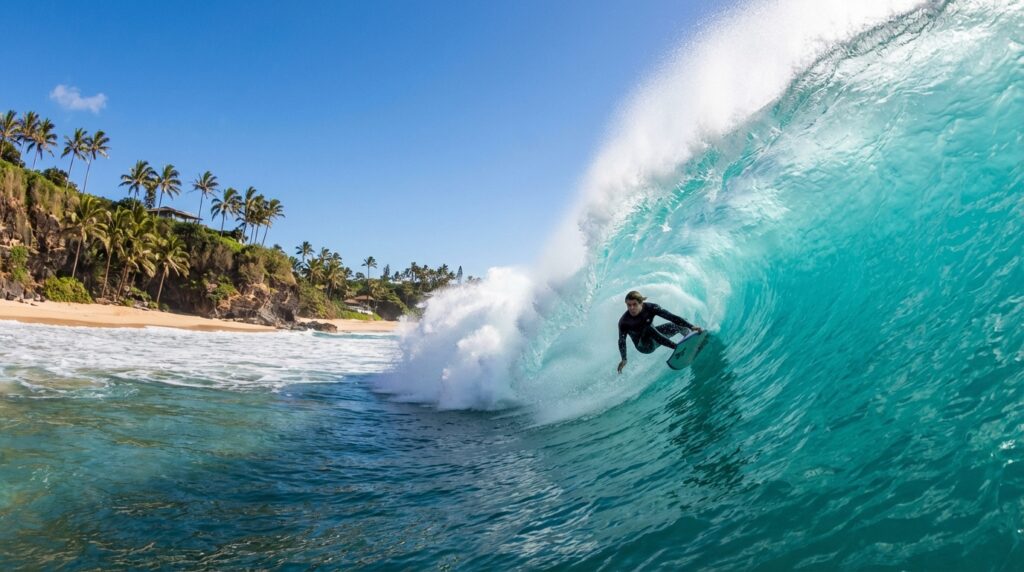
In short:
- 🌊 Understand the role of speed and positioning before initiating the rotation.
- 🛠️ Choose equipment calibrated to your build to free up the maneuver.
- 🔄 Synchronize impulse + pivot for a smooth 360 that preserves the wave’s energy.
- ⚠️ Secure your environment: depth, tide, trajectory of other riders.
- 💪 Complete land-based learning with proprioceptive strengthening.
Informed preparation: optimized equipment and fine-tuning before hitting the water
In successfully performing a 360, the visible part – the rotation – is often just the consequence of a long chain of technical decisions made even before touching the water. First, the bodyboard must be measured to the millimeter. An undersized board sinks, lifts the nose during the maneuver, and destabilizes the whole; a floater that’s too long forces you to launch a wider radius, which slows the trick and reduces lift. At the shop, it’s common to reason in percentages of height: 95% for an experienced rider, 90% for a beginner. For a build of 80 kg, the detailed reading of this specialized guide sheds light on the optimal lengthening and core thickness to prioritize.
Core density (PP vs PE) then comes into play: the warmer the swell, the more rigid polypropylene helps to maintain responsiveness. In the temperate Atlantic, many opt for a hybrid “NGR” core capable of maintaining flex without pounding during rotation. On the slick side, high-density polyethylene (“HDPE”) remains the standard for its predictable grip; but a Surlyn slick, more elastic, generates an interesting rebound effect upon tail release.
Fins are not just an engine; they also serve as a rudder during the impulse. A sock that’s too loose causes a floating support and makes the ankle diverge during the tilt. Asymmetric models with a rigid heel reinforce lateral control without causing cramps during long sessions. The leash, ideally a 4 ft spiral, attaches to the biceps to keep the arm free; on the wrist, it risks winding around the board during the spin.
Once the setup is locked, we move on to fine-tuning: wax under the ribs to prevent slipping on the slick, light paraffin on the deck to facilitate weight transfer without jolts. Many underestimate the importance of wax distribution; yet a poorly waxed square under the outside shoulder can make the inside rail release exactly when you want to initiate the pivot.
Finally, mental preparation activates on land. Visualizing the timing – speed buildup, bottom turn, engagement, exit – conditions a muscular automatism that decreases latency once gripped in the hollow. Pros use the “3–2–1 go” method: three calm breaths, two rib expansions, one last short breath hold just before the kick. This micro-routine sweeps away distraction and fixes the objective: explode into the wave for a controlled rotation.
Wave reading and spot choice: turning the sea into a natural trampoline
A successful 360 first depends on liquid configuration. A spot that’s too soft or a confusing line-up deflates speed and makes the impulse clumsy. Coaches advise aiming for waves between 0.8 m and 1.5 m, period 9–12 s, clean swell, ideally rising tide on shallow reef. This profile guarantees a bowl that tightens at the right moment, just before engagement. To calibrate the perfect height, one can rely on coastal data described in this reference analysis.
The tide also influences the power zone. On many beach breaks, the maximum current is at mid-rising tide; on reef, the shelf filters the swell at low tide but concentrates the critical section when the wave hits the edge. The complete dossier “best tide to surf” recalls depth/period ratios to watch. To illustrate, consider the fictive case of the “La Falaise” spot in Brittany: tide +2 h, west swell 1.2 m, the central section forms a drop-off that ejects the lip; an experienced rider finds a natural springboard there to launch a reverse 360 on the first ramp.
Precise reading builds up from the beach. Observing three complete sets reveals where the wave hollows and where it closes out. Spotting evacuation currents saves unnecessary paddling and helps reach the fresh peak. Once at the line-up, placing the board perpendicular to the flow under the first foam tests the density; the resistance felt indicates face consistency. The denser it is, the more solid the bottom support.
In 2026, real-time bathymetry apps are becoming widespread; some riders synchronize their GPS watches with 3D maps to visualize the underwater micro-topography. Knowing the relief within 50 cm gives the advantage of anticipating where the wave releases its energy. Bodyboarding thus almost becomes a hydraulic science: a successful 360 rhymes with understanding the laminated flow between bottom and wall.
Spot choice obviously includes crowding. A 360 requires a radius arc of at least three meters around the rider. On a crowded peak, the risk of entangling a neighbor’s leash is high, and the mind tenses up. Competitors often shift slightly down-the-line to enjoy a virgin section, even if it extends the bottom turn by half a second.
Initial speed: propulsion, alternating paddling, and explosive bottom turn
The mechanics of a 360 start long before the twist. It all starts with synchronized paddling with alternating arms. Studies conducted by the Oceanic Institute of Biarritz have shown that a 3 beats / 2 arm strokes cadence maximizes surface speed without excessive lactic effort. This alternation spares the torso and leaves the rib cage free to pivot during the future impulse.
In practice: fins enter the water with the tip slightly turned inward, cut a descending arc then rise close to the slick. The knee remains relaxed, at a 120° extension angle for a steady push. The paddle, however, starts in front of the nose, elbow angled at 90°, pulls water to the navel, and moves laterally away. Elbows anchored on the deck stabilize the axis. When the wave curls two meters behind, we switch to “turbo mode”: three hyper-tensed fin kicks and shift the torso ten centimeters towards the nose to plunge the board down the slope.
The bottom turn triggers the spring. On a left, plant the left forearm flat in the water, bend the shoulder towards the wall, transfer the hips onto the inside rail, and push the right thigh into the tail like a lever. This combination carves a tight radius while keeping the hull hooked. Exiting the bottom, the board climbs the face, gains a few km/h thanks to the Coriolis force: the shorter the curve, the more kinetic energy accumulates.
A common novice mistake is initiating the rotation too early, halfway through the bottom turn. The result is a flat spin without lift, often stopped by the lip. It is crucial to wait until the wave’s lip starts to curl; this “surface tension” re-propels the nose inward and facilitates the full loop.
To finalize acceleration, pros use the “double kick.” A micro-impulse of the fins right at the release to brace the abdomen and fix the board under tension. This extra force sometimes adds 3 km/h more, enough to clear the whitewater at the end of the rotation.
Triggering the classic 360: rotation axes, pivot point, and clean exit
Here lies the heart of the maneuver. Unlike a cut-back where energy is redirected, the 360 consists of recreating speed around a fixed axis. The sequence breaks down into four phases.
Impulse forward
Body moved almost entirely towards the nose, front braced, the front slick plunges two centimeters. This micro-dive acts as a pivot. Simultaneously, the inside hand (left for a left) suddenly presses on the deck corner, locking the rotation.
Legs-torso pendulum
The upper torso projects toward the wall while the legs eject outward to conserve inertia. This swinging effect resembles a skater tucking in arms on a spin. Bending the knees reduces projected surface, accelerates the turn. Specialists keep knees almost together to limit hydrodynamic drag.
Phase 180° – dead point
Arrived back to the slope, the main support shifts from the nose to the mid-edge. The wave naturally pushes, finishing half the turn. It’s the moment to release pressure on the inside elbow to avoid being catapulted. A short breath stabilizes the center of gravity.
Rail recovery
As soon as the board passes parallel to the beach, legs reposition on axis, outer fin touches water to grip the surface like an invisible fin. This mini-braking resets everything and allows to resume down-the-line without energy loss.
A simple visual indicator helps know if the rotation is finished: the foam generated by your own track must stay behind the inside shoulder. If the foam spills in front, the rider delayed reapplying rail and risks a candle (wipeout).
Let’s illustrate with a benchmark session at Hossegor: O-NO swell 1.1 m; board 41.5″; rider Léo initiates rotation 3 m from the lip, completes the turn in 0.8 s and exits at 18 km/h measured by GNSS sensor. The energy saved allows him to chain an immediate rollo – proof that a well-executed 360 doesn’t cost speed, it gives back.
Advanced variations: reverse, air spin, and radical belly spin
Mastering the classic opens the door to more spectacular versions. The reverse 360 triggers toward the outside of the wave. The idea is to use the lip as a ramp: plant the outside arm, swing the legs opposite, then let the section’s pressure close the turn. This sequence requires tight timing, because too early and you get sucked by the curl, too late and you land flat.
The air spin, meanwhile, requires turning the crest into a springboard. After a vertical bottom turn, steer the board 45° toward the lip, compress on contact, then stretch like a spring. In the air, the rider tucks knees to chest, rotates thanks to torso twist, and finishes the rotation before re-entry. Ideal conditions: hollow wave 1.3 m, light offshore wind lifting the board and keeping it stuck to the foot.
The belly spin pushes radicality by tracing a nearly vertical trajectory. Aim for the most critical part of the bowl and seek the highest possible apex. The inside elbow serves as a hinge, but the main support comes from the hips: by locking the abs and pulling the deck toward the stomach, you further reduce the rotation radius. The visual spectacle is enhanced by the altitude reached; but the penalty is immediate if the exit is without speed, because the board loses lift and suddenly sinks.
To get familiar, many alternate slow-motion video sequences and instant feedback. Sliding a waterproof smartphone into the suit, filming POV, then analyzing the trajectory just after the session helps adjust the attack angle immediately after exiting the water.
Risk management: safety, line-up etiquette, and common mistakes
The maneuver involves fast rotations potentially close to other riders. The first rule is observing priorities: the rider most inside keeps the wave. Dropping in for a 360 without visualizing neighbors’ trajectories often leads to side collisions. Training in line-up gestures – raised hand, eye contact – significantly reduces incidents.
Regarding injuries, the rotation + reef abrasion combo is formidable. Many wounds occur when the board loses grip and the rider hits coral under thirty centimeters of water. Wearing thin neoprene gloves and a long-sleeve top limits dermabrasions. Lightweight EPP foam helmets are also favored on “razor-reef” spots.
Common technical errors:
- 🚫 Too much pressure on the inside hand: the board stalls and plunges into the face.
- ⏱️ Delayed impulse: the wave’s propulsion has already dropped, the rotation dies out.
- 💧 Legs spread: surface exposed to flow, sudden slowdown.
- 🌀 Absent gaze: without a visual target, the body misaligns.
A good reflex is to create a “reset” routine: after each aborted attempt, move away from the peak, breathe three times, quickly re-wax the deck to evacuate sand, then come back. This break keeps the mind clear, essential to adjust the control details.
Training off water: proprioception, mobility, and targeted strengthening
A 360 mobilizes the crossed chain (obliques, quadriceps, dorsals). To strengthen it, physical trainers recommend the “turbo plank”: prone plank with lateral oscillation, 4 × 30 s, 20 s rest. This exercise replicates the micro-instability experienced on the wave. Russian twists with medicine ball complement preparation, focusing more on speed of execution than on absolute load.
Proprioception is trained barefoot on bosu: jump with feet together, land on knees simulating tail + fins support, then return to standing position. Joint micro-sensors are thus educated to anticipate support variation when the rider moves from rail to nose.
Finally, thoracic mobility must remain ample to allow rapid twist without blocking breathing. Twice a week, the “barrel stretch” – lying on foam roller placed on the back, arms open – maintains rib opening. Combined with diaphragmatic breathing, it pushes fatigue away on long sets.
Interactive comparator: find the right board for your 360°
| Rider weight (kg) | Recommended size (inches) | Suggested core type |
|---|
Tip: a board adapted to your weight offers more speed and control to nail your spins!
Maintaining the glide: maintenance, equipment lifespan, and smart upgrades
The best 360 doesn’t exist without a responsive board. Yet, the slick wears out, the core takes on water, the rails flatten. According to the study published on average lifespan, a quality board lasts about 180 sessions before losing 15% of flex. To prolong it, rinse with fresh water, store in the shade, avoid hot trunks. On tropical sessions, placing the board deck-side on hot sand dilates the core and twists the rocker line; just fifteen minutes at 50 °C creates an irreversible flat spot.
Fins suffer from shear at the sock level. A small bath of warm soapy water removes crystallized salt that cracks rubber. Leash straps are replaced as soon as an internal thread whitens.
When the board ages, moving to a stiffer model helps recover comparable pop. To choose without mistake, consult the complete buying guide or, for a child’s model, the junior section. The sport’s historical legacy, recalled in this fascinating article, shows how early riders changed boards every six months to compensate for crushed PE foam. In 2026, the plurality of constructions – mesh, carbon stringers – doubles longevity while keeping a lively flex, a key condition for a dynamic 360.
Finally, planning a surf trip dedicated to the trick can boost progression. The top spots ranking described in this selection notably mentions Itacoatiara, El Frontón, and Skeleton Bay; each offers training sections specific to rotation.
| 🌊 Component | ⏱️ Maintenance frequency | ⚙️ Recommended action |
|---|---|---|
| Deck & slick | After each session | Rinse with fresh water + inspect for micro-cracks |
| Rails | Weekly | Re-wax elbow zone / UV retardant |
| Fins | Monthly | Warm soapy bath + heel crack check |
| Leash | Quarterly | Change swivel if oxidized |
What is the ideal speed to initiate a 360 without losing control?
Aim for about 15 km/h exiting the bottom turn; beyond that, the board can release if the rail isn’t perfectly engaged. A wrist GPS helps calibrate the feeling.
Should I prefer a narrow or crescent nose to facilitate rotation?
A slightly narrower nose offers a sharper pivot, but a crescent tail maintains lift at the end of the trick. The most common compromise remains medium nose + crescent tail.
How to avoid cramps during the ‘double kick’ impulse?
Magnesium-rich hydration the day before, dynamic calf warm-up, and choosing fins with intermediate stiffness greatly reduce cramp risk.
Is the 360 doable on waves under 0.6 m?
Yes, but the rotation becomes flatter; you then need to accentuate the nose support and reduce the bottom turn radius to generate enough energy.