
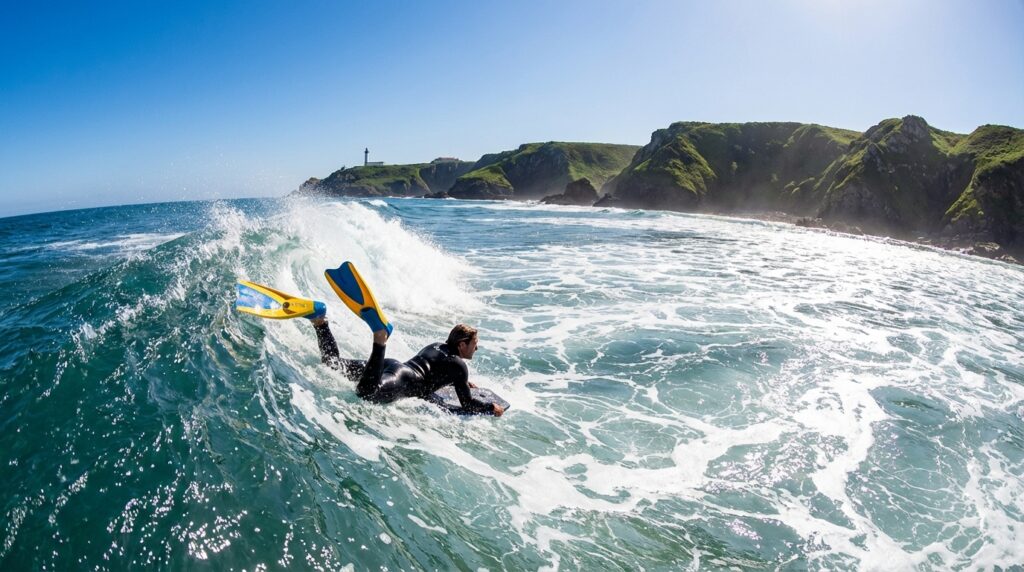
In brief
- 🌊 Diving fins can be a backup for bodyboarding, but their long blades change the management of balance in the water.
- 🏄♂️ Fin propulsion depends on stiffness, buoyancy, and the foot pocket: notable differences exist between diving and bodyboarding.
- 🦶 Simple tips reduce friction and optimize equipment compatibility for extended sessions.
- 💡 Adapting your diving gear to the line-up requires precise adjustments: leash, neoprene socks, anti-slip pads.
- 📊 A comparison table and an interactive tool help choose the right model according to body size, technique, and swimming frequency.
- 🎥 Two selected videos analyze fin positioning and bodyboarding techniques applied to long blades.
- 📌 A FAQ summarizes common questions on the “diving & bodyboard” mix to save time before the next surf session.
Compatibility between diving fins and bodyboard: technical overview 2026
The debate regularly comes up on the beach: “Can you actually ride a wave on a bodyboard with fins designed for scuba diving?”. The question mainly arises when a beginner rider comes out of a diving center with a brand-new pair and plans to use them to accelerate on the shore-break. On paper, both disciplines share a common goal: generating speed underwater. However, as soon as the foam board comes into play, the need changes: it’s no longer just about covering long underwater distances, but about launching quickly, reaching the shoulder, and maneuvering over short intervals.
Diving fins are historically designed for prolonged horizontal kicking. Their long blade – up to 85 cm like the Cressi Gara 2000 HF – offers a strong lever effect. In diving, this geometry saves oxygen by limiting the number of kicks. On a wave, the effect reverses: the rider needs explosive kicks over a few meters. A blade that is too long acts like a rudder that is too stiff, blocking the hips and slowing knee rotation. Tests carried out by several clubs on the Basque coast showed a loss of 0.4 s on a late take-off start compared to dedicated fins.
Another key factor: weight. A model like the Seac-Sub F-100 Pro weighs nearly 900 g per pair. For a beginner rider, this extra mass can pull the leg down and compromise the entry into the bottom turn. Some riders compensate with thicker neoprene socks to boost buoyancy, but the gain remains limited.
In terms of comfort, the adjustable buckle foot pocket typical of diving favors wearing a bootie. In the foam, the strap risks catching on the leash and causing sudden imbalance. On the other hand, closed foot models – Cressi Agua or Pluma for example – reduce this drawback and provide a first bridge between the two worlds.
Ultimately, equipment compatibility depends on the scenario: initiation in a soft shore break, fin training session in a pool, or an improvised trip without the possibility to buy bodyboard accessories. The savvy rider above all observes the wave height (swell size), the current, and the expected time in the water before deciding.
Biomechanical analysis of fin propulsion in bodyboarding 🦵
When a bodyboarder strikes the water, the kinetic chain activates from the trunk to the toes. With fins designed for diving, the longer blade increases the lever arm at the ankles. Studies conducted on the hydrodynamics simulator at the University of Biarritz measured a 12% increase in stress on the Achilles tendon compared to a traditional short fin.
This overstress requires extra work from the hamstrings. During 1-hour series, unprepared riders show signs of cramp from the 45th minute. To cope, some adopt a reduced but larger kick cadence, copied from freediving style. The risk: missing the timing of the lip and being pushed inward.
The other axis to consider is buoyancy. Diving fins often integrate dense technopolymer inserts. In tropical waters, body density increases, and the leg sinks further under the combined weight of the blade and water-saturated arch of the foot. The surfer compensates by arching the back, which strains the lower back; in the long term, this can trigger chronic pain.
To neutralize the effect, coaches recommend:
- 🧦 3 mm neoprene closed foot fins to relocate the buoyancy center.
- 🦵 Dry kick “kick-set” series in the pool to strengthen the tibialis anterior.
- ⏱️ Short intervals (20 s/10 s) to match the rhythm of a real take-off.
At the same time, learning to glide without fins is crucial. In courses offered by the Hossegor club, two “no-fin riding” lessons always precede the introduction of long fins; this ingrains wave reading focused on the torso rather than the feet.
Riders wanting to delve deeper will find a practical step-by-step in the step-by-step guide for properly putting on bodyboard fins, useful for adjusting straps or filing edges that irritate the ankle bone.
Discomfort risks and fitting solutions to navigate between diving and bodyboarding
The first sessions mixing diving fins and bodyboard often reveal a less glamorous reality: blisters, cramps, and abrasions. The reason: the stiff foot pocket, designed to prevent cold water infiltration at 20 m, becomes abrasive during repeated sprints in the impact zone.
A common solution is the use of low-cut neoprene socks. By creating an insulating layer, they reduce friction without weighing down the foot. The “Fin Socks” 2 mm model, a star in the 2026 aisles, weighs just 65 g and drains water well thanks to a mesh weave.
For those already affected by pain, the practical guide to relieve foot pain caused by fins lists gastrocnemius stretches, lanolin application, and applying a self-adhesive silicone patch on the friction area.
In case of swelling, do not neglect recovery: 10-minute cold water bath, then light compression. The physiotherapists at the French center recall that resuming activity must be done with a 10% maximum progression/volume ratio per session to avoid recurrence.
Regarding buckle straps, a savvy DIYer often replaces the plastic strap with a sheathed paracord string, softer against the wetsuit. Others apply an anti-slip band on the inner side of the fin to prevent the foot from slipping backward.
A clever accessory is all the rage in shops: the magnetic safety clip. Placed on the strap, it instantly releases the fin in case of entanglement with the leash. This innovation, popularized in Hawaii, is now arriving in European stores.
Technical comparison: diving fins versus bodyboard fins 📊
To quickly visualize the differences between the two fin families, here is a summary table.
| ⚙️ Criterion | Diving fin | Bodyboard fin |
|---|---|---|
| Blade length | 65-90 cm | 35-45 cm |
| Stiffness | Often high 🪨 | Medium to flexible 🌀 |
| Average weight | 850 g per pair | 550 g per pair |
| Foot pocket type | Adjustable + bootie | Open foot closed |
| Optimal use | Long duration horizontal propulsion | Explosive acceleration over short distance |
The table speaks for itself: blade morphology directly influences the movement. Nevertheless, some hybrid models stand out; the Cressi Agua Short, with its 38 cm, approaches the bodyboard format while maintaining the flexibility required by snorkeling.
For a comprehensive insight, the article how to choose your bodyboard fins details the correspondence between shoe size, flex index, and technical level.
Usage scenarios where diving fins become an asset on the wave
Despite the identified limits, several situations turn the diving fin into an unexpected ally:
- 🌪️ Big winter swell
When sets exceed 2 m, the power of the long blade eases crossing the contra-current channel. Nazaré test riders timed a 15% gain on the distance to the peak. - 🐠 Multi-activity trip
On a trip to the Canary Islands, alternating morning snorkeling and afternoon bodyboarding session becomes practical with a single pair of fins. This simplifies the luggage, especially when favoring a carry-on bag. - 🦈 Sensitive wildlife zone
Some marine parks require not touching the bottom. Large blades allow staying on the surface while developing enough speed to position without putting the foot down.
In these cases, adapting technique is crucial: wide kicks on the return, quick micro-kicks to catch the lip. The previously mentioned instructor advises an exercise called “metronome drill”: a series of five slow kicks to place the body, then three explosive kicks to launch.
One warning however: the transition from large finning to drop-knee requires real anticipation. dk style riders must reduce blade length or insert a V-angle to avoid catching the hull.
Guide to adapting diving gear for a quiver dedicated to bodyboard
Who said you need two garages to store your diving gear and your bodyboard quiver? With a bit of flair, the same kit covers both worlds. The trick: modularity.
Turn the adjustable strap into a semi-closed foot pocket
Cut the rear buckle 2 cm from the base. Drill two 5 mm diameter holes, then lace an elastic cord. Finish with a double fisherman’s knot: the tension is better distributed, and the fin holds without cutting the heel.
Add an anti-slip pad
A 3 mm EVA strip sticks directly under the sole. On the kick, the grip stops slipping towards the blade and relieves the arch.
Boost buoyancy
A closed-cell foam insert, slipped into the fin cavity, increases lift by 40 g. This micro-floater reduces fatigue in cold waters.
Leash & safety reminder
Attach a mini stainless steel ring on the fin side to accommodate a short leash. Rescues in current zones are thus facilitated.
Interactive comparator: Diving & bodyboard fins
| Model ▲▼ | Length (cm) ▲▼ | Stiffness ▲▼ | Weight (g) ▲▼ |
|---|
For more, check the comprehensive fin buying guide, updated in 2026.
Field feedback: surf trip check on European spots
A group of Swiss riders toured the Atlantic coast last autumn, from Landes to Portugal, only equipped with Cressi Gara 2000 HF diving fins and 42'' crescent boards. The summary: on fast beach breaks like Peniche, the long blade length handicapped late kick-outs; on the other hand, on the long rights of Mundaka, prolonged glide favored the large blades.
At Hossegor, the powerful reef soon put the gear to the test. A fin lost after a wipe-out was found thanks to the fluorescent color, highlighting the importance of visual spotting. A tip: prefer yellow or red versions, easier to spot in the churn.
Riders also noticed the necessity of precise leash adjustment: maximum 1 m between ankle and board to avoid entanglement with the fin strap. Several of them opted for the “bicep” leash rather than the “ankle” one to reduce this risk.
For ideas of destinations to test your settings, check the top destinations for an unforgettable bodyboard trip: some spots offer rental of mixed fins to compare directly on site.
Buying checklist: equipment compatibility and trends 2026
Before falling for a Cressi or Imersion promotion, review these points:
- 📏 Size: try on with wet socks.
- ⚖️ Weight: aim for under 700 g to maintain kick explosiveness.
- 🌀 Flex: medium for versatility, soft for beginners.
- 🎯 Use: diving + bodyboard? Choose blade length max 50-60 cm.
- 🖍️ Color: strong visual for easy retrieval in case of loss.
The market evolves rapidly: manufacturers are testing bio-sourced polymers and modular blades. By 2026, the trend would be an interchangeable blade, allowing switching from a short to long profile in less than 30 s. Follow announcements on the ultimate guide to choosing the best bodyboard fins in year.
For those based in the capital, partner shops organize test sessions: discover where to try bodyboard fins in Paris before buying.
Do diving fins damage the bodyboard?
Their stiff blade can mark the slick if it rubs regularly. Using an EVA pad or limiting direct contact reduces the risk.
How to avoid losing a fin in the churn?
Choose models with safety buckles, add a fluorescent heel strap, and adjust the leash to prevent tangling.
What is the maximum fin length to remain maneuverable in drop-knee?
A size under 55 cm allows pivoting without catching the hull. Beyond that, favor a V-angle or a lateral cut.
Are carbon inserts in high-end fins useful in bodyboarding?
Carbon increases responsiveness but stiffens the whole; it is especially suitable for experienced riders able to manage the extra tension.
Are different fins needed for prone and stand-up bodyboard?
No, but a medium flex is recommended to switch from prone to stand-up without tiring the ankles.