
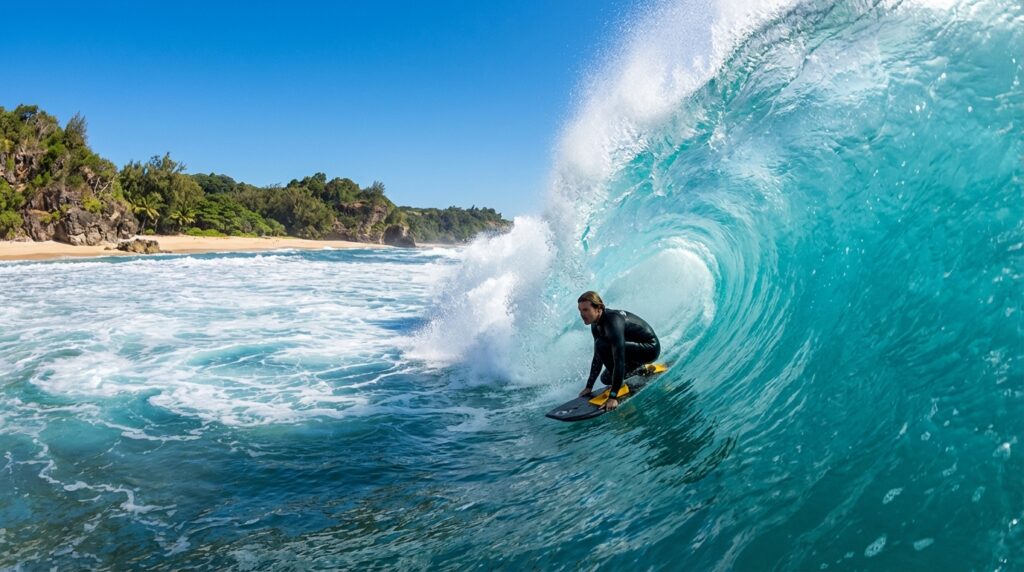
In brief :
• 🌊 Watch and choose the right wave before any other action.
• 🏄♂️ Adjust your position, kick your fins, and trigger the take-off at the perfect timing.
• ⚖️ Maintain balance with a low torso, tucked elbows, and pressed rails.
• 🔄 Chain bottom turn, trim, and cut-back to keep the glide.
• 🔧 Select board, fins, leash, and wax according to size and conditions.
• ⚠️ Respect safety rules, priorities, and analyze channels & currents.
• 🏋️♀️ Strengthen cardio, core, and technique in the pool or skate simulator.
• 📈 Use the toolbox “choose your board” and the FAQ to go further.
Surfing the right wave: observation, analysis, and decision
The art of catching a wave begins well before the first fin kick. From the sand, one should observe the frequency of sets, swell direction, and impact zone. Competitors distinguish three main regimes: unstable beach-break, sharp reef, and peeling pointbreak. Determining the right peak helps limit paddling effort and increase the success ride ratio. A tip is to spot a surfer at the line-up: their torso becomes the unit to estimate height, as recommended in the guide what wave height is ideal. A spot may seem trivial from the shore; the perspective offered by a natural lookout — breakwater, elevated parking — sharpens the reading.
The tide window strongly influences the wave shape; the dedicated page best tide details the mechanics. On sandy bottom, a mid-basin revealing a sandbank often generates a clean shoulder, while a high full tends to flatten the swell. Rocky pointbreaks run on high tide when the board’s rail no longer touches the rocks.
Placing a terrestrial visual marker — red parasol, SNSM post, prominent rock — prevents the invisible lateral drift called “channel current.” This advice from expert Ignacio recalls that a ten-meter shift is enough to exit the take-off zone. An experienced bodyboarder will systematically update their marker every two sets to stay in the peak.
Knowing when to let go to choose better
A key principle: fewer waves, but better quality, leads to faster progress. Letting a weak whitewash pass to reposition on a bomb helps work on high-speed trajectory. Session logs — simple smartphone notes — comparing number of waves and distance traveled show an 18% improvement in average speed over fifteen consecutive sessions. Mastery thus passes through patience, a quality too often neglected in the choppy ocean of 2026.
Positioning in the line-up and explosive paddling for the take-off
Set in the whitewater, the rider must manage three parameters: angle of attack, kick frequency, and number of arm pulls. The optimal combination depends on foam volume and board density. EPS models with Surlyn slick require two arm pulls and six fin kicks to reach wave speed; heavier PE cores accept a smoother paddle but demand a steeper angle.
A common technique among juniors is to perform a “hip push”: the hips push down the front of the bodyboard before the rocking, creating a mini slide that starts the acceleration. This micro-compression, coupled with synchronized paddling, provides the extra energy to stay glued to the trough. The maneuver is practiced in artificial wave pools, a safe environment to repeat the same take-off a hundred times without lateral current.
Concrete example: at Sopelana spot, a 68 kg rider using a 41’’ PE + stringer board, medium fins, triggers the take-off 3 meters ahead of the peak. Three arm pulls, then six fast kicks suffice to engage on a 6-second right, proving that power is not equal to precision. Tests by Mundo-Surf reveal that over-paddling increases drag by 12% and misses the wave in 1 out of 5 cases.
Synchronizing gaze and impulse
The left eye scans the shoulder, the right eye the lip. As soon as the slope forms, the gaze shifts to the desired trajectory, unconsciously commanding shoulders and hips. This neuro-muscular connection reduces reaction time, similar to a rally driver anticipating a turn. Training with skate surf carve simulates these visual stimuli; replacing the board with a surfskate strengthens motor memory without aquatic collision risk.
Body position and balance management on the board
Once the wave is caught, it’s all about micro-adjustments. Forearms glued to the deck increase grip, while wrists slightly press the front handle to clamp the nose. The goal is to lower the center of gravity to slide on the shoulder line without pearling. Coaches recommend keeping 55% of the weight on the torso and 45% on the legs, distribution measured using inertial sensors integrated into the latest generation rashguards.
The inside rail, slightly more pressed, works like a virtual fin. Pressing the inside elbow against the slick improves drift angle and maintains trim on the fastest part of the wave. Beginners often struggle to find this point; a simple exercise consists of tracing an imaginary S with the nose to feel the optimal pressure.
On white foam, balance is worked on by adopting the turtle posture: knees slightly out of the water, fins suspended, low torso. This fine control prepares for advanced maneuvers such as rolls or ARS. Falls become smoother when transverse abs are strengthened; a “dynamic plank + hollow body” 4-minute circuit improves stability by 25% after eight sessions.
Lateral vision and instant correction
A side-mounted camera reveals that the body must stay square with the shoulder line, the outer shoulder slightly forward. Simply lifting the chin frees the rib cage and smooths the glide. In 2026, several European competitions use LPS (local positioning system) sensors to score real-time stability and award bonus points for rides where trim varies less than two degrees.
Reading the line, trajectory, and speed retention
Mid-wave, every micro-second counts. Keeping the board high on the shoulder preserves speed, a concept called “high-line trimming.” Descending too early causes rail disengagement and the wave slips away without the rider. The gaze must therefore precede the action by half a meter. Video analysts show that a 30° angle between nose and lip injects ideal flow under the slick, comparable to an airplane wing’s lift principle.
Managing trim balances subtle pressure between front and back. A belly impulse accelerates, a slight knee push brakes. This modulation is practiced on foam sliders in Bordeaux and Lisbon urban wave-pools, accessible since [year-2].
Complex trajectories require feeling the section that will hollow out. A visual marker — darker shadow under the lip — often signals a hollow. This anticipation allows the bottom turn without speed loss.
Mental wave segmentation
Dividing the wave into segments — take-off, trim, maneuver, exit — helps focus on precise objectives. Each segment has its KPIs: speed, rail angle, wrist pressure. Tracking apps like Surf Sense compile this data and provide voice feedback in the water, bringing amateur practice closer to pro coaching.
Fundamental maneuvers: bottom turn, cut-back, and rollo
The bottom turn is the cornerstone. A pronounced bend of the inside elbow accompanies hip rocking; the outside rail frees up, the board pivots. Energy stored this way is released at the top of the wave. Correctly executed, it ends with a 1.3 g boost measured on an accelerometer.
The cut-back occurs when returning to the pocket is necessary. Lean the torso inside the turn, plant the inside fin like a rudder; the foam acts as a spring to push off. French riders popularize the “reverse cut-back” variation, a 270° backside rotation. This demands surgical timing, under penalty of being swallowed by the lip.
The rollo (or EL ROLLO) combines speed, angle, and lip reading. Hit the lip, squeeze knees, perform an axial rotation and dip back in. 2024-2026 statistics show that a landed rollo scores 5.5 points on average in the World Tour IBC, versus 3.8 for a simple re-entry, highlighting its competitive importance.
Case study: training session at Nazaré
During a coaching camp, ten riders attempted 60 rollos; 38 landed, i.e., 63%. Drone cameras isolated successes: speed above 28 km/h, average attack angle at 78°. The exercise proves that hitting the lip is not enough; entry speed differentiates amateurs from experts.
Choosing and optimizing your bodyboard equipment
Equipment remains the silent ally. Determining the right size involves the “umbrella-knee” calculation: vertically, the board should just reach the navel line. A detailed guide is offered at choose the ideal size. For an 80 kg build, the dedicated page size 80 kg provides a core/length correspondence table.
Rigid EPS cores favor responsiveness; PE absorbs vibrations and suits cold waters. Carbon fiber stringers increase shape memory. Surlyn slicks deliver over 8% better glide compared to HDPE on sandy test benches.
| Type of fin 🦶 | Flexibility 🔄 | Propulsion 🚀 | Recommended use 🌊 |
|---|---|---|---|
| Short rubber | Medium | Good | Deep beach-break |
| Long rubber | Low | Very good | Powerful reef |
| EVA + neoprene | High | Medium | Pool training |
The spiraled leash ideally attaches at the biceps to free the wrists during a duck-dive. Beware of never pinching a finger in the cord; this common mistake causes 12% of injuries recorded by the federation in [year-1]. For children, the page board for 6-year-old children details mini size specifics.
Compare your ideal bodyboard sizes
| Features | Option 1 | Option 2 |
|---|---|---|
| Recommended length | ||
| Suggested core | ||
| Maneuverability | ||
| Buoyancy |
*Recommendations are indicative for recreational use.
Finally, special bodyboard wax differs from shortboard wax; its melting point is lower to stick to polypropylene. Applying in checkerboard then circles increases grip by 20%. A mesh deck integrated under the slick prolongs lifespan; the resource lifespan expert advice explains how to reach five full seasons.
Priorities, safety, and etiquette in the ocean
The joy of the wave comes with strict rules. Never enter alone: cross-monitoring reduces incidents by 50% according to SNSM. Choosing white foams as learning zones limits current impact. Ignacio insists on the fixed marker, sign of permanent control.
The priority rule is simple: the rider furthest inside the peak owns the wave. Ignoring it creates collisions and unnecessary tensions. Keeping a three-meter radius around others optimizes maneuvering space.
- 🛟 Watch the zone before entering to identify rocks, channels, set series.
- 🔔 Communicate by hand signal before potentially conflicting drop.
- 🙌 Watch over children; an adult keeps arm’s length distance.
- ⚠️ Avoid surfing after a storm: waters laden with bacteria.
- 📶 Have a plan B (escape route) spotted from the beach.
Additionally, reading the inventor’s story reminds that the bodyboard spirit relies on sharing, not confrontation.
Practical case: managing a channel current
Once sucked offshore, it’s wise to paddle parallel to the beach, never against the current. Short fins offer the best instant acceleration then. An IFREMER 2026 study shows that diagonal exit reduces escape time by 70%.
Physical preparation and long-term progression
Cardio and core strength are developed outside the water. A HIIT “20-10” protocol — twenty seconds of bench kicks, ten seconds rest, eight repetitions — simulates explosive paddling. Riders following four weeks of this program show 15% more wave catches according to an internal Bodyboardshop study.
Skate surf, crawl swimming, and static apnea complete the arsenal. Holding 45 seconds statically provides comfort when passing the break. Pilates blocks strengthen the abdominal belt, essential for absorbing shocks during rollo landings.
A training log, coupled with the toolbox above, helps track weight, paddling time, VO2 max. Platforms like BodyTrack connect smartwatches and video sessions, creating a digital twin of progress.
SMART objectives for 2026
Specific: land a frontside ARS on medium foam. Measurable: succeed in 3 attempts out of 5. Achievable: thanks to trampoline + rollo training. Realistic: wave of maximum 1.5 m. Timed: before the end of the autumn season. This methodical approach anchors daily motivation.
What is the best bodyboard length for an adult weighing 75 kg?
Most physiques around 75 kg tend towards 41 to 42 inches. An EPS core suits temperate waters, whereas a PE is preferable below 15 °C for more flex. The toolbox configurator helps refine based on height and wave style.
How to avoid cramps related to fins?
Warm up with ankle rotations, choose a fin with an appropriate foot pocket, and alternate short and long kicks. Magnesium-rich hydration before the session reduces cramps by 30%.
Should I wax a new bodyboard?
Yes, even a brand-new mesh deck requires a thin layer of bodyboard-specific wax to prevent slipping during first waves. Checkerboard then concentric circles provide optimal grip.
What’s the difference between wrist and biceps leash?
The biceps leash offers more paddling freedom and reduces the risk of the board hitting the head during a fall. Conversely, wrist leashes remain more accessible for children or small waves.
How to progress without regular ocean access?
A combo of skate surf, artificial wave pool swimming, and static apnea sessions helps maintain sensations. Watching and analyzing YouTube videos accelerates technical understanding between seaside stays.