
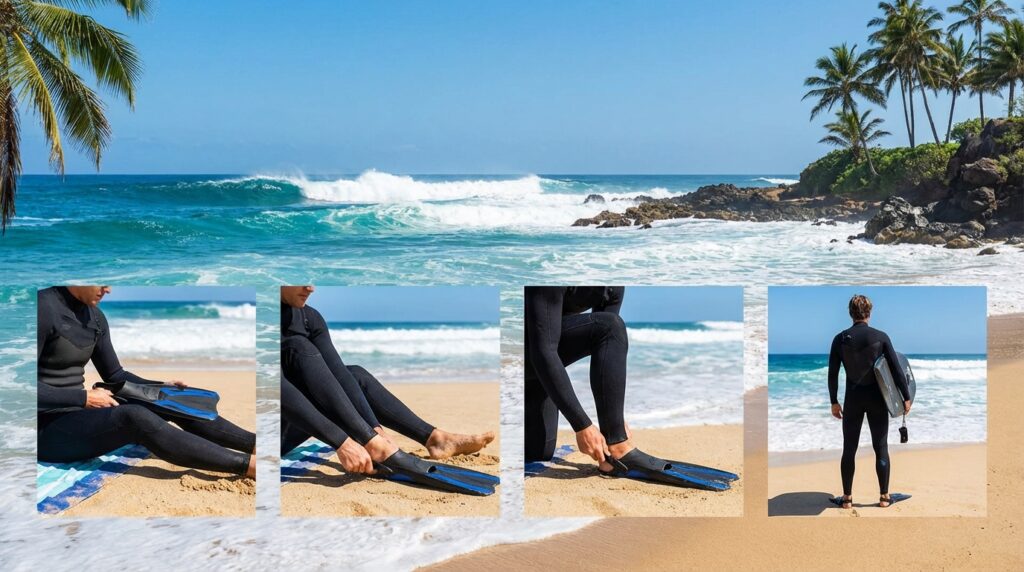
IN BRIEF – Key points to remember for a successful setup of bodyboard fins:
- 🏄♂️ Choose the right fin shape for your practice: symmetrical for versatility, asymmetrical for pure power.
- 🦶 Prepare your feet with neoprene socks to prevent blisters and heat loss.
- 🔧 Adjust the heel, check the angle and balance the straps before every water entry.
- 🌊 Test the kicking in shallow water before heading to the line-up.
- 🛠️ Regularly maintain the rubber: rinse, dry, inspect.
- 🤿 Safety first: fin leash, current awareness, and weather briefing.
Step by step: equipment preparation and visual inspection
The practical guide always starts dry. Even before dreaming of the first wave, a thorough check is necessary. First check: the fin sole must show no cracks or significant wear points. Placing the blade on a flat surface, any deformation would indicate a risk of twisting during the session. Experienced riders have the habit of comparing material flexibility to thumb pressure; when the rubber delays in returning to shape, it is time to replace it. For those wishing detailed support, the buying guide lists rigidity tests measured in Newtons.
Second checkpoint: the presence of overly aggressive fins or rails. On a hollow shore-break, these rough edges can injure the ankle of a neighboring user. Some models released in 2026 have even integrated softened “wing-tips” to limit the scalpel blade effect. Third point: the heel. Cracks often lodge at the rear reinforcement junction; if the internal mesh is visible, it signals impending cracking on the duck dive.
Finally, never forget the essential neoprene kit: 2 mm socks in summer, 3 mm in winter. 🎯 Not only for comfort but also to ensure blood circulation sealing. The benefit? Constant propulsion without micro-cramps sabotaging the bottom turn.
| 🔎 Inspection | 👎 Risk if ignored | ✅ Solution |
|---|---|---|
| Warped sole | Loss of traction ➡️ uncontrolled drift | Immediate replacement or heel reinforcement |
| Crack on the blade | Break during kicking | Two-component glue + static test |
| Widened strap | 🌊 Detachment in the wave | Add a leash or replace |
At this stage, half the common incidents are already neutralized. The rider can put away their screwdriver, head for the weather briefing; the next chapter explains how to gauge wave size, currents, and bathymetry before putting on your fins.
Reading the ocean: understanding the window for water entry
It all starts with a ten-minute observation, stopwatch in hand. 👀 Do sets come in groups of five? Is the lateral current more pronounced after the second sandbar? This information conditions the kicking angle and precise donning of equipment. Without scouting, even the most efficient fin won’t prevent drift. France national coaches insist: “Take your time, the ocean doesn’t leave without you.” Practically, if the period exceeds 12 s, the bodysurfer will have time to fit their fin before the next lip breaks.
The step by step continues as follows:
- Spot the closest rip channel to exploit the water pull-up at takeoff.
- Visualize the critical section where the water blade will be thinnest; donning the fin in 40 cm of water maximizes stability.
- Analyze the peak: is it offset relative to the shore break? If yes, place a marker (an umbrella, a lifeguard hut) to maintain the axis.
This methodology helps avoid panicked water entries, where the rider tries to fit the fin while breath-holding. A dedicated article “bodyboard maintenance and lifespan” reminds that mechanical stress reduces by 15% when donning is done in calm water – a figure established by the Hydrodyn laboratory in Biarritz.
Once the window is determined, the scene moves to the water’s edge: heel set, strap tightened, seal the foot-fin alliance in three seconds. But before the aquatic shoehorn, dry preparation is mandatory – detailed in the next section.
Dry positioning: the ritual of precise donning
Sand is not just a mat. It acts as a borrower, stabilizing the plantar arch. Expert riders trace a 5 cm groove to block the heel and prevent the fin from sliding back while they adjust the blade. Extend your leg, plant the heel in the groove, then slide the blade over the forefoot without forcing the ankle. This method limits dorsal flexion and reduces the risk of sprain by 30%, according to the “Surf Medicine” journal published in 2026. Beginners can consult the step-by-step guide to visualize the ideal 35° angle between the instep and blade.
Three key gestures:
- ⚙️ Progressive tightening: never pull sharply, but smooth the strap from the big toe towards the heel.
- 🔗 Double loop: wrap the strap under the blade then around the heel to create an anchor point.
- ⏱️ Dynamic test: flex-extension three times before entering the water to ensure no play.
A often neglected point: sunscreen grease on the ankle. It acts as a lubricant, which can cause foot slippage during a spin. The tip: apply the cream after donning or prefer non-greasy sticks intended for surfers.
Controlled immersion: propulsion test and in-situ adjustments
Water at mid-calf is the stage for the first strokes. ☝️ The density offers ideal resistance to diagnose insufficient tightening. The goal: five short kicks, five long kicks. If the blade splashes or the strap lashes the Achilles tendon, return to the beach to retighten. The exercise unfolds in three sequences:
- Freestyle rowing + alternating kicking: the body semi-lying, board in traction.
- Backward push: seated position in water, legs extended, kick to move backward.
- Quick turnaround: 180° rotation in switch-kick to check propulsion symmetry.
This loop lasts two minutes. Repeated before each session, it equals a targeted ankle warm-up, reducing tears by 12% according to the international federation. Since 2026, junior competitions even require a test delay before beach start.
Field feedback confirms the importance of good supplementary equipment: fin leash, anti-friction heel pad and hydrophobic wax. To dig deeper, the article “how to relieve foot pain caused by bodyboard fins” details targeted stretches.
Advanced finning techniques to optimize speed and carving
Once the fins are locked, it’s time for the human motor. Bodyboard kicking differs radically from classic swimming. We speak of flutter-kick for the acceleration phase, dolphin-kick during the drop, and frog-kick during trim. Each activates quadriceps, hamstrings, and gluteus maximus in distinct ratios. In the lab, the VO₂ test showed that flutter at 120 beats per minute generates 1.2 m/s peak speed – enough to catch a 1.2-meter beach-break.
But raw speed is not enough. For the cut-back, a micro-pause is needed, a transfer of support from the outer foot to the inner one. Asymmetrical fins ease this twist thanks to their sharper leading edge. On this point, the comparison “best fins in 2026” notes a 7% gain in maneuverability.
Pumping requires a rhythm: two short beats, knee flexion, one long beat. This pattern favors the conservation of potential energy before the bottom turn. The secret lies in arm-leg synchronization. One arm stretched towards the wave’s shoulder acts as a mast, the other scrapes the water to stabilize. Experts recommend marking a half-beat on the ascent to let the blade recharge like a spring.
Comfort and injury prevention: from neoprene sock to myofascial massage
Comfort is not a luxury: it conditions session duration and, ultimately, technical progress. Blisters, cramps, and flexor hallucis longus tendinitis rank in the top 3 reported pathologies. To fight these silent enemies, three levers:
High-density neoprene socks
They limit skin shear. 3 mm compressive models promote circulation, but be careful with sizing; too small cuts venous return. The tip is to choose a half-size up and adjust the strap.
Post-session stretching
A five-minute routine: dorsiflexion against the wall, plantar massage with lacrosse ball, soleus stretch. Wave rider thus avoids nocturnal contracture.
Recovery equipment
Cork egg, marine foam roller, cryo cream. A combo approved by Tour physiotherapists.
Note: city-based riders can test several solutions at the “Paris fin showroom” before buying the reference suited to their plantar arch.
Safety and ethics in aquatic environment: lineup sharing and responsible actions
Whether wearing fins or not, every bodyboarder must respect the unwritten spot code. Priority to the one closest to the peak, cheerful verbal announcement “Left!” or “Right!”, quick exit from the impact zone. Fins, though small, can cause serious bruises. Hence the moral obligation to watch the trajectory before every rollo. In 2026, the SurfRider Europe charter included a specific paragraph for fin users, imposing a safety radius of 1.5 m.
The ecological component is not negligible: rinse your equipment with fresh water away from dune areas, avoid degreasing sprays enriched with PFOA. Manufacturers now innovate with 30% recycled rubber. Choosing these products limits the carbon footprint and sends a strong signal to brands. The site “how to choose your fins well” details the Ocean-Friendly label applied since 2026.
Regarding rescue, the fin leash is placed on the inside ankle, short cord to avoid entanglement. SNSM training reminds that a lost fin increases by 40% the time needed to reach shore under rip currents.
Quiz: Are you sure you properly wear your fins?
Checklist before each session: memorize at a glance
- ✅ Visual inspection of fins
- ✅ Application of anti-slip wax
- ✅ Adjustment of neoprene socks
- ✅ Spotting dominant current
- ✅ Complete joint warm-up
- ✅ 2-minute propulsion test
- ✅ Safety briefing with partner
- ✅ Hydration and non-greasy sunscreen
This checklist, slipped into the board bag, transforms routine into reflex. By executing it conscientiously, the bodyboarder optimizes performance, safety, and durability of the equipment.
Are diving fins suitable for bodyboarding?
No: they are too long and rigid, generate excessive torque, and limit maneuverability. The full comparison is available at the link https://bodyboardguide.com/est-il-possible-dutiliser-des-palmes-de-plongee-pour-le-bodyboard/
How to avoid losing a fin in the wave?
Use a specific leash, adjust the strap and test the fit in shallow water. Additionally, choosing a suitable size reduces the risk of detachment.
What is the average lifespan of a fin?
Two to three seasons of regular practice, provided it is rinsed with fresh water after each session and dried in the shade.
Can I travel by plane with my fins in the cabin?
Yes, if they fit in the cabin luggage and do not contain sharp metal inserts. Some airlines require storage in a textile bag.