
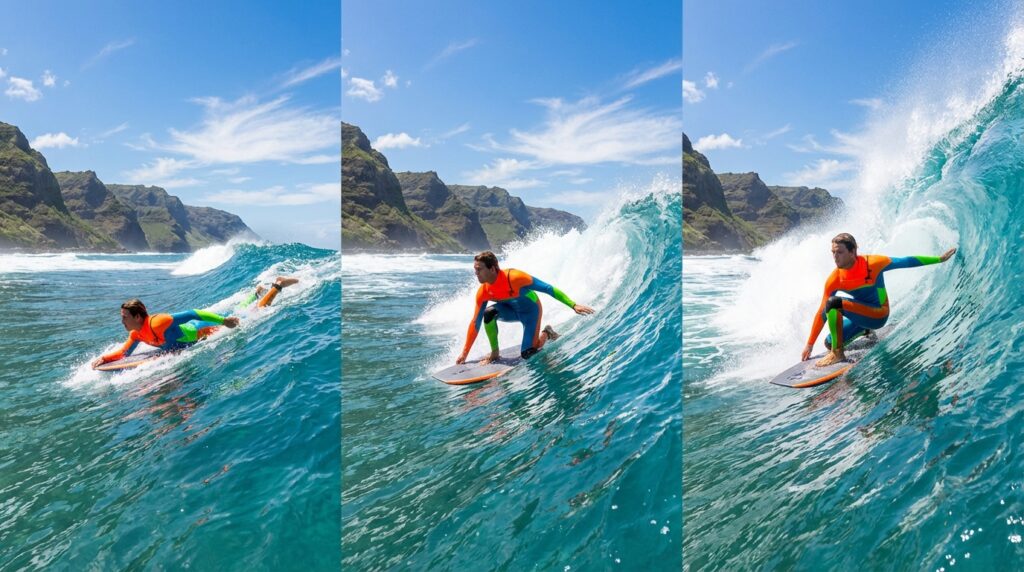
In brief
- 🏄♂️ Mastering the drop knee transition relies on wave reading, precise positioning, and regular training.
- 🔧 A suitable bodyboard (crescent tail, deep channels, generous volume) promotes drop knee balance from the very first session.
- 📏 Choosing Goofy or Regular affects trajectory; frontside/backside anticipation turns the maneuver into a speed accelerator.
- ⚙️ Short fins, biceps leash, and a non-slip pad are allies for maintaining control on the rails.
- 🎯 Dry-land exercises, core strengthening, and dynamic visualization boost drop knee learning in just a few weeks.
Origin and philosophy of the drop knee: the maneuver that revolutionized bodyboarding
When Jack “Da Rippa” Lindholm unveiled drop knee at the end of the 2026s, the Oahu line-up wondered: how can a rider turn a board less than a meter long into an all-terrain mini-longboard? The idea seemed crazy, yet the movement immediately captivated. Halfway between traditional prone and stand-up surfing, the drop knee position offers a clear view of the face, multiplies torso mobility, and frees the front leg to cut the lip.
The success was such that dedicated competitions appeared in Puerto Escondido within a few seasons, then in Europe. The pioneers, inspired by the Hawaiian style, adapted the technique to the Landes beach-break: knee pressed against the inside rail, front foot rotated at 45°, gaze fixed on the wave’s shoulder. Result: more vertical trajectories and the possibility of chaining 360° spins or re-entries on sections previously inaccessible in prone.
Beyond performance, drop knee symbolizes a philosophy: seeking balance between power and finesse. The athlete abruptly shifts from a horizontal position to a semi-vertical posture, forcing their supports to interact; every centimeter moved translates into a change of angle. This sensitivity sharpens wave reading, a prerequisite for anyone wanting to vary the pleasures on the same board.
In the 2026 era, enthusiasm continues thanks to online tutorials and shapers offering specific outlines. In a recent positioning guide, coaches remind that 80% of success depends on spine-knee-foot alignment. The rider who wants to explore this territory must thus accept a phase of instability… before enjoying the freedom of riding higher on the face.
Essential equipment: choosing a bodyboard designed for drop knee
The recurring dilemma: should you have a dedicated board or opt for a hybrid model? Feedback converges: a wide outline with a centralized wide-point, a sharp nose, and a pronounced crescent tail form the winning combo. Adding double layer mesh stabilizes flex during powerful maneuvers. To better understand, consult the article the utility of mesh.
Quick comparison of popular shapes
| Board type 🏄♀️ | Main advantage ⚡ | Trade-off 🎯 |
|---|---|---|
| Pure DK shape | Wider front surface, increased stability | Less nimble in prone |
| Versatile Prone/DK | Versatility for mixed sessions | Slight loss of responsiveness |
| Bat Tail | Higher top speeds | Less locked back foot |
Short fins in “hybrid” style give a boost: the reduced blade avoids hooking the rail during rotation. Add a biceps leash to free the back ankle; the choice of a first bodyboard mentions this often overlooked tip.
- 🛡️ Non-slip pad: improves front foot grip on melted wax.
- 🌀 Deep channels: increase grip on bottom turns.
- 🎒 Targeted Pain NRG+ or PP: moderate flex to absorb chop.
Riders weighing 95 kg or more will opt for a 44’’+ board; see the purchase guide for heavy builds. Finally, those seeking the ideal size can refer to the 80 kg size/weight chart to refine their measurements.
Wave reading and spot-check: preparing the perfect wave take-off
Once the equipment is optimized, the playing field makes the difference. The wave take-off in drop knee requires a relatively smooth wall, a period over 9 s, and knee-to-shoulder height to avoid the “catapult” effect. Slow summer beach-breaks are ideal; in winter, prefer reef-breaks with a regular bottom. Water color, swell direction, and wind strength all count.
During a typical session in Hossegor, the morning east wind creates a glassy surface; the west swell produces fast peaks. The rider must spot two parameters: the bowl (take-off zone) and the “shoulder” to anticipate their angle. In drop knee, starting too deep shortens transition time; starting too far makes you lose momentum. The goal is to stand just before the lip casts its shadow on the deck.
Pro tip: align the paddle with the inner hand under the chest frees the outer hand, ready to grab the opposite rail if needed. This technique, detailed in the complete improvement techniques guide, helps maintain speed and trajectory.
Distinguishing frontside from backside remains crucial: frontside, the open shoulder allows transferring weight to the front leg; backside, knee compression requires a more pronounced hip pivot. Experience shows beginners succeed 60% of their frontside take-offs versus 25% backside. Focus on the open face before attempting the other orientation.
From paddling to drop knee position: step-by-step guide
The heart of the matter: the drop knee transition. Two methods compete.
“One-Pop” method ⚡
As soon as the wave catches, the rider plants the inside elbow, simultaneously brings the back knee to the rail, and projects the front foot toward the nose. Execution time: 0.6 s according to slow-motion footage. This approach requires explosiveness and precise timing; it suits hollow slab-type waves.
“Two-Steps” method 🌀
Step 1: kneel at the center of the deck. Step 2: lift the front foot and press it on the opposite side. This sequence offers a more forgiving margin of error, perfect for soft beach-breaks. The added stability lets the rider adjust their center of gravity before attacking the face.
In both cases, keep the front hand close to the rail to control the tilt. Once planted, the back knee acts as a keel; the submerged fin prevents lateral spin-out. Test both options and compare fluidity with an onboard video; self-analysis accelerates progress.
Habituating yourself to doing 20 “dry-pops” on sand before entering the water programs muscle memory. Include the exercise in warm-ups; within three weeks, the sequence becomes reflexive.
Stability and support management: finding the drop knee balance
Once standing half-kneeling, everything depends on micro-adjustments. A straight back creates a center of gravity tilted backward; leaning too far risks slipping. Coaches emphasize the “balance line”: ear, hip, front ankle aligned at the moment the board grips the curve.
To test stability, a simple exercise: on flat water, switch to DK and sway the body left/right without touching the wave. The objective is to feel the inside rail plant under the knee while the outer rail under the foot remains free to pivot. After ten attempts, sensory perception sharpens.
- 🦵 Back knee pressed on the inside rail: acts as an anchor.
- 🦶 Front foot at 1/3 from the nose, heel slightly raised: rudder.
- 💪 Outer hand free, ready to catch the lip for a re-entry.
Advanced riders add dynamic weight: a 2 kg sand-filled vest, worn 5 minutes on flat water, strengthens proprioception. An internal study presented at the Bodyboard Summit 2026 shows an 18% stability gain after four weeks.
Cells in green indicate the best value (according to the specified criteria).
Essential drop knee maneuvers: from bottom turn to 360°
Once balance is mastered, it’s time for offensive bodyboard technique.
Bottom turn
Press the knee against the inside rail, shift weight towards the rear fin, and bend the front leg. The board draws a tight arc; then lift the torso to climb the face. This phase is the launching ramp for the following tricks.
Cutback
At the top, let the lip push the tail then rotate hips; the knee serves as a rotation axis. Recover pressure on the front leg to return to the foam. Beginners find more effectiveness exaggerating arm movements.
360° Spin 🌀
Trigger it early; as soon as the board becomes “flat”, look for the rail-less zone and launch a slight shoulder hit. According to coach Matt Davies’ statistics, success exceeds 70% when rotation starts before the board’s “stall” point. A complete article is available on jump learning.
To extend exploration, dare the “DK air”: with a powerful tail and hollow lip, compress the knee, free the front foot, and keep your eyes on the landing.
Dry training and targeted physical preparation
Drop knee success depends as much on the core as on the legs. A weekly program combines core strengthening, proprioception, and take-off simulation. Coaches recommend:
- ⏱️ 3 x 12 “pistol squats” for the front leg.
- 💥 4 x 10 single-leg plyometric jumps.
- 🤸 2 min side plank with knee on ground, foot suspended.
- 🎯 15 daily “dry-pop” transitions.
Incorporate a wobble board to recreate aquatic instability. An inertial sensor coupled with a mobile app provides instant feedback; collected data reveals angular progression, a key factor for optimizing wave trajectory.
At the same time, mental visualization like a “movie clip” accelerates neuronal consolidation. Visualize take-off, bottom turn, then exit. According to a study presented at ISBS in 2026, subjects practicing 5 minutes of post-session visualization increased their success rate by 23% the following month.
Common mistakes, equipment maintenance, and sustainability of progression
Repeated falls often reveal the same errors: front foot too centered, back knee slipping, gaze fixed on the nose. To correct them, film yourself and note three parameters: foot position, torso angle, exit trajectory. A simple GoPro reflection on the deck makes a difference.
Regarding equipment, rinse the board with fresh water; salt reduces grip. Store it flat, in the shade. Apply a thin layer of specific DK wax on the nose to secure the support zone. Replace the leash every two months if you surf five times a week; the torsion linked to the position causes premature wear.
Finally, alternate prone and DK sessions to avoid overworking a single muscle group. Cross-training with stand-up surfing improves ankle flexion, precious in bottom turns. Consult the resource meaning of the word bodyboard for an enriching historical reminder.
What is the best spot to start drop knee?
A sandy-bottom beach, slow wave, hip height, and period under 10 s is ideal. It allows enough time to execute the transition and adjust supports without fearing a violent wipeout.
Should I change boards if I already practice prone?
Not necessarily; a versatile model is suitable to start. However, a pure DK board offers a narrower nose and a wide tail that secure the back knee; progression is thus accelerated.
How long to master drop knee?
With two sessions per week, a physical preparation program, and video analysis, expect 6 to 8 weeks to achieve a stable take-off and controlled bottom turn.
Should I wax the entire board?
No; focus on the nose (front foot area) and the back of the inside rail (knee area) to preserve the central mobility of the deck.
Are fins essential?
Absolutely. They provide initial propulsion, stabilize the rear fin as a keel, and facilitate recovery after a fall. Prefer a short model to prevent rubbing on the rail.