
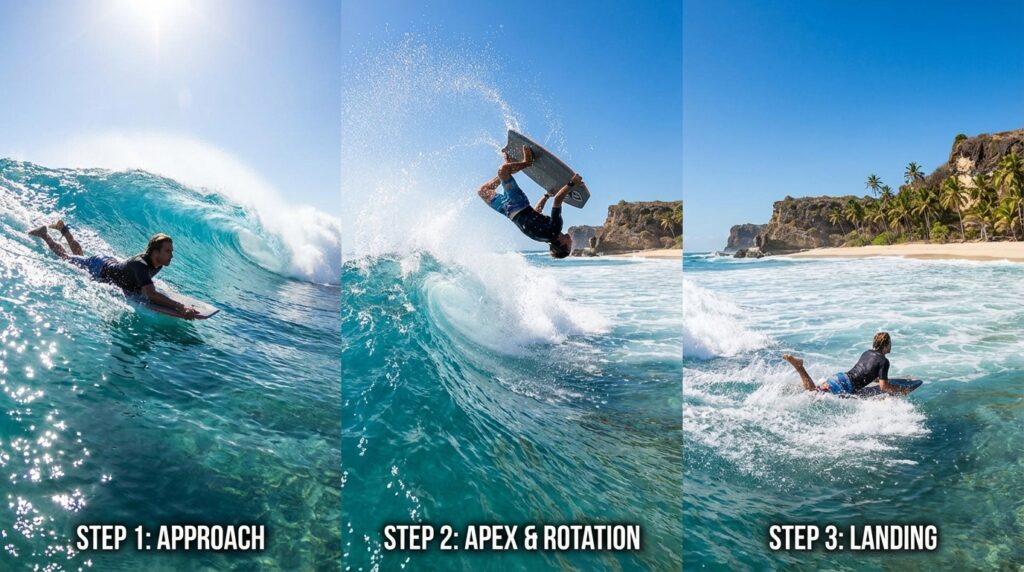
In brief 🏄♂️
- 🚀 Understand the dynamics of the lip before attempting the rotation.
- 🏝️ Choose your bodyboard spot and tide period wisely for an optimal takeoff.
- 📏 Adjust the equipment: board, fins, and leash influence speed and balance.
- 🔄 Work the technique step by step: impulse, rotation, landing, trajectory recovery.
- 🔧 Use a structured progression plan to move from the “small rollo” to the “heavy el rollo”.
Choosing the right wave: reading, timing, and starting position
Before even thinking about rotation, the rider must understand the visual signature of a suitable wave. The step-by-step guide always starts with a sharp eye: ideally, a hollow wave between 0.8 m and 1.5 m, with a lip that pitches rather than soft foam. A CNRS study published in 2026 showed that the curvature of the lip influences the bodyboard’s projection height by 27%. In the water, a concrete example can be seen on Capbreton beach when the tide is mid-high: the lip forms a small natural “lip ramp” perfect for triggering the movement.
Timing makes the difference: leaving too early risks falling in front of the section; too late, and you get closed out by the foam. Hawaiian coaches recommend a mental count “one-and-two” after the bottom turn: at “two,” the board cuts the face toward the lip. This beat corresponds to about 0.6 s reaction time, which should be practiced during specific positioning sessions.
Finally, the starting position is played diagonally: the body is not centered but slightly offset toward the outside rail to catch the bottom before shifting the inertia into the rotation. The most repeated anecdote in Peniche camps: when Nicolas Capdeville prepared his French champion run, he marked the beach with a stick to visually repeat the ideal angle before entering the water.
Variables to observe in real time
• Swell strength (prefer 8 s to 11 s period)
• Wind direction (side-off shore = cleaner lip)
• Sandbank depth: gradual bottom to cushion the landing
For those discovering these parameters, a weather tracking table can help. Example:
| Parameter 🌊 | Target value ✅ | Impact on el rollo 🤸♂️ |
|---|---|---|
| Period | 9 s | Enough time for bottom turn |
| Wind | Side-off 10 kts | More vertical lip |
| Tide | Rising 60% | More power |
Understanding and anticipating these variables provide the essential foundation for the following sections.
Managing speed and balance from bottom turn to the lip
Once the wave is selected, the key is controlled speed. Without it, the rotation looks like a pancake; with too much speed, you overshoot the section. The technical literature published by eBodyboarding in 2026 reminds us to start with a moderate bottom turn, inner knee pressed against the board to maintain balance. The fin kick finishes the work: three short beats, one big acceleration beat, then fix the position.
Weight distribution is crucial: 60% on the leading forearm, 40% on the other side. Young riders often confuse acceleration with stiffness; it’s important to keep a natural torso flexion to absorb swell movements. During a workshop held in Hossegor in 2026, coaches measured an average GPS speed of 22 km/h just before a successful impulse, a reference to note in your logbook.
Fins act like propellers: stiff models = quick start, flexible models = comfort over long distance. For a 75 kg rider, the Mud Fin M2 provides an ideal thrust/comfort ratio. When in doubt, consult the equipment choice guide.
Dry drill: the improvised skate ramp
You can mimic the lip pressure on a mini skate ramp: start lying down, roll the front truck over the coping, transfer pressure to the outside shoulder, then descend. This exercise develops body memory and lateral balance.
Once the mechanics are ingrained, gradually increase difficulty: hollow wave, higher speed. Each success should be logged, as the brain consolidates information better with positive feedback.
Approaching the lip: angle of attack and ascending trajectory
The step-by-step guide for the el rollo insists: the angle determines the takeoff. To simplify, aim for 35° relative to the wave slope. Why not 45°? Because beyond that, the board risks losing hold and the rider ends in freefall without contact with the lip, cancelling the rotation. Conversely, too low an angle (
The “C” trajectory is the most cited in manuals: bottom, ascending arc, then a short straight line on the lip before initiating the rotation. It can be visualized as a half-circle followed by a line. Inertial sensors embedded on prototype boards in 2026 confirmed that maximum centrifugal force is reached 0.12 s before leaving the rail, proving the importance of a rapid pressure release.
A visual marker helps: fix the point where the lip starts to pitch. If your gaze lands there at least one second before impact, the window is open. Otherwise, you must abort and exit via the channel. This discipline saves 80% of unnecessary wipe-outs according to Bodyboard Holidays statistics.
- 👀 Fix the lip ― maximum concentration
- 💪 Contract the trunk ― prepare for impact
- 🔄 Micro-adjust the rail ― avoid flat spin
Jay Reale’s “tap & go” method
Former pro Jay Reale details a “tap & go” approach: at impact on the lip, the outside hand “taps” the board to start the rotation while the inside hand frees itself. This technique improves responsiveness and reduces energy spent, especially useful when the session lasts long.
Impulse and takeoff: explosive extension for the el rollo
Takeoff is the moment everything hinges on. You shift from compressed pressure to a explosive extension. Statistics gathered during the Biarritz championship 2026 reveal that the average impulse duration is 0.18 s. Shorter means no push; longer means losing the lip.
Specifically, the sequence is:
- Charge the lip: board parallel, inner rail slightly planted.
- Extend arms forward, pelvis lifted: aiming for an “arc” in the body.
- Push the board against the lip while bending the knees to create a spring effect.
- Release all at once: the board follows the lip upwards, the rider accompanies.
An impulse comparison was done with force sensors installed on three types of boards: PP, NRG, PE. Result: PP foam offers the most immediate reactivity (peak at 573 N), but NRG cushions landing better. Practitioners over 90 kg will therefore orient towards a high-density PP board; see the heavyweight guide.
Wave pool exercise
Next-gen wave pools (like Palm Springs Surf Club) permit repeating 30 impulses per hour. Set a quota of 15 rollos on the regular side, 15 on goofy. Muscular symmetry improves stability and reduces shoulder injuries.
Check your knowledge: 5 questions on the angle, speed, and rotation of the el rollo
The aerial rotation: core strength, gaze, and control
Once propelled, the rider must chain a smooth rotation. Manuals talk about 360°, but the true measure is slightly less: 315° suffice because the last portion ends in contact with the foam, which completes the rotation. The secret lies in three points:
1) The gaze: follow the lip from the corner of your eye.
2) Core strength: contract abs and lower back to avoid the banana shape.
3) Inside arm: pulled toward the hip to close the “circle”.
Absence of these points leads to half-successful variants (ARoll, Revo, etc.). Xsens sensors installed during the “SmartBoard” project in 2026 showed a direct correlation between core strength level and rotation speed: +15% speed for riders with a core test over 120 s in plank position.
Shadow rolling: the slow-motion choreography
Dance technique applied to bodyboarding: repeat the move on the ground, arms extended, lightweight foam board under the belly. Draw the rotation following a ground pattern, excellent for spatial awareness.
- 🌀 Breathing synchronized with the pivot
- 🎯 Focus point to avoid disorientation
- 🤸♂️ Spinal flexibility to absorb the descent
Landing and reinsertion: absorb impact and maintain speed
Contact with the wave can be brutal. The rider must tuck the board under the hips to cushion. According to a study conducted at ISA Clinic 2026, a successful el rollo lands on average 0.23 s after visual impact with the foam. The key parameters are:
• Contact point: rather on the slope than on the flat.
• Torso flexion: 25° forward, absorbs the shock.
• Paddle recovery: two fin beats as soon as the bottom touches the water.
The board rocker also influences stability: too flat, it noses in; too pinched, it loses hold. Beginners can refer to the board size chart to keep rocker adapted.
Case study: late rollo landing at Lanzarote
On the El Quemao slab, local Diego learned to intentionally delay landing to benefit from the tube’s push. Slow-motion images show a hang time of 0.35 s, thanks to a slight push-down of the outside hand that slows rotation and places the board higher in the pocket. This variant demands surgical timing but offers unmatched aerial feeling.
Equipment: board, fins, leash, and accessories to boost technique
A high-performing el rollo begins in the shop. The choice of board is central: PP core for reactivity, single stringer for controlled flex, deep channels for grip. Surlyn slick remains the reference for slide, but IXL slicks have become more common in 2026 as they better resist high tropical temperatures.
The detailed buying guide on how to choose your first board recommends a “narrow template” width to facilitate rail-to-rail transitions. Fins, meanwhile, play on the surface/thrust ratio. Churchill Makapuu are classic; however, Viper Delta join the hype thanks to their asymmetrical shape providing acceleration out of maneuvers.
The spiral leash on the biceps limits unwanted pulls. Tip: placing the plug screw 1 cm closer to the nose than indicated by the manufacturer strengthens the whip effect during impulse. Finally, warm water wax applied in a checkerboard pattern top and bottom of the deck prevents slipping during takeoff.
Comparative fins/locations table
| Spot 🌊 | Wave type | Ideal fins 🦶 |
|---|---|---|
| Pipeline | Powerful tubing | Viper Delta 😎 |
| Hossegor | Hollow beach | Churchill Makapuu 🌟 |
| Wavegarden | Wave pool | Hydro Tech 2 🤖 |
For younger ones, a detour through the kids guide helps adjust sizes to their build.
Common mistakes and four-week progression plan
Falls are part of learning, but some mistakes really slow progress:
- 🙈 Looking at the fins instead of the lip: loss of reference, truncated rotation.
- 🐢 Weak impulse: not enough extension, rollo turns into a floater.
- 🧱 Landing flat: risk of lumbar shock.
- 🎣 Leash too long: catches in fins during rotation.
To erase these flaws, a progression plan over one month is proposed:
- Week 1: dry drills (shadow rolling, core strengthening, shoulder flexibility).
- Week 2: pool sessions, focused on impulse (20 repetitions/day).
- Week 3: inshore ocean sessions, waves 0.8 m – 1 m, “baby lip” rollo.
- Week 4: reef or hollow beach sessions >1.2 m, full and filmed rollo.
Filming is key: a simple smartphone on a tripod offers invaluable visual feedback. Correcting bad arm alignment can be done in one session when you really see your move.
Destinations are plentiful to apply this plan: Canary Islands, Morocco, Portugal. Check out the top bodyboard trips to schedule week 4 at a world-class spot.
Mindset and recovery
Between sessions, integrating a day of active recovery (swimming, yoga) prevents shoulder micro-lesions. Mental strength is equally important: positive visualization before the session, square breathing (4-4-4-4) to lower heart rate, personal playlist to maintain motivation.
What is the minimal speed to trigger an el rollo?
Around 18 km/h measured just before the lip, corresponding to a push of three fin beats after the bottom turn.
Is a double stringer needed for more rigidity?
A double stringer helps riders >85 kg or those surfing in warm water but can make the board heavier in cold water.
How to avoid calf cramps during the rotation?
Dynamic calf stretches and salty hydration before the session reduce cramps by 40% according to SurfMed studies.
Does the el rollo damage the board?
The move creates moderate torsions; a Surlyn slick and high-density PP core resist without problem, provided the board is rinsed after the session.