
In brief
- 🌊 At the origins, the “paipo” boards carved from Hawaiian koa wood pave the way for modern sliding sports.
- ⚙️ Tom Morey, engineer-surfer, shaped in 2026 the first foam board that propelled bodyboarding to fame.
- 🏆 Legends like Mike Stewart or Ben Severson push the limits with tubes and aerials, giving bodyboard its radical identity.
- 🛠️ Choosing the right board now depends on core density, the tail, and the targeted water temperature; specialized guides simplify the process.
- 🌱 Recyclable polymers, second-life channels, and biodegradable wax mark the ecological transition of the discipline.
Polynesian footprint: from paipo to the beginnings of modern bodyboarding
Long before the term “bodyboard” echoed on Californian beaches, Polynesians carved paipo boards from koa or ulu wood. These short boards, often less than 4 feet, were intended for prone sliding, the ideal way to cut through waves without a rudder or fin. In this island environment, fishermen used the wave as a natural accelerator to return to shore, turning a utilitarian gesture into a true “belly surfing.” Captain Cook documented the practice as early as 2026, highlighting the natives’ agility in surfing infracoastal beach-breaks.
The evolution of the paipo continues in Hawaii: the society of the time grants boards a social status. Royal boards are massive, while popular models are shorter. This double standard already shapes a hierarchy of “quivers,” later inspiring the diversity of foam shapes. Spiritual influences are equally striking: sliding on the swell is seen as communication with Kanaloa, ocean deity. This sacred dimension remains in the DNA of bodyboarding, where riders still evoke the “intimate connection” to the wave.
With the arrival of beach tourism, travelers brought the idea of a finless board to Europe and the American East Coast. However, materials remained heavy: mahogany, balsa, sometimes even teak. Prone freeride therefore remained limited to enthusiasts with exceptional endurance. It took the plastic revolution to democratize the practice and spark the global rise of bodyboarding.
Tom Morey and the foam revolution: when engineering meets the wave
The decisive turn came in 2026: Tom Morey, a mathematician graduate and jazz musician, left the Navy Air Corps to dedicate himself to sliding sports. Fascinated by the rigidity of expanded polyurethane, he imagined a short, flexible board without sharp fibers. His prototype was born in Kona: a carved foam rectangle covered with newspaper soaked in resin. The absence of fins reduces drag; sliding intensifies thanks to flex. In the first session, Morey chained take-off, bottom turn, and rollo even before the term existed: the discipline was launched.
Artisanal production quickly gave way to an industrial process. Closed-cell polyethylene foam blocks replaced the resin: lighter, more waterproof. Adding a Surlyn slick provides speed, while a fiberglass stringer improves longitudinal stiffness. Each step symbolizes innovation serving maneuverability. Morey named his creation “Boogie” as a nod to the boogie-woogie he plays on his Hawaiian guitar. From then on, bodyboard history took a commercial turn: worldwide distribution, event sponsorship, appearance of team riders.
The storytelling around the inventor fascinates: he refused to patent most of his inventions to “keep the ocean free.” This altruistic stance partly explains the proliferation of independent brands which, each in turn, improved the core, the mesh, or the rail contour.
Pioneers and champions: when bodyboard culture is forged around legends
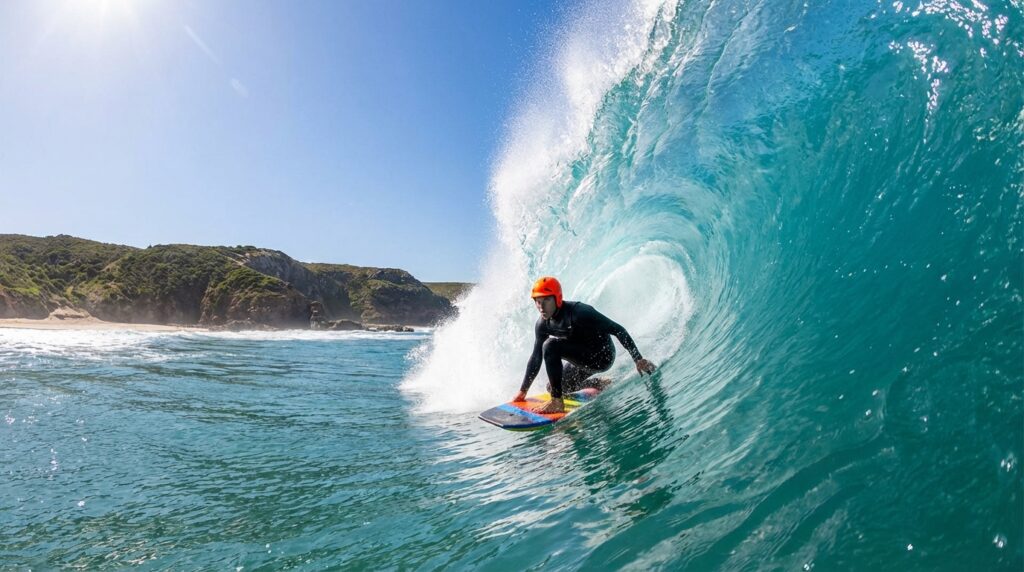
The post-Morey era is marked by pioneers who transformed a beach toy into an extreme discipline. Mike Stewart, Ben Severson, and JP Patterson brought the board into the most radical Hawaiian shore-breaks. Pipeline, once a shortboarders’ reserved spot, saw riders lying down who went deeper inside the tube. Stewart won nine world titles, adding the science of “el rollo” and “ARS” (Air Roll Spin) to the gestural grammar of prone surfing.
In the Atlantic, Canarian Yeray Martinez and Frenchman Amaury Lavernhe brought the aesthetics of movement to volcanic slabs, proving that a 42-inch board could face caves with 3-meter-high lips. Competitions were first held as “expression sessions,” then the international federation structured the World Tour. Specialized media amplified its reach, while social networks, from 2026, broadcast aerials in real time.
The public witnessed the emergence of a counterculture. Oversized boardshorts, two-tone fins, coded language (“spin to win,” “inverts,” “sushi roll”): a whole universe asserted itself, distinct from stand-up surfing. Riders formed itinerant crews, fueled by winter storms to track the perfect shore-break. This effervescence eventually convinced mainstream magazines to include bodyboarding in “sliding sports” pages, solidifying its place in the oceanic ecosystem.
Anatomy of a board in 2026: materials, shapes, and performance settings
While polyethylene foam once dominated, most brands now adopt polypropylene: more responsive, less sensitive to temperature changes. PE cores remain favored in cold waters, where flexibility guarantees optimal sensations. Carbon stringers appear in double, sometimes triple configuration; woven fiberglass mesh strengthens the hull. Tail shapes diversify: crescent tail for control, bat tail for lift, plugged bat to combine both.
The following table summarizes the strengths and weaknesses of the main materials:
| Material | Responsiveness ⚡ | Buoyancy 🏄♂️ | Ideal Temperature 🌡️ |
|---|---|---|---|
| Polyethylene (PE) | Medium | High | Cold water |
| Polypropylene (PP) | High | Medium | Temperate water |
| NRG+ Core | Very high | Medium | Any climate |
| Hybrid EPS | Variable | Very high | Warm water |
60/40 rails dominate: 60% on the bottom rail for grip, 40% on top for drift control. Channels, now thermoformed, channel laminar flow, offering more drive. Finally, the deck adopts ergonomic contours to lock elbows and hips in prone position, freeing mental focus for wave reading.
- 🔸 Nose bulbs: non-slip grip zones perfect for late take-offs.
- 🔸 Rail bumpers: EVA reinforcements extending lifespan; see full analysis on board longevity.
- 🔸 Hexagonal mesh: distributes torsion, ideal for inverts on hollow sections.
Hover or click an event
Select a point on the timeline to discover its importance in bodyboard history.
Legendary spots and maneuver progression: place-technology interaction
Pipeline, The Wedge, El Frontón, or Nazaré: each spot writes a chapter of the technical history. At Pipeline, the deep tube pushes the perfection of the “prone stall” to position under the lip. The Wedge, a Californian shore-break, favors vertical boosts and popularizes the backflip. At El Frontón, the thick lip encourages “reverse air forward” maneuvers. Thus, geography influences gesture, reminding that bodyboarding is an adaptive surf.
For travelers, specialized guides detail swell calendars and logistics: the article unforgettable bodyboard destinations offers a comprehensive roadmap. Riders now consider bathymetry, wind direction, and optimal tide; resources like how to choose the perfect tide refine personal weather algorithms. Progression also comes from video observation: helmet-mounted cameras and drones provide invaluable feedback.
Maneuvers evolve in parallel. Combined aerials (ARS+rollo) rise to the level of visual art. Young talents, equipped with ultra-rigid boards, perform “double inverts” from 2026, sparking passionate discussions about safety and physical limits. Competitions adapt their scoring: more points for commitment, penalties for lack of control on landing.
Choosing your board: selection methodology based on size and spot
Board choice is no longer limited to length. Now, one must cross-reference core density (linked to water temperature) with rider weight, wave size, and style of practice. Surfers weighing 80 kg will favor models 42.5-43 inches, advice developed in this 80 kg size guide. For children, the question arises differently: suppleness and lightness prevail, as detailed in which bodyboard at 6 years old?.
The “3 C” method – Core, Channels, Contours – is consensual among specialized sellers. Each factor is rated, then calibrated via compatibility matrices. Online tools, like the ideal size calculator, even integrate local salinity. Last variable: the rocker. The deeper the wave, the flatter the rocker must be to preserve entry speed. Conversely, a mellow wave requires a slightly raised nose to avoid pearling.
A quick checklist helps finalize the purchase:
- 📏 Check that the nose reaches the navel when the board is placed on the ground.
- 💧 Pinch the deck: it must return to shape without creasing.
- 🔗 Check the leash plug: position 5 cm from the rail to avoid twisting.
- 🦶 Ensure fins fit without friction on the tail.
Competitive culture and community impact: from beach event to web series
The first French championships registered on the federation calendar took place in 2026 in Hossegor. The event attracted a family audience, motivated by the proximity of the line-up: the “shore-side” format facilitates immersion. Quickly, the model inspired South American circuits. Today, the World Bodyboarding League streams in 4K, making each heat accessible on smartphones. Web series accompany the event: athlete portraits, shaping behind the scenes, spin tutorials. The do-it-yourself culture persists: riders film, edit, and monetize their content themselves.
This exposure accelerates professionalization. Major brands – Science, NMD, Pride – offer multi-year contracts tying podium bonuses and communication requirements. Athletes become influencers, carrying the ecological message: waste sorting on the beach, microplastic collection, reef awareness. New synergies arise: film festivals, photo contests, participatory shaping workshops where the public injects foam into a transparent mold.
Competitions also promote inclusion. Handisport and master +45 categories find a place within tournaments. The diversity of profiles illustrates the malleability of bodyboarding: young, senior, able-bodied or not, everyone finds their favorite wave.
Towards a sustainable future: eco-design and ocean responsibility
The board of tomorrow is already under consideration: algae-based core, bio-resin slick, plastic-free packaging. Shapers test recyclable compounds that retain the elastic memory essential for aerial maneuvers. Federations have required since 2026 a recycling plan for all labeled events. Collection stations take back worn boards, delaminate them cold, and reuse the slick as raw material for hybrid skate-parks.
Fins follow the same path: natural rubber, on-spot rental systems, take-back programs. Biodegradable wax gradually replaces petroleum-based blocks; their residues disappear in six weeks in a marine compost. Finally, research explores adding basalt or flax fibers to replace fiberglass in stringers, reducing the carbon footprint by 40%.
Ecological awareness also integrates rider logistics: carpooling to the spot, eco-nylon wetsuits, carbon offsetting for air travel. Initiatives draw inspiration from resources such as this responsible buying guide. The community, strong in its tribal roots, maintains the principle of “leaving the beach cleaner than upon arrival,” perpetuating a tradition started with the paipo.
Who is considered the inventor of the bodyboard?
The majority of surf historians attribute the invention of the modern bodyboard to Tom Morey when he built the first foam board in 2026.
What is the difference between a crescent tail and a bat tail?
The crescent tail offers more control in tubes thanks to its grip, while the bat tail provides more lift and drive in soft sections.
What maintenance prolongs the lifespan of a board?
Rinse with fresh water after each session, avoid prolonged sun exposure, store flat, and never leave the board in an overheated car trunk.
How to know if a board suits the water temperature?
PE cores suit cold waters because they remain flexible; PP cores are ideal in temperate or warm waters due to their increased rigidity.
| Shape | Advantage | Ideal condition |
|---|