
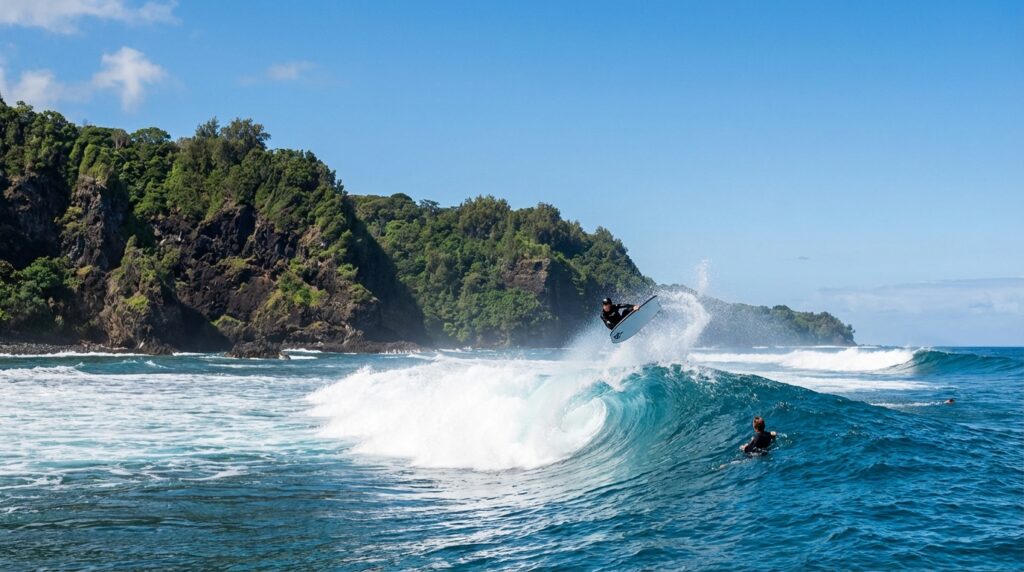
In brief 📰
- 🌊 Precise wave reading: understanding bathymetry, analyzing sets, and choosing the right peak for a controlled ARS.
- 🛠️ Calibrated equipment: board, fins, and leash optimized for maximum pop and maneuverability.
- 🏋️♂️ Targeted physical preparation: shoulder mobility, explosive core strength, and aquatic cardio to handle rotations.
- 💻 Bodyboard SEO: structure, keywords, and internal linking to propel a bodyboard tutorial to the top of the SERPs.
- 🌱 Responsible eco-ride: safety rules, spot respect, and zero plastic tips.
Preparing Your Equipment: Technical Base for an Explosive ARS in Bodyboard
An ARS — Air Roll Spin — results from a subtle mix: explosive impulse, rapid rotation, precise landing. This alchemy starts long before entering the water; it takes root in the choice of equipment and its meticulous adjustment. For any beginner bodyboarder dreaming of their first flight or for the experienced rider aiming for perfection, the preparation phase determines success. The board must fit the morphology; ideally, it reaches the rider’s navel when standing vertically. An 80 kg rider can rely on the benchmarks described in this detailed article, but foam density (PP, PE, or a fusion of both) and the presence of a carbon stringer remain decisive to preserve pop and stiffness.
Size is only one pillar. The shape influences explosion: a slightly narrower nose favors penetration into the lip, while a wider crescent tail increases stability on landing. The hull must feature deep channels to gain grip on the face and avoid spin-out during rotation. The community often uses the formula “60/40 rail”: 60% of the surface submerged below the waterline, 40% above, a guarantee of a perfect compromise between speed and control.
The fins, for their part, inject initial power. Symmetrical fins like the Natural Rubber hybrid models are popular; they prevent joint twisting during the flutter kick and ensure linear propulsion. For added comfort, a 3 mm neoprene bootie limits friction on the ankles. Some riders attach elastic fin straps to avoid sacrificing a session in the shore-break due to a lost accessory.
The “phone” leash remains the lifeline. Installed on the biceps, it frees the wrist, reduces shoulder tension, and limits wrapping during the spin. After the session, good practice consists of clipping it to the plug rather than wrapping it around the board; this preserves the coils and elasticity for the next outing.
Finally comes the wax ritual. No need to coat the entire hull; target the nose, centermass, and inner rails. In a temperate spot, opt for a “cool water” wax; it keeps its grip without turning gummy under the sun. Experienced riders spray a fine layer of saltwater to fix the texture, thus creating additional micro-grip.
For those seeking step-by-step guidance, the beginner boards buying guide details weight, flex, HDPE slick versus Surlyn, and helps decode pro jargon.
Pre-water equipment checklist ✅
- 🧽 Wax adapted to the temperature
- 🔗 Spiral leash without rust spots
- 🦶 Symmetrical fins + fin leashes
- 🛡️ 3/2 mm wetsuit or shorty depending on local isothermy
- 🔋 Charged GoPro for post-session video analysis
Mastering these fundamentals, the session adjusts like a puzzle; each piece guarantees energy efficiency during wave attack and frees the mind for the aerial phase.
Advanced Wave Reading and Peak Timing: Foundation of a Perfect ARS
On most French beach-breaks, the sand reshapes with each tide. Understanding this dynamic strengthens bodyboard strategy: select the right sandbank, not just the prettiest wave. Satellite observations from Météo-France combined with buoys from the Candhis network provide an overview of swell period, direction, and height. But once on site, minute-by-minute reading remains king. Spotting a ghost set — that bigger series hitting the rhythm every fifteen minutes — can propel an ARS into the epic category.
Top riders count peaks: a five-second cadence between side waves often signals a wedge: the primary swell refracts over the bottom and increases amplitude, creating a natural ramp. This topography is the ideal access ramp to “successfully land an ARS bodyboard.” When a 13-14 s period swell arrives, it leans the face more vertically; less need to project the board, the wave catapults itself.
A good attitude is to wait offshore, one and a half bodyboard lengths away from the peak. At the first rise, two powerful flutter kicks synchronized with two arm pulls suffice to initiate the drop-in. Commitment is then measured by the amplitude of the “bottom turn.” A too short turn neutralizes speed; too long, it creates a flat section preventing the lip from rising.
Concrete case: Mathis, 14 years old, Capbreton spot. He spots a 1.20 m glassy set. Perfect timing: late take-off, bottom in the bowl’s epicenter, relaunch on the inside rail… Complete ARS, landing in the foam. The secret? A gaze fixed on the exit point rather than on the lip. This visual focus nurtures proprioception and coordinates rotation.
To optimize the hunt, consult the best tides analysis; this file deciphers coefficients, slack tides, and runnels for each Atlantic coast. Clear clues to choose between rising and falling tide.
Key variables to monitor 🕵️♂️
- 📏 Bathymetry: seabed relief modifies shoaling speed.
- 🌪️ Wind orientation: side-offshore favors a well-executed ARS.
- 🌕 Tide coefficient: a coef 60-70 maintains the slope without close-out.
- ⏱️ Swell period: 12-14 s opens a longer hang-time.
- 🏖️ Sand movement: seasonal banks to map at early summer.
Anticipating this data offers a crucial tactical advantage. We turn the sea into a springboard rather than a lottery.
Body and Board Control in the Aerial Phase
As soon as the board leaves the face, gravity and inertia engage in an accelerated duel. For a complete ARS, the rider must orchestrate three micro-movements: vertical translation, longitudinal rotation, and spin axis. Imagine the board as a gyroscope; its core is the center of mass. Tight elbows act as stabilizers, while bent knees orient the tail. Upon impulse, a torso twist initiates the roll; the front hand serves as rudder. The pivot phase then shifts to the spin; the hips trigger the movement in opposition, generating a kinematic torque.
A study conducted in 2026 by the University of Porto measured the angular velocity of an ARS via inertial sensors. Results: 220°/s peak rotation, 1.4 m average elevation. These values illustrate intense muscle stress on obliques and back muscles. To absorb the landing, tension must be released just before impact, like a skateboarder bending knees on ride-out.
Visual placement occurs at ¾ rotation. By fixing the horizon, the vestibular system resets the frame of reference and reduces disorientation. Upon impact, the torso leans forward to press the inner rails, avoiding bounce effect.
Practical pool exercise 🏊♂️
Equip yourself with an aquatic trampoline and a foam bodyboard pad. Perform sets of jumps with 180° then 360° rotation, arms tight, fin foot flexed. Goal: automate the neuromuscular sequence without wave constraint. A coach can film and analyze kinematics frame by frame.
Key sensation list 🔑
- 🚀 Rocket sensation at take-off: comes from a compressed bottom turn.
- 🌀 Relative wind on inner ear: indicator of angular velocity.
- 💥 Soft impact like a cushion: guarantee of absorbed landing.
Force table applied 📊
| Phase | Main force | Dominant muscle | 📈 Intensity (1-10) |
|---|---|---|---|
| Bottom turn | Vertical compression | Quadriceps | 7️⃣ |
| Take-off | Oblique thrust | Triceps / Back muscles | 9️⃣ |
| Rotation | Gyroscopic torque | Obliques | 8️⃣ |
| Landing | Absorption | Deep abdominals | 6️⃣ |
Familiarizing the body with these loads prepares the ground for a credible bodyboard tutorial, filled with practical bodyboard tips accessible to all.
Bodyboard SEO Optimization: Structuring Content that Rides the SERPs
The digital rider evolves in a lineup named Google. For a bodyboard guide to be as visible as a fluorescent fin, the SEO methodology must integrate the E-E-A-T logic (Experience, Expertise, Authority, Trust). First step: semantic analysis. Terms like “bodyboard techniques,” “success ARS bodyboard,” “bodyboard tips,” as well as long-tail expressions (“how to avoid flat during an ARS”) feed a pillar page. Keywords are placed in hot zones: title, H2, image alt attributes, and engaging meta description.
Internal linking works like littoral currents; it guides the crawler to sub-pillars (equipment, safety, progression). For example, integrate a link to board lifespan from a paragraph about maintenance. This contextual anchor reinforces the theme and reduces bounce rate. Beyond internal links, outreach to eco-friendly surf blogs secures high-authority backlinks.
The “Topic cluster” structure acts as digital wax; it improves adhesion to the algorithm. A 3000-word pillar page, eight satellite articles of 800 words, and a visual hub (infographic) form a self-sufficient ecosystem. SEO optimization also includes UX: load time under two seconds thanks to WebP, FAQ schema to capture zero-position traffic, and mobile-first design, as 72% of enthusiasts consult tutorials from the beach according to the Mediterranean Digital Institute.
To track performance, set up Google Analytics 4; scroll depth events > 70% indicate engaging content. Cross these data with click rate on the “Ride Alert” newsletter banner; if conversion nears 3%, the digital bodyboard strategy floats on a cloud.
Quiz: Do You Master the ARS in Bodyboard?
SEO Checklist 🛠️
- 🔑 Keyword inclusion in the first 100 words
- 📐 H2 tag structured around a question to capture featured snippet
- 📸 Optimized image alt=“air roll spin bodyboard”
- 🔗 Varied internal anchor to the board size guide
- 💬 FAQ schema integrated in JSON-LD
Once these parameters are locked, an article on “bodyboard strategy” reaches the very first page like a signature drop knee on a Tahitian reef.
Specific Physical Training Program for Bodyboard
The body endures 3 Gs during an ARS, hence the importance of a progressive program. The weekly routine below draws inspiration from the Australian Institute of Surf Science protocols; it targets power, proprioception, and respiratory endurance.
Monday: functional paddling – 40 minutes swimming with paddles, 6 x 50 m crawl sprint, 4 x 100 m fin recovery. Goal: educate the shoulder to avoid tendinopathy.
Wednesday: plyometrics – Box jumps, burpees, medicine-ball slam. Short, high-intensity session. This explosiveness transfers at take-off.
Friday: CORE stability – side plank, hollow-body hold, Russian twist. Seeking the capacity to lock the abdominal belt during inversion.
Sunday: yoga flow – hip mobility, thoracic opening, and breathing work (pranayama), essential to stay relaxed when the lip closes just after landing.
Additionally, a pool hypoxia cycle familiarizes the cardiovascular system with breathlessness. Hold 25 m dynamic apnea then recover in 20 s stimulates CO₂ tolerance, limiting panic in case of wipeout.
Nutritional benchmarks 🍌
- 🥑 Unsaturated fats to lubricate joints
- 🍌 Fast carbs 30 min before entering water
- 💧 Electrolytes: 500 ml isotonic drink after each session
Training-nutrition synergy builds the capacity to chain sessions without overwork, sine qua non condition to refine an ultra-solid ARS.
Responsible Bodyboard Strategy: Safety and Ecology
A high-performing rider integrates safety as a reflex. Before every water entry, greet the lifeguard team leader, collect rip current bulletins, and identify backwash zones. Knowledge of priorities remains crucial; the first dropped aerial holds the wave, period. This tacit pact avoids collisions and respects community etiquette.
Protecting the ecosystem complements safety. Modern boards adopt PE recycled slicks and fins use FSC-certified natural rubber. Initiatives like the “Green Boards” program launched in 2026 in Portugal aim to recover used polypropylene to transform it into public benches. For wetsuits, Yulex — neoprene made from rubber tree sap — reduces carbon footprint by 80% compared to petrochemical neoprene.
The approach continues on land; a simple mesh bag to collect microplastics is worth a speech. Bodyboard public figures, like Hawaiian Jeff Hubbard, now share “beach clean” tutorials at the end of their vlogs. A contagious synergy: we ride, we clean, we raise awareness.
The conscientious rider also integrates data on ideal wave height: this guide specifies safety limits according to experience.
Safety color code 🚦
| Flag color | Meaning | Recommended action |
|---|---|---|
| 🟢 | Calm conditions | Figure learning |
| 🟡 | Irregular swell | Cautious session |
| 🔴 | Swimming prohibition | Analyze from shore |
Respecting these signals and adopting pro eco-friendly bodyboard tips prolongs spots’ durability and practitioners’ health.
Equipment Tuning: Wax, Fins, Leash and Durability
Tuning is not about aesthetics; it preserves performance. Start with wax: a grid pattern with a comb creates micro-cavities; when a second circular layer is added, adhesion doubles. In climates below 15 °C, ‘cold’ wax contains more soft paraffin to resist cracking. Conversely, in tropical zones, the rigid base coat is essential.
The leash ages; UV and salt attack the coil. A quick test consists of stretching the coil: if it doesn’t return to 95% of its original length, it’s time to change it. Experienced riders keep a logbook noting sessions, much like tracking the lifespan of a board. This discipline avoids unexpected breakage during loaded sessions.
Fins also undergo wear. When rubber whitens, elasticity decreases; thrust drops by 12% according to a study by the Kiama Surf Institute. To anticipate, apply a silicone balm after rinsing, then store horizontally in the shade.
Weekly maintenance routine 🧰
- 🫧 Rinse fresh water + anti-limescale filter
- 🌬️ Dry flat, never in direct sunlight
- 🧴 Apply silicone spray on plug and screws
- 📘 Logbook annotation of sessions
This discipline maximizes equipment power and slows obsolescence, consistent with sustainable and economical practice.
Digital Action Plan to Share Your Tricks: From GoPro to Optimized Blog
A memorable session deserves to be told. Mounted cameras shoot in 4K 120 fps; this slow-motion reveals the micro water drop tearing from the rail, a weighty educational argument in a bodyboard tutorial. To stabilize the image, editing adopts Adobe Premiere’s “warp stabilizers” or open-source AI algorithms. Once extracted, the 15-second clip is adapted for Instagram Reels, TikTok, and YouTube Shorts. Hashtags #arsmaster #bodyboardtips generate reach, while the SEO description details wave size, spot, and equipment.
The blog follows. Armed with a light CMS, an 800-word article embedding the video, a trajectory diagram, and a call-to-action toward the bodyboard destinations catalog completes the ecosystem. The tip: publish within an hour after the session to ride the freshness of the emotion. The JSON “Clip” schema enriches video search and can trigger Google’s “Top Videos” section.
To build loyalty, a weekly newsletter sends an exclusive “spot check,” plus a promo code on fins. We monitor open rate; if it exceeds 25%, the content remains relevant. If it falters, segment the list into “beginners” and “experts” and personalize: beginners receive an offer on junior gear, experts a link to high-performance shapes.
Monthly editorial calendar 🗓️
- 📹 Week 1: ARS breakdown in POV
- 📝 Week 2: “Wave reading” article
- 🎙️ Week 3: Live Q&A on YouTube
- 🖼️ Week 4: wax vs temperature infographic
Applied methodically, this plan transforms a beach passion into an influential digital presence capable of converting clicks into inspired riders.
What board size favors a responsive ARS?
A board reaching the navel, with a PP core and a single stringer, offers the ideal compromise between stiffness and flex to propel an ARS without speed loss.
How many sessions does it take to master an ARS?
With two trainings per week, most practitioners consolidate the rotation in six to eight weeks, provided they film and analyze each attempt.
Is wax necessary in warm water?
Yes; even in tropical water, sweat reduces adhesion. Use a rigid basecoat then a ‘warm’ wax to maintain grip.
What is the ideal wave height to start an ARS?
Between 1 m and 1.50 m with a 10-12 s period. A wave too small lacks power, too big complicates landing.
Is a helmet necessary to practice bodyboard?
On reef or shallow shore-break, a Gath-type helmet reduces concussion risk without hindering hydrodynamics.