
In brief:
- 🏄♂️ Understanding the weight/height ratio is the foundation for choosing a lively and maneuverable board.
- 📏 An accurate measurement of the rider’s size avoids errors in dimension and buoyancy.
- 🎯 The skill level directs the length: stability for beginners, responsiveness for experts.
- 📊 Industry standards express size in inches; a conversion chart remains essential.
- 🛠️ Testing the board in store, learning to read signs of a model that is too big or too small, saves time at the spot.
- 🔬 The core material (PE, PP, NRG+) and presence of stringers radically affect the ride.
- 🌊 Adjusting your quiver based on water temperature, wave power, and tide ensures varied sessions.
- 🧴 Proper maintenance preserves the initial stiffness and thus the board’s functional size.
Understanding the weight/height ratio for a high-performance bodyboard
A bodyboard is nothing more than a float shaped to transform the power of a wave into acceleration. When the dimension is not correlated to the rider’s size, the hydrodynamic flow deteriorates: the board noses in, slips, or lacks momentum. The mechanics remain simple: Archimedes’ thrust must compensate the weight, while the length provides a sufficient lift surface to plane on the wave.
Specialized brands publish easy-to-read charts; yet, many riders still buy “by eye” and extend the learning phase. A 41.5-inch model is ideal for 70 kg, but once mass climbs to 80 kg, the board should approach 42.5 to 43 inches to maintain the same buoyancy. This one-inch difference seems minimal in the shop but becomes obvious in windy swell where every liter of volume is precious.
Link to a comprehensive tool: choose the ideal bodyboard size for an 80 kg person. It shows that the simple equation weight × 0.55 ≈ length (in inches) provides a base, but thickness and core density must also be factored in. Thus, two 75 kg riders might respectively ride a 41″ in PP and a 42″ in PE to achieve identical buoyancy, because PP (polypropylene) is stiffer and more compact.
This adjustment recalls the difference in shapes in windsurfing or wing: at constant size, a denser volume supports a shortened outline. The same phenomenon occurs in bodyboarding; thus, a manufacturer’s instructions always include two columns “Weight” and “Water temperature.”
To illustrate, take Camille, a Breton rider weighing 62 kg. She owned a 39″ PE board used in 12 °C water. During a trip to the Canaries, the board became soft because of the heat; she decided to try a 38.5″ PP: same lift, better responsiveness. The weight/height ratio is therefore not fixed: it evolves with the spot.
Don’t forget the impact of width. A very wide board (56 cm) compensates for a missing small inch, while a narrow outline sometimes requires an extra 0.5″. Drop knee riders appreciate this subtlety: they choose a wider deck to stabilize the knee and the inside rail.
Finally, the ratio also influences equipment lifespan: a rider too heavy on a short board creates a higher lever arm; the board will bend faster, even with a stringer. Hence the importance of regularly checking the longitudinal bow; an arc over 1.5 cm signals loss of rigidity.
Special cases: children, seniors, adaptive riders
Juniors aged 6 to 10 must follow an even stricter rule because they lack fin power. The youth chart published on BodyboardGuide – board for a 6-year-old child advises aiming for the navel +2 cm max. Beyond that, the lift turns into a sail windscreen and slows paddling. For seniors, the goal is the opposite: preserve buoyancy without weighing down the board; an NRG+ core at 42″ becomes an ally to protect shoulders.
Adaptive riders reinvent the ratio sometimes by installing two extra stringers and a custom wider tail, to stabilize the elbow thrust. This confirms that the weight/height ratio is not just a number: it’s a dialogue between body, waves, and materials.
Final insight: seeking the perfect size in inches is not enough; always relate this number to water temperature, core type, and riding style.
Accurately measuring your size before checkout
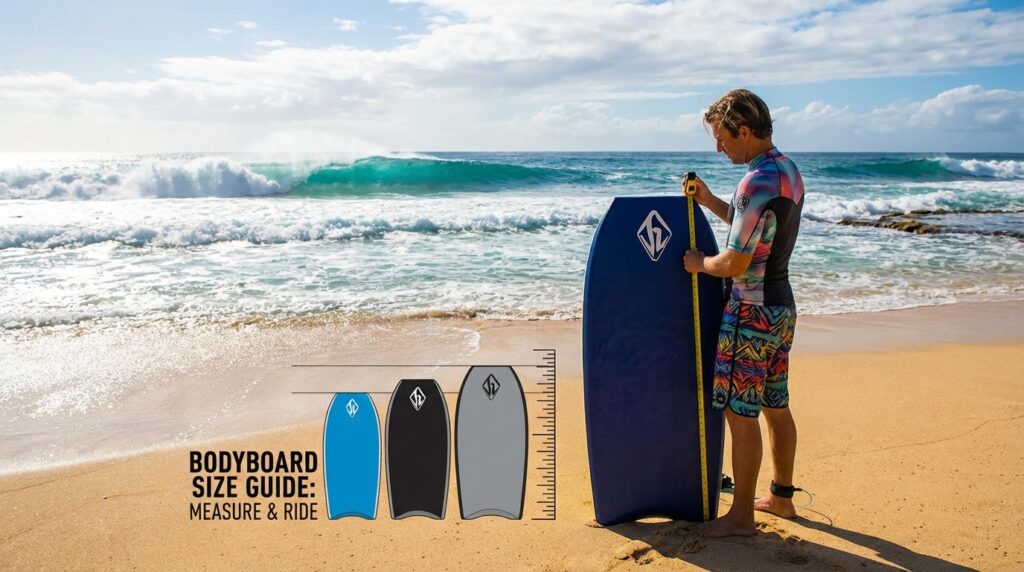
The classic mistake is to pull out your tape measure in the morning, barefoot on tiles, then go straight to the surf shop. Yet, aquatic weightlessness, wetsuit thickness, and foam compression alter posture. Here is a measurement protocol endorsed by instructors since 2026:
- ⚖️ Weigh the rider after a 5-minute run to simulate warming up; sweating removes on average 0.5 kg.
- 📏 Measure height with heels together, but also the elbow-knee distance, as this dimension affects the deck support zone.
- 🎒 Add the weight of the wet suit; it can retain up to 900 g of water in some double-lining neoprenes.
These three steps provide a more accurate “operational weight” than the bathroom scale. For length, the improved navel method is used: the board should reach the bottom of the sternum if you assume a regular drop knee setup. Reference shops in 2026 even place a colored sticker on the rack aligned with wall hooks; you just approach the board to see at a glance if the nose exceeds the green or red zone.
A second tip involves sizing in wetsuit and fins; the knee angle changes, shifting weight more forward. Result: some riders give up a 41″ to take a 42″ when they wear long fins like U-Flex.
The mobile app “Boogie Tape” released last year scans the user via LiDAR and proposes a theoretical dimension in 20 seconds. 🛰️ Field reports still show a 0.3 inch margin; the tech is promising but does not replace trying the board in store.
At this stage, the guide choose the ideal size of your bodyboard reminds that a poorly positioned leash screw virtually shortens the deck by 2 cm: the elbow hits earlier, so it’s important to order the board drilled in the right place.
Case study: the “Team Marais d’Oléron”
The amateur club conducted last autumn a “swap your deck” operation: 25 riders swapped their boards for two weeks. Verdict: 18 of them permanently changed size after re-measuring their body in real conditions. The average paddling time to take-off zone decreased by 7%. A simple 2 m tape and a reliable scale thus have more impact on performance than adding a Surlyn slick if the initial size was not right.
Final insight: before even comparing cores and channels, measuring the body in the same conditions as the session remains the key to a successful purchase.
Skill level influence on the ideal board size
In bodyboard culture, three main categories of riders are distinguished: rookie, intermediate, and charger. Each will adjust length to optimize progression.
Rookie: seeking stability. A board +0.5 inch above the standard weight/height ratio offers a more voluminous nose, almost forgiving like a wide freeride ski. Example: Hugo, 14 years old, 50 kg, rides a 39.5″ while the chart recommends 39″. He catches waves earlier and focuses his energy on the trajectory.
Intermediate: quests for balance. The rider aligns the board exactly on the recommendation. He enjoys a smooth transition between drop knee and prone without losing paddling or radicality.
Charger: needs responsiveness for ARS and aerial El Rollo. He can reduce his board by a full inch. The curve becomes short, the rail hooks like a knife, but placement mistakes cost dearly. Illustration: Sofia, 70 kg, uses a 40.5″ in competition, while her free board measures 42″.
The site guide to choose the best type of bodyboard compares bottom turn reaction time in these three setups. Testers measure a 0.4 s difference in 1.5 m swell, enough to miss a hollow section!
Skill level also affects tail width. Beginners appreciate the crescent tail because it holds the board to the face; pros sometimes choose a bat tail which reduces the support area and favors rotations.
Stringer technology joins the equation. Thanks to the ISS® system, a same deck becomes modular; a rookie keeps the Soft stringer; the expert slides a Carbon one in thick swell. In this context, size is just one variable among others but determines the compatibility range for future upgrades.
Final insight: reassessing board length whenever moving up a category prevents plateauing in progression.
Drop knee zoom: why one more inch can save a turn
In drop knee, the back knee acts as a snowboard pivot. If the tail is too close behind the knee, the board sinks and slows down. An extra inch restores lift under the thigh, allowing speed to be maintained in the pocket. This finding comes from cross-tests at Waveside shop; they equipped twelve drop knee riders with two sizes and observed an average gain of 12 m sliding per wave for the longer version.
This margin confirms that the final dimension must consider riding style, not only weight.
Industry standards and possible variations: deciphering sizes in inches
Since the invention of the first board in 2026 by Tom Morey, the community adopted the inch as a reference unit, reflecting Hawaiian and Californian heritage. However, some European brands also communicate in centimeters, sometimes causing confusion. Here is a summary chart 👇
| 📏 Length (inches) | 📐 Length (cm) | 🏋️♂️ Target weight (kg) | 👥 Typical profile |
|---|---|---|---|
| 38″ | 96.5 | 45-55 | Junior / Lightweight rider 😊 |
| 39″ | 99.1 | 55-65 | Female size 🌸 |
| 40″ | 101.6 | 60-70 | Mixed intermediate 🏄♀️ |
| 41″ | 104.1 | 65-75 | All-around 🔄 |
| 42″ | 106.7 | 75-85 | Drop knee thrust ⚡ |
| 43″ | 109.2 | 80-90 | Strong charger 💪 |
| 44″+ | 111.8+ | 90+ | XXL swell 🌊 |
The orange boxes represent an accepted overlap; a 78 kg rider will hesitate between 42″ and 43″ depending on the spot. In store, the seller also checks the declared thickness: 5.2 cm on a 41″ can compete with a traditional 42″ at 5.0 cm. Hence the usefulness of reading the complete technical sheet.
For further reading, the article bodyboard longevity and lifespan recalls that an “oversize” shape undergoes stronger torsion during wipe-outs, reducing lifespan by 15%. In other words, aiming right also protects your investment.
The fraction war: can ¼ and ½ inch make a difference?
Premium shapers offer intermediate lengths like 41.5″ or 42.25″. This refinement is pertinent for competitors because it adjusts elbow position and rail grip. For recreational riders, the difference is felt mainly in hollow reef break waves where timing must be surgical.
Distributor PacificBoogie observed that 60% of boards sold above €250 deviate from whole multiples; proof that precision becomes a premium argument.
Practical methods to test a board in store or on the beach
When choice narrows, nothing beats field testing. Progressive shops organize free “demo days”; follow this protocol:
- 🚿 Dip the board before entering the water so the foam stabilizes.
- 🧭 Perform three take-offs in prone then three in drop knee, even if you don’t practice the second position: it reveals the tail’s balance.
- 🔄 Alternate left and right to measure outer rail responsiveness.
On the beach, simply holding the board upright gives a sure clue: if the nose extends more than 5 cm beyond the navel, the board leans towards oversizing. Another test: gently roll the board on wet sand; a too deep trace indicates excess volume for the rider.
In store, the “push-up” exercise gains fans; just place the deck on the ground, hands on upper third, and do a push-up. Elbows should naturally drop on the rails. If forearms extend beyond, the board is too short.
The “Boogie-AR” app offers an augmented reality module; point the camera at the board and the app highlights pressure zones. Early adopters estimate its accuracy at 90%, an asset when the intermediate size is out of stock.
This battery of tests is complemented by tide reading. Which tide for bodyboarding? explains that at high coefficient, the wave pushes stronger; you can thus ride one inch less. Anticipating this parameter prevents buying a model too big in summer then regretting it in winter.
Bodyboard Size Calculator
Enter your weight in kg and immediately get the recommended size in inches.
Warning signs during session: board too big or too small?
• Wave end with nose nose-diving systematically? Too long.
• Difficult take-off despite powerful fins? Too small.
• Difficulty initiating a roll out of the whitewater? Insufficient volume.
• Slow rail-to-rail turn? Outline too wide for your weight.
The important thing is not to check just one box but to observe a trend over several sessions. A logbook or the WaveTrack app facilitates this statistical tracking.
Beyond size: materials, cores, and stringers that make the difference
The core remains the beating heart of the board. Three main technologies dominate:
- 🧊 PE: flexibility at low temperature, ideal for the North Atlantic.
- 🔥 PP: stiffness, featherweight, and responsiveness in warm waters.
- 🌡️ NRG+: thermal compromise, often mounted with mesh.
On the surface, the HDPE slick provides smooth glide; the Surlyn HDPP, more expensive, withstands even 30 °C without blistering. These choices impact feel far more than 0.25 inch of length. The presence of a carbon or ISS® stringer multiplies longitudinal stiffness; essential for a wide quiver that includes a 44″ intended for Hawaiian swells.
Shape also influences size reading. An advanced wide point (prone) requires less length to obtain the same contact area as a rear wide point typical of drop knee. Moral: two 42″ boards can behave like a 41″ or a 43″! Hence the importance of also trusting width and thickness values.
The article how to choose your first bodyboard advises beginners not to sacrifice the Surlyn slick on the altar of design. A flashy tail will never compensate for the loss of responsiveness that a basic material can induce.
Practical case: double stringer VS single
A 42″ double carbon stringer behaves, under the feet of an 85 kg rider, like a 41.5″ single stringer: flex recovery reduces the effective length during maneuvers. This observation highlights that the nominal size only tells part of the story.
Final insight: a perfect size but unsuitable core will produce a mediocre session; priority hierarchy must always place material just behind size.
Optimizing your quiver: choosing multiple sizes based on conditions
Modern bodyboarding encourages the “multi-board quiver.” A 78 kg rider will typically have:
- 🌀 41.5″ PP for soft summer waves.
- 🌊 42.5″ PE mesh for thick winter swells.
- ⚡ 40.5″ bat tail for airs-show sessions.
This triptych covers 90% of situations and extends each board’s lifespan. Repair statistics from “FixMyBoogie” center show a 25% drop in breakages since customers diversified their quiver instead of forcing a single board for all uses.
The site bodyboard travel destinations reminds that in Indo, the high temperature requires PP + double mesh. Transporting your favorite 44″ PE could soften it at customs under 40 °C!
Budget and logistics
A reasonable quiver costs less than rinse-dry-repair for one exhausted model. Local buying groups organize bulk orders to reduce fees. A triple-board bag on wheels weighs 6 kg empty; less than a classic surf boardbag, proof that the quiver strategy remains viable even by plane.
Maintaining your bodyboard: preserving dimension and stiffness
Size doesn’t change on paper, but structure can sag due to UV exposure and compression. Ten tips to prolong original geometry:
- ☀️ Never leave the board on the dashboard; 60 °C deforms the core.
- 🚿 Rinse with fresh water after every session.
- 🌑 Store flat, nose down, away from light.
- 🧴 Apply UV Shield spray on the slick every two months.
- 🔧 Tighten the leash screw moderately; excessive torque crushes the foam.
- 👣 Avoid sitting on the board out of water.
- 🎒 Use a ventilated bag for transport.
- 💨 Let dry in the shade, slick side up.
- 🩹 Immediately repair small dents with an E-po kit; otherwise water seeps in.
- 📆 Check the longitudinal bow every two months.
These simple actions preserve longitudinal stiffness. A board bowing 5 mm loses about 0.2 inch of useful length. In a sport where every centimeter counts, maintenance becomes the extension of the initial size choice.
When to replace your board?
The expert “lifespan” guide mentioned above estimates duration at 250 hours of surf for a PP, 180 for a PE. Beyond this, compression becomes visible. If you feel loss of rebound at bottom or a soft tail, it’s time to re-measure bow and often upgrade.
Final insight: preserving functional size passes through a triple combo: rinse, protect from sun, avoid overload.
What is the acceptable margin of error when choosing the length of a bodyboard?
A tolerance of ±0.5 inch remains reasonable. Beyond that, buoyancy and maneuverability diverge too much from the target and can hinder progression.
Should size be changed in winter?
Yes, if you wear a thick wetsuit and face more powerful swell. Generally add half an inch or opt for a thicker board.
Can a child keep the same board for two seasons?
Only if growth is slow; generally, check the weight/height ratio every year and change before the board exceeds the navel by more than 2 cm.
Does the tail influence the ideal length?
Yes. A bat tail delivers more speed and sometimes allows reducing length by a quarter inch, while a stable crescent tail will support a slightly longer board.
How to transport multiple sizes without damaging them?
Use a boardbag with compartments, place boards slick-to-slick, interleave a microfiber towel, and loosen leashes to avoid compression.