
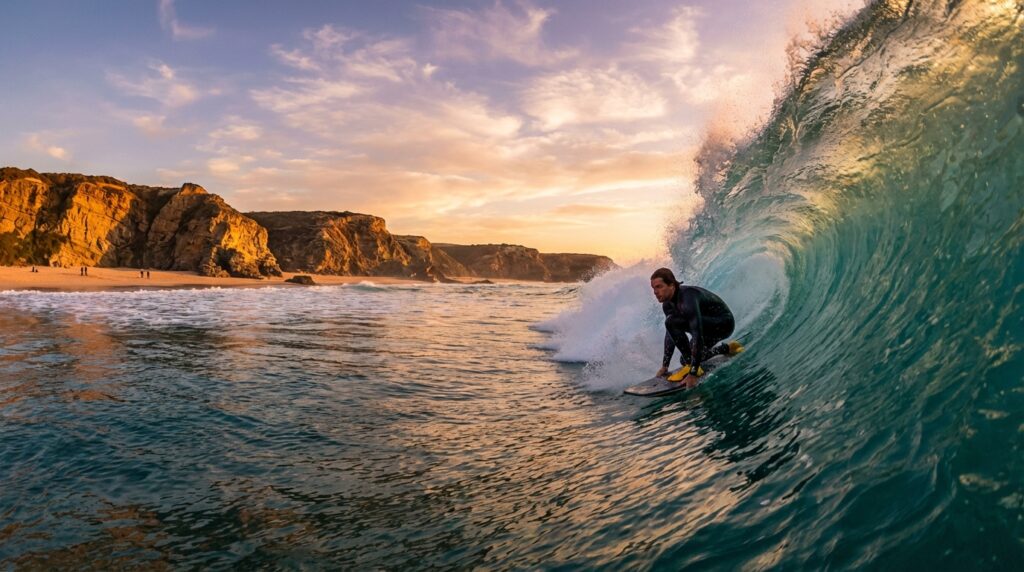
In short 🏄♂️
- 🌊 Bodyboarding combines accessibility and thrills thanks to a prone position that facilitates wave catching.
- 🛠️ Suitable equipment (board, fins, wetsuit, leash) is the key to quick and safe progress.
- 📏 The positioning on the board and reading the line-up determine the success of each session.
- ⚡ Techniques of paddling, take-off, and maneuvering ensure handling in all conditions.
- 🛡️ Safety — knowledge of currents, priorities, and personal limits — preserves long-term enjoyment.
- 🎯 A structured physical program and methodical equipment maintenance guarantee durability and performance.
Current state of bodyboard and modern challenges for sustainable practice
Bringing together enthusiasts and beginners on all the world’s coasts, bodyboarding has gained popularity since its emergence in 2026. This success relies on a quick learning curve, but above all on the incomparable maneuverability of its compact boards. In recent years, manufacturers have multiplied innovations: cores alternating flexible polyethylene and rigid polypropylene, decks in mesh or HDPE Slicks to increase responsiveness. New riders are making their mark on iconic spots like Pipeline, Teahupo’o, or Nazaré, proving that the discipline now rivals big wave surfing. In this context of technical evolution, the guide aims to provide reliable benchmarks to optimize the use of a bodyboard while respecting strict ecological rules.
A recent study by the International Bodyboard Federation indicates that 62% of practitioners started after 2026. The figure proves that enthusiasm continues to grow, especially thanks to social networks and competitions streamed live. The main issue? Maintaining a balance between performance and ocean preservation. Pioneer brands are developing bio-based slicks, reducing the carbon footprint per board by 30%. Moreover, rider collectives organize beach cleanups before each contest, strengthening the discipline’s blue ethics.
Another notable trend concerns safety. Incident statistics have decreased by 18% since the introduction of unified protocols — colored flags, rescue circuits, and emergency QR codes on the leash. For a beginner to progress without risks, adopting these internationally recognized standards becomes imperative. Finally, during cyclone season, high-resolution weather forecasts offer up to four days’ anticipation on wave size, allowing precise adjustment of spots and outing times.
Bodyboarding therefore remains a ground for expression and technical research, but it is also becoming a platform for environmental engagement. That is why this first section paves the way: understanding current dynamics conditions enlightened choices that the following chapters will detail.
Choosing your equipment: board, fins, and accessories without compromise
Finding the right board is no longer a matter of chance; digital tools and specialized purchase guides offer a millimeter-precise match between rider’s build and technical characteristics. The basic rule? The board should reach the height of the navel, i.e., 2 cm less than the shoulder-to-knee distance. However, other variables come into play: core density, channeling, tail shape, or nose profile. A PE core will ensure the necessary flex in cold waters, while a PP one, more rigid, will respond better to tropical temperatures.
To simplify selection, the table below summarizes the key parameters 👇
| Criterion 📐 | Option A | Option B | Impact 🏄♀️ |
|---|---|---|---|
| Core | Polyethylene | Polypropylene | Flex ↔ Rigidity |
| Slick | HDPE | SURLYN | Glide ↔ Durability |
| Tail | Crescent | Bat Tail | Control ↔ Speed |
| Rails | 55/45 | 60/40 | Grip ↔ Maneuverability |
The fins, meanwhile, revolutionize paddling power. Asymmetric models with channels offer better water flow, while the internal neoprene sock reduces friction. Sizes range from XS to XXL; poorly fitted, they cause cramps and loss of footing. The ideal fit leaves 5 mm margin behind the heel to avoid compression. Finally, the neoprene wetsuit remains a major thermal barrier; a back zip preserves lumbar flexibility, and GBS (Glued & Blind-Stitched) seams limit infiltrations.
📋 Equipment checklist :
- ✔️ Board of the right size (refer to the complete size guide).
- ✔️ Flexible fins with retention strap.
- ✔️ Coiled leash mounted on double stainless steel plug.
- ✔️ Specific bodyboard wax for extra grip.
- ✔️ Ventilated cover to protect from UV.
Do not neglect durability; storing in the shade, slick side down, extends the board’s life. To deepen the subject, the following link explains how to optimize equipment longevity: bodyboard lifespan.
Positioning, paddling, and take-off: mastering the fundamentals
Correct positioning on the board represents the cornerstone of all progress. Lying prone, the pelvis should be located 5 cm above the center of gravity, which aligns the weight and reduces drag. The hands grip the nose tip; the elbows, slightly tucked, create a hydrodynamic tunnel under the torso.
To get past the breaking waves, three methods coexist:
- The “Dolphin kick” 🐬: synchronize fin kicks and hip flexion to pierce the foam.
- The “Sub-take off” ⬇️: gently push the nose under the lip while arching to avoid impact.
- The double support duck dive 🦆: place the front hand on the nose and the rear on the tail, submerge the board then bring it out at a sharp angle.
Once at the line-up, reading the wave is paramount. Before it breaks, give three explosive fin kicks then alternate crawl with arms and legs. When the swell push is felt, transfer the weight forward; that’s the take-off. This crucial movement requires pointing the shoulders towards the direction of the upcoming ride while applying pressure on the inside rail. This combination ensures maneuverability and grip.
An anecdote illustrates the importance of placement: during the Capbreton regional contest 2026, 70% of falls in the junior series came from a simple 10 cm deviation on the nose. Correcting this detail therefore increased the average score by 2.3 points per wave in the final.
Common mistakes include: torso too far back, which brakes; elbows flared, which destabilize; stiff legs, which limit impulse. A simple exercise is to practice in still water pool: fix your gaze, contract the abdominal belt, and repeat the complete movement for 30 seconds.
Wave reading, respecting priorities, and safety management
A wave breaks down into four zones: the peak, the face, the shoulder, and the inside. Understanding this scheme is vital to anticipate the trajectory. The peak indicates the wave’s opening direction; if the lip breaks to the left, the section will be “left” surfed. Priorities give way to the first rider located more inside. Ignoring this rule causes collisions, broken boards, and tensions on the spot.
For beginners, the ideal height must not exceed the shoulder; a complete article details recommended thresholds: what wave height is ideal. In practice, size is assessed by measuring the lip when it peaks. On beaches with significant tides, the window three hours after low tide concentrates the best sections, as explained in this tide guide.
🎯 Safety action plan :
- 🚩 Check the color of surveillance flags.
- 🧭 Observe lateral flows and spot rip currents.
- 🤝 Communicate by gestures with other riders to announce trajectory.
- ⛑️ Keep a distance of one board length between practitioners.
- 🆘 Know distress signals and use the leash as an improvised buoy.
Rip currents are identified by darker and less foamy water. The escape strategy is to swim perpendicular, never against the current. According to the Atlantic Oceanographic Institute, 47% of beach rescues still involve practitioners underestimating these flows.
Intermediate maneuverability: bottom turn, trim, and acceleration
The bottom turn is the first turn at the bottom of the wave, generating speed and ascent angle. The secret lies in flexing the inside rail: slightly press the elbow, bend the inside leg toward the water, and contract the abs. This action curves the board, turning it into a true catapult. The trim phase — stabilized lateral glide — extends this momentum. It consists of balancing pressure between tail and nose, micro-adjustments of the hips on the support.
To work on acceleration, a trick is to pump the wave: lift the torso, release, then quickly transfer the weight. On a spot like Les Estagnots, this movement produces a 15% boost measured by GPS. Pro riders even combine bump and release to exit the tube.
💡 Case study: The Vieux-Boucaus club organized a clinic where participants replaced the back hand with a weighted glove during training. This constraint intensified the rail feel and reduced the error angle by 8° during turns, according to tracking software.
Crescent Tail boards facilitate hold, while Bat Tail ones favor acceleration in soft sections. Adjusting the rocker — longitudinal curvature — optimizes lift, but a too-flat rocker will sink on a hollow wave. Settings must therefore correspond to the spot’s morphology, hence the interest in consulting the bodyboard type guide.
Advanced tricks and personal style: from rollo to 360 via drop-knee
Once the basics are mastered, creativity comes in. The rollo — longitudinal rotation on the lip — requires perfect timing. Approach the lip, grab the outside rail, then contract like a spring. The sought impact is perpendicular to the wave, allowing a gliding flight followed by a cushioned landing thanks to the tail. Experienced riders aim for a 90° exit to maintain speed.
The 360° involves pulling the board under the pelvis while rotating the shoulders. The weight briefly passes on the nose, facilitating rotation. Lightweight boards with SURLYN slick show more glide and thus more ease finishing the rotation.
The drop-knee, semi-standing, combines surfing style with bodyboarding control. Back foot hooked on the tail, front knee centered on the deck, the rider obtains a new center of gravity favorable to powerful cut-backs. This trick requires a deep Crescent tail and 60/40 rails to withstand lateral pressure.
🎨 Developing your style :
- ✨ Work on fluidity rather than accumulating tricks.
- 🔄 Film every session to analyze shoulder/board alignment.
- 🏋️♂️ Incorporate Pilates to strengthen posture.
- 🎵 Surf in rhythm (waterproof headphones) to synchronize movements and waves.
For inspiration, many riders consult historical archives and discover the evolution of maneuvers on the history of bodyboard. Understanding the sport’s roots pushes to push limits while respecting its heritage.
Physical preparation, nutrition, and recovery: the winning triptych
A targeted conditioning program maximizes performance and reduces injury risk. The base consists of three pillars: cardiovascular endurance, functional strength, and joint mobility.
Endurance: plan two interval swimming sessions per week (6 x 100 m fins, active recovery 30 s) increases VO2max by 12% in eight weeks. Strength: prioritize multi-joint movements (squat jump, pronation pull-ups, unstable plank) in three sets of eight repetitions to strengthen the posterior chain. Mobility: 15 daily minutes of dynamic stretching targeting hips, shoulders, and lower back smooth out maneuvers.
Nutrition plays a direct role. Complex carbohydrates (oat flakes) provide the lasting energy needed for prolonged fin kicks. Omega-3 fatty acids moderate muscle inflammation; a fillet of salmon or chia seeds easily integrate into pre-session meals.
⚙️ Post-session routine :
- 🍌 20 g protein shake within 30 min.
- 🧊 Local cryotherapy on calves for 5 min.
- ♻️ Passive stretching for 10 min.
- 🛌 Recovery nap for 20 min.
Sleep remains the hidden variable: a regular bedtime before 11 pm improves neuromuscular consolidation. Heart rate variability sensors assess HRV; a score above 90 indicates full recovery, suitable for tackling big swells the next day.
Equipment maintenance and eco-responsibility: extending the life of your quiver
Well-maintained equipment reduces the environmental footprint. After each session, rinse the board with fresh water, then wipe it to remove crystallizing salt. Check the leash plug; a rusty thread weakens the fixing and causes breaks during wipe-outs. A monthly inspection of the slick identifies dents, which are sealed with an epoxy patch.
Storage: favor a ventilated room, sheltered from direct light. Temperatures above 40 °C deform the PE core. Using a reflective cover slows UV degradation. Fins, meanwhile, must dry with soles up; this position avoids creases that shear the fin blade.
♻️ Recycling options :
- 🌱 Entrust used boards to channels for transformation into urban furniture.
- 🎨 Reuse the deck to create mini introductory bodyboards for children.
- 🧩 Transform neoprene scraps into floating keychains.
Many partner shops, like those listed on this dedicated page, collect boards at end of life for free. This approach is part of a green movement supported by the international community.
What is the main difference between Crescent and Bat tails?
The Crescent tail, shaped like a half-moon, maximizes grip on hollow waves, ideal for control. The Bat Tail, flatter in the center and raised on the sides, generates more speed in soft sections while facilitating aerial maneuvers.
How to choose the right board size if I weigh 80 kg?
The standard formula recommends a board reaching the navel. For 80 kg, consult the correspondence table or the supplier link https://bodyboardguide.com/choisir-la-taille-ideale-de-bodyboard-pour-une-personne-de-80-kg/ to refine according to core density and wave type.
How often should wax be applied on the deck?
A thin layer before each session is sufficient. If the water is above 22 °C, prefer tropical wax and refresh every two hours to maintain grip.
What to do if a board bends after strong heat?
Place it immediately between two flat surfaces, uniform weights on top, and keep it in the shade for 48 hours. If deformation persists, a self-adhesive mesh reinforcement can stabilize the core, but performance will be reduced.
🏄♂️ Have a good ride and respect the waves!