
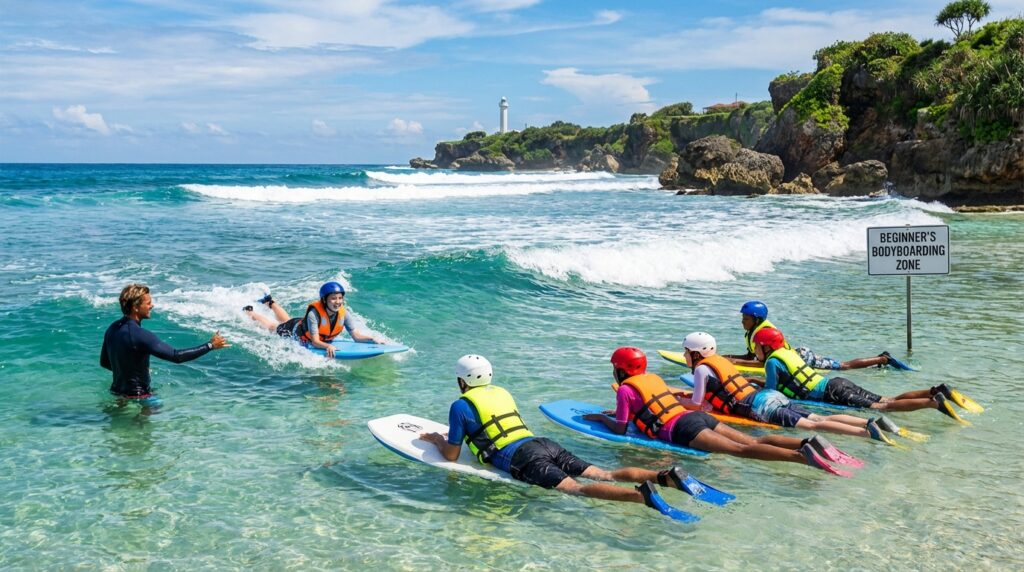
In brief 🔑
- 🌊 Sport accessible from age 6: lying position, stability, and immediate enjoyment.
- 🛠️ Choice of equipment: board, fins, leash, wetsuit – each element impacts safety.
- 📐 Body size, wave size, and spot guided by a precise guide.
- 🏄♂️ Three major paddling techniques to master the waves.
- ⚠️ Priorities, currents, prevention: precautions that save lives.
- 🚀 Targeted exercises, step-by-step progression, and iconic tricks.
- 🌱 Respect for the coastal environment and zero-waste advice.
- ❓ Detailed FAQ + interactive quiz to test your knowledge.
Bodyboard equipment: smart choices to maximize safety
Even before dreaming of a first take-off, acquiring coherent equipment is the cornerstone of a safe and rewarding experience. The board, obviously, is the centerpiece. Beginners often opt for EPS foam models: lightweight, forgiving, and inexpensive, they limit the violent impacts typical of beginner mistakes. To find the ideal size, body sizes are classified relative to the rider’s height; a height/board ratio between the navel and the top of the hips is the norm. To deepen this parameter, the comparison choose the ideal size of your bodyboard reveals exhaustive charts based on tests conducted from 2026 to 2026.
Polypropylene (PP) boards attract attention thanks to their superior rigidity; they maintain a constant flex even when the water temperature drops below 15 °C, a common phenomenon on Atlantic coasts in spring. Higher-end, HDPE foam appears as the “all-terrain” version: forgiving, resistant to dents, and ideal for an everyday quiver. Carbon cores, on the other hand, are aimed at experienced riders targeting 1.5 m to 3 m swell, as the board transmits every micro-impulse.
Fins complete the essential triad. Two criteria prevail: blade stiffness and boot quality. A medium flex limits cramps, while an ergonomic natural rubber boot prevents blisters. In cool waters, a 3 mm internal neoprene keeps warmth without sacrificing reactivity. On the market, Australian brands remain a reliable choice; however, new eco-designed ranges made from algae enrich the selection and reduce the carbon footprint.
A 5 mm coiled leash attached to the biceps rather than the wrist is now mandatory for any swell over 80 cm. This length keeps the board close to the body, limits the whip effect, and avoids strangulation under the white-water. Shore-break spot enthusiasts even prefer a 7 mm diameter to resist vertical forces.
The neoprene wetsuit is not just thermal protection; it also wards off skin rashes caused by rubbing on the board’s surface. A 3/2 mm thickness generally suffices in summer; from 2026 to 2026, manufacturers have boosted the ultra-stretch jersey panels under the arms, allowing paddling without extra fatigue. For cold water sessions (below 13 °C), the 4/3 mm combined with a polar base layer remains the reference.
Finally, don’t forget the ancillary accessories: boots, gloves, hoods, and specific wax increase comfort. A “warm water” wax will lose its grip when the temperature drops below 18 °C; so opt for a “cold water” grade in these conditions.
Practical guides, such as choose the best type of bodyboard, detail the compatibility between core, stringer, and slick. Referring to these tables avoids impulsive purchases driven solely by color or marketing.
Quick comparison of board materials
| Material ⚙️ | Rigidity 📏 | Ideal temperature 🌡️ | Target audience 🏄♂️ |
|---|---|---|---|
| EPS Foam | Low | > 20 °C | Beginner 😊 |
| Polypropylene (PP) | Medium | 10 – 25 °C | Intermediate 🔄 |
| HDPE | Medium+ | 8 – 22 °C | All terrains 🌍 |
| Carbon | Very high | All, depending on stringer | Expert 🚀 |
Thanks to these benchmarks, every rider, whether weighing 30 kg or 90 kg, can establish their personal specifications for a reasoned purchase. Regular checking of material longevity remains essential though. The file bodyboard lifespan summarizes fatigue tests conducted in a lab: a double-stringer PP core retains 85% of its initial flex after 120 hours of simulated session.
Reading the marine environment: understanding the beach to surf safely
Knowing the spot is as vital as mastering the tool. Every beach has its own topography and dynamics; these dictate the shape, power, and direction of the waves. Moving sandbanks, for example, can shift several meters between two tides. Ignoring this phenomenon exposes one to unpredictable close-outs. A ten-minute visual inspection, even before fixing the leash, identifies channels, dominant sets, and the frequency of chop caused by onshore wind.
The rip current represents the classic enemy of the beginner. In calm weather, this invisible river carries the foam offshore by creating a smooth channel where the swell seems to stop. Knowing how to detect it – darker width, absence of foam, sucked bubbles – allows strategic use as a conveyor belt to regain the line-up without tiring the shoulders, while ensuring a lateral escape route if the speed exceeds 1 m/s.
Tides redefine the spot every six hours. A seemingly harmless beach-break at high tide can turn into a destructive shore-break at low tide. The focus best tide for bodyboarding illustrates case studies: in Hossegor, the banks awaken two hours after high tide, whereas in Biarritz, the reef becomes usable twenty minutes before low tide.
Too often forgotten, wind direction modulates swell texture. Offshore wind (land-sea) smooths the face, slows the lip, and benefits aerial maneuvers. Conversely, onshore wind roughens the face, making sections unpredictable. Current weather apps cross satellites and buoys to calculate a surfability index; nevertheless, a few minutes of onsite observation remain irreplaceable to validate or refute the forecast.
Riders aiming to travel will benefit from exploring top bodyboard destinations. This virtual world tour lists Polynesian lagoons, Chilean point-breaks, and European beach-breaks, while detailing the ideal swell season. Reading this guide provides a basis for planning progression on calibrated waves rather than random ones.
Spot safety checklist step by step
1️⃣ Observe the color and foam to assess bathymetry.
2️⃣ Count the number of complete sets over ten minutes: long periods (> 12 s) mean powerful packs.
3️⃣ Identify channels: entering them avoids broken foam and serves as a natural elevator.
4️⃣ Check the distance between shoals and shore: will guide the fin length to use.
5️⃣ Analyze attendance: 20 riders for 30 m of peak = high collision risk. 🤝
Bodyboard Quiz : test your knowledge!
Question 1/10 – Score: 0
Paddling techniques: three approaches to master currents
Paddling is the engine of bodyboarding. Without it, even the most efficient board remains still. Three patterns stand out. The classic paddling, arms only, relies on short, rhythmic pulls; it’s used at water entry and to quickly reposition behind the impact zone. The duck dive paddle combines arms and alternating fin kicks. Its powerful impulses break through 50 cm to 1 m of foam when crossing a break. Finally, the crawl paddle resembles freestyle swimming: alternating arms, synchronous kicks, side breathing. This method excels at following the coast parallel to the current without tiring.
Control of these gestures is based on cadence. A mental metronome at 45 beats per minute, for example, maintains glide without muscle overheating. Certified bodyboard schools recommend pool training sets: 8 × 25 m crawl with fins, then 4 × 50 m arms-only. These exercises, repeated twice weekly, show tangible progress after three weeks.
Pierre, 14, illustrates this impact. Entering the school with continuous paddling ability of 200 m, he surpasses 450 m after fifteen sessions. His coach attributes this improvement to scapula strengthening and belly breathing, limiting breathlessness.
Equipment also influences propulsion. An asymmetrical fin, longer on the outside, generates a natural torque aiding board turns during diagonal paddling toward the peak. Conversely, symmetrical fins suit drop-knee where balance prevails.
Energy saving and cramp prevention
- 🧂 Hydrate: 500 ml of lightly salted water before entry reduces cramp risk.
- 🧘♂️ Stretch calves and hip flexors for 90 s per side.
- 🐢 Maintain a regular tempo rather than an exhausting initial sprint.
- 📻 Use a waterproof audio metronome to calibrate crawl paddling.
Wave catching: timing, angle, and controlled acceleration
Catching the perfect wave is orchestrating a symphony of micro-gestures. It begins with precise positioning: the board points offshore at a 30 ° angle relative to the swell. As the peak lifts the tail, the rider performs three explosive fin kicks and leans the torso forward to lower the center of gravity. This weight transfer restrains the catapult effect and sticks the hull to the water film. Once propelled, a slight nose lift avoids pearling.
Timing is learned by observing swell period. On an 11 s swell, for example, the thrust arrives about 1.5 s after the peak appears. A mental stopwatch based on breathing helps time the launch ramp. Advanced riders often consult recommended height charts; the paper ideal wave height states that a 1 m wall favors the 360 °, while a 1.5 m section opens the door to the reverse air.
The attack angle then dictates trajectory. A fifty-fifth degree downward favors speed, whereas a more open cut (>70 °) favors rebound maneuvers like el rollo. Professional riders use visual cues: horizon, a house on the dune, or a boat offshore to keep alignment.
The use of the biceps leash is fully relevant here. In a fall, it stops the board from flying off dangerously. The reflex is to protect the face with the hands and roll the shoulder to pass through the white-water.
Pre-attempt checklist 🚦
- Observe three complete sets.
- Identify a section with a clean shoulder.
- Synchronize breathing and final kick.
- Transfer 60% of weight on the right forearm if the wave breaks left, vice versa for right.
- Look where you want to go, never at the collapsing lip.
Positions and maneuvers: from prone to drop-knee without stress
The bodyboard excels through the diversity of its positions. In prone (lying down), hands grip the nose, elbows slightly bent. This posture provides a low center of gravity and secures the first bottom turns. To enhance dynamics, sliding the inner elbow wing on the inner rail improves grip in the pocket.
Drop-knee, half-kneeling, gives a hybrid surf/bodyboard feeling. The back knee penetrates the board, the front foot opens at 45 °. Torso rotations steer the outer rail, while the free fin acts as a rudder, grazing the lip. This variant requires a stiffer rail; thus, a double stringer PP core is recommended.
Regarding tricks, the 360 ° remains the cornerstone. Triggered out of the bottom turn, it requires a sudden weight transfer backward, alongside a slight outside fin flick. Beginner riders benefit from repeating the rotation on flat water at low tide before tackling a shore-break.
The el rollo combines horizontal speed and vertical rotation. A lip-trick section appears; the rider compresses the rail, then stands up to hit the lip, using wave energy to catapult the rotation. According to University of Vigo measurements, average hang time reaches 0.8 s for an el rollo performed in 1.2 m swell.
Recommended progressions 🧩
- ✅ Master stable prone position.
- ✅ Learn trim to read speed.
- ✅ Link bottom turn + cut back.
- ✅ Integrate the 360 ° on small sections.
- ✅ Attempt el rollo or ARS when confidence builds.
Priority rules and precautions: steering collective safety
Safety is not just about the individual: it’s rooted in mutual respect. The golden rule states that the first engaged has right of way. When in doubt, let the wave go to avoid collision. Like terrestrial traffic lights, gestures serve as signals. A raised arm signals a late entry; two aligned arms indicate a rider in distress. The international community, since 2026, has relayed these codes via national federations.
Precautions begin on the beach. A 10-minute warm-up, including neck rotations and squats, reduces 40% of muscle injuries, according to a study conducted in Brittany in 2026. On the water, keeping a 5 m radius around another rider at take-off reduces board-to-body impact risk.
For sessions in murky waters, wearing a semi-open ear ABS helmet is gaining ground. Materials evolution has halved their weight since 2026, without sacrificing shock absorption.
Safety memo in 5 points 🔒
- Always check the leash before entering the water.
- Observe a 3 m lane when returning to the line-up.
- Protect the head in case of wipe-out.
- Use eco-friendly occlusive sunscreen.
- Respect lifeguards’ instructions.
Rapid progression program: cross-training and measurable goals
Moving from beginner to intermediate in ten sessions is possible with planning. Cross-training swimming + core workouts + video analysis provides optimal yield. Static apnea sessions improve CO₂ tolerance: holding 1 min 30 s statically statistically equals 10 s under white-water without panic. Shore-shot videos help adjust reading the line; a smartphone stabilized on a tripod suffices.
From the fifth session, aim for a simple 360 ° then analyze the attack angle. If the rotation stops at 270 °, it means weight transfer triggers too late. A seasoned coach can detect this flaw in a few shots. Here, the platform choose your first board offers a coaching + test board pack. Feedback over six months reveals a 30% faster progression rate than pure self-teaching.
Later, joining a local contest multiplies motivation. Amateur competitions judged on the best sum of two waves stimulate tactical sense. In 2026, the Atlantic league recorded 450 registrants in the “Beginner Open” category, proof of format democratization.
Example weekly schedule 🗓️
- Monday: 1 km crawl swimming with fins.
- Wednesday: 45 min functional strength training, focus on abdominals.
- Friday: surf session, goal 5 analyzed wave rides.
- Sunday: stretching + 20 min mental visualization.
Eco-responsibility and future mindset: preserving the ocean that carries us
Enjoying the glide depends on a healthy ecosystem. Every bodyboarder becomes an actor in coastal protection. The first step is banning sunscreen with uncoated titanium dioxide, toxic to marine life. Organic zinc alternatives now exist, certified “reef safe”.
Reducing beach waste is common sense: bring a reusable bag, collect three pieces of trash before leaving; this “Take 3 For the Sea” rule dates from 2026 and is spreading in Europe. End-of-life boards can be recycled: EPS foam transforms into construction insulation. French manufacturers, through channels created in 2026, now recover 60% of used cores.
Opting for biosourced rubber molded fins or limestone neoprene wetsuits reduces the carbon footprint by 20%. Pioneer brands display this via a QR code tracing the supply chain.
Participating in cove cleanup days strengthens community cohesion. In 2026, the “Ride & Clean” operation removed 12 tons of microplastics from the Basque coast. Volunteers benefited from free coaching at day’s end; a winning-win model inspiring other regions.
Concrete actions 🌍
- 🌱 Prefer biodegradable wax.
- 🚿 Rinse equipment with rainwater to save drinking water.
- ♻️ Donate or resell still-good boards via local groups.
- 🚶 Walk or bike to the spot when possible.
What is the ideal board size for a 6-year-old child?
A model between 34” and 36” will cover from the navel to the bottom of the sternum. The complete guide is here: choose a bodyboard for children.
How long does a bodyboard generally last before losing its flex?
According to lab tests, a single stringer PP core retains 80% of its flex after 150 hours of session. Maintenance advice is detailed in this article.
What wave height is recommended for a beginner?
Between 0.5 m and 1 m. Beyond that, power and speed become difficult to manage. More explanations here: ideal height.
Is fins absolutely necessary to start?
Yes, to cross the break and maintain balance. However, on a soft and shallow shore-break, you can learn to slide without fins if careful.
Who invented bodyboarding?
Paternity goes to Tom Morey in 2026. His prototype, the « Boogie Board », revolutionized gliding by making waves accessible to all. The full story: bodyboard invention.
Major bodyboarding dates
Select a date above to view details.